The network for creativity
Join 1.25M professional creatives like you
Connect with clients, get discovered, and run your business 100% commission-free
Creatives on Contra have earned over $150M and we are just getting started
Back to feedPost

Nobody's AI Assistant Fails Because of the Model
It fails because of the documents. And the escalation log is the fix nobody looks at.
Every conversation I have about building an AI support assistant starts in the
same place. Which model. Which framework. How to write the prompt.
Those are real questions. They're also not where these projects go wrong.
I've built one of these into a live product, on WhatsApp, and the thing that
decided whether it was any good had almost nothing to do with the model. It was
whether the answer existed anywhere in writing in the first place.
Retrieval is only as good as what's behind it
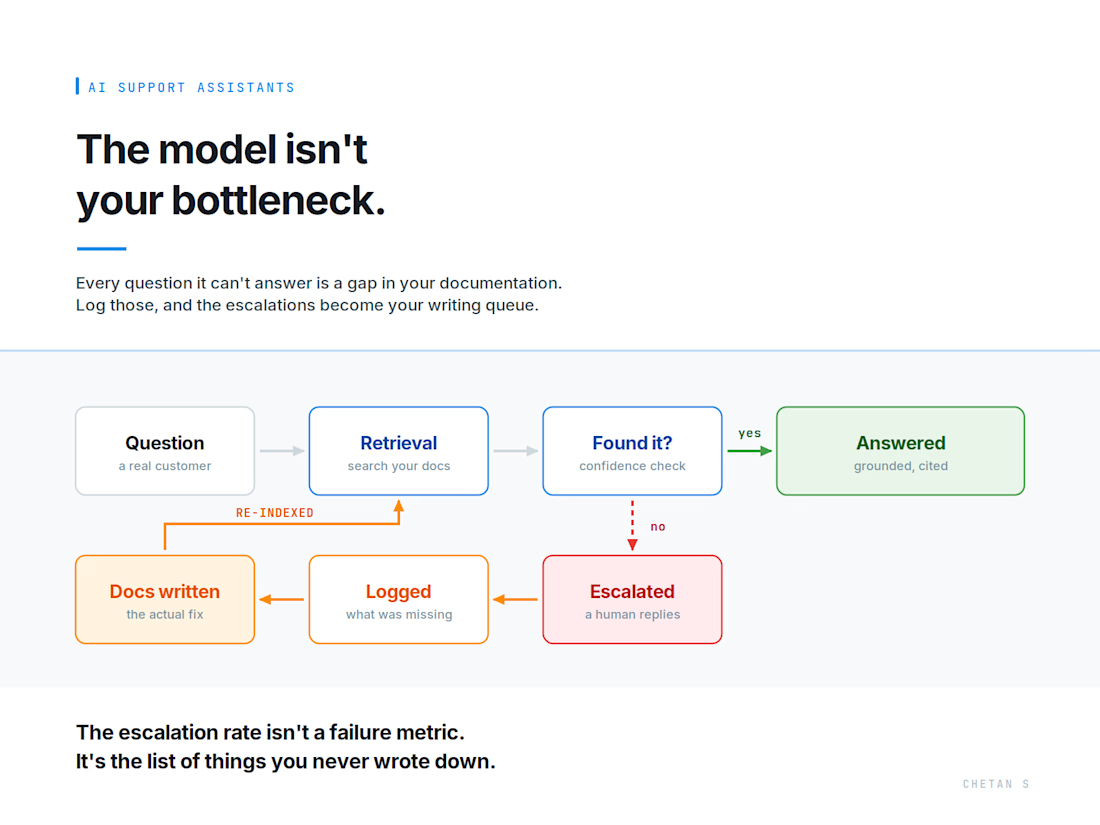
The architecture everyone draws is the same. Question comes in, you search your
documents, you pass what you found to the model, it writes an answer grounded in
that.
The diagram is fine. The problem is what's actually in the box labelled "your
documents."
In most companies it's some product docs written eighteen months ago, an FAQ page
nobody has touched since launch, and a support inbox where the real answers live
— scattered across thousands of individual replies, in nobody's head but the
three people who've been there longest.
You can put the best model in the world on top of that. If the answer to "does
my plan cover international numbers" was never written down, retrieval returns
nothing useful and the model has two options: say it doesn't know, or invent
something.
We spend enormous effort making sure it picks the first one. But that's damage
control, not a solution. The actual solution is that the answer should have been
there.
The metric everyone reads backwards
Here's the part I find genuinely useful, and I almost never see anyone talk
about it.
When you build this properly, the bot escalates whatever it isn't confident
about. Every escalation gets logged with the question, the intent it detected,
and what retrieval did or didn't return.
Most teams look at that number as a failure rate. Escalations went up, the bot is
doing badly, someone should fix the prompt.
That's backwards. The escalation log is the single most valuable output of the
whole system. It is a ranked list, generated by real customers, of every question
your company cannot currently answer in writing — ordered by how often people ask
it.
You could not commission better research than that. Companies pay agencies for
worse.
What to actually do with it
Read the escalations weekly. Group them. The clusters are your writing queue.
Someone writes the missing answer — properly, once. It goes into the knowledge
base, gets embedded and indexed, and the next customer who asks gets an immediate
grounded answer instead of a wait for a human.
That's the loop. Question, retrieval, escalation, documentation, back into the
index. Every turn of it makes the assistant better without anyone touching the
model, the prompt, or the framework.
And the second-order effect is the one clients don't expect: the documentation
gets better for humans too. New support hires ramp faster. The website FAQ stops
being fiction. You didn't just build a chatbot, you built a forcing function for
writing things down — which is a thing every company knows it should do and none of them prioritize.
The uncomfortable conversation
This does mean the honest answer to "can you build us an AI support agent" is
sometimes: not yet, usefully.
If there's no real documentation and no archive of resolved tickets, there's
nothing to ground answers in. Building the assistant first means shipping
something that escalates almost everything, and everyone concludes the technology
doesn't work.
I'd rather have that conversation in week one than in month three. Usually it
turns into a smaller first scope — pick the twenty questions that make up most of
the volume, write those properly, launch narrow, then widen using the escalation
log.
Narrow and correct beats broad and confidently wrong. That's true of the launch
and it's true of every week afterwards.
What this means about the work
The engineering here isn't hard in the way people expect. Retrieval, a queue,
some Lambdas, a confidence threshold, an escalation path — I've written about the
architecture before and none of it is exotic.
The hard part is organizational. It's convincing a support team that the bot
saying "I don't know" fifty times a week is a gift rather than an embarrassment,
and getting someone to act on the list.
The model is not your bottleneck. It hasn't been for a while. Your bottleneck is
that nobody wrote it down.
If you're running one of these — are you reading your escalation log? I'd
genuinely like to know how many teams have that as a weekly habit versus a
dashboard nobody opens.

The network for creativity
Join 1.25M professional creatives like you
Connect with clients, get discovered, and run your business 100% commission-free
Creatives on Contra have earned over $150M and we are just getting started

Challenges
View all


Related posts

AI Voice Agent for Real Estate Lead Booking
An AI-powered phone receptionist built for real estate agencies that answers inbound calls, qualifies leads in real time, and books showings directly to Google Calendar — all within the call itself, with no manual follow-up required.
The problem: Real estate agencies routinely lose leads to missed calls — after-hours inquiries, calls during showings, or overflow during busy periods. A slow callback often means the lead has already moved on to a competitor.
What it does:
Answers every call instantly, 24/7
Naturally qualifies the caller (buy/sell intent, area of interest, showing vs. agent call)
Collects contact details and preferred timing conversationally
Checks real-time calendar availability before booking
Prevents double-bookings and duplicate entries automatically
Confirms the appointment out loud before ending the call
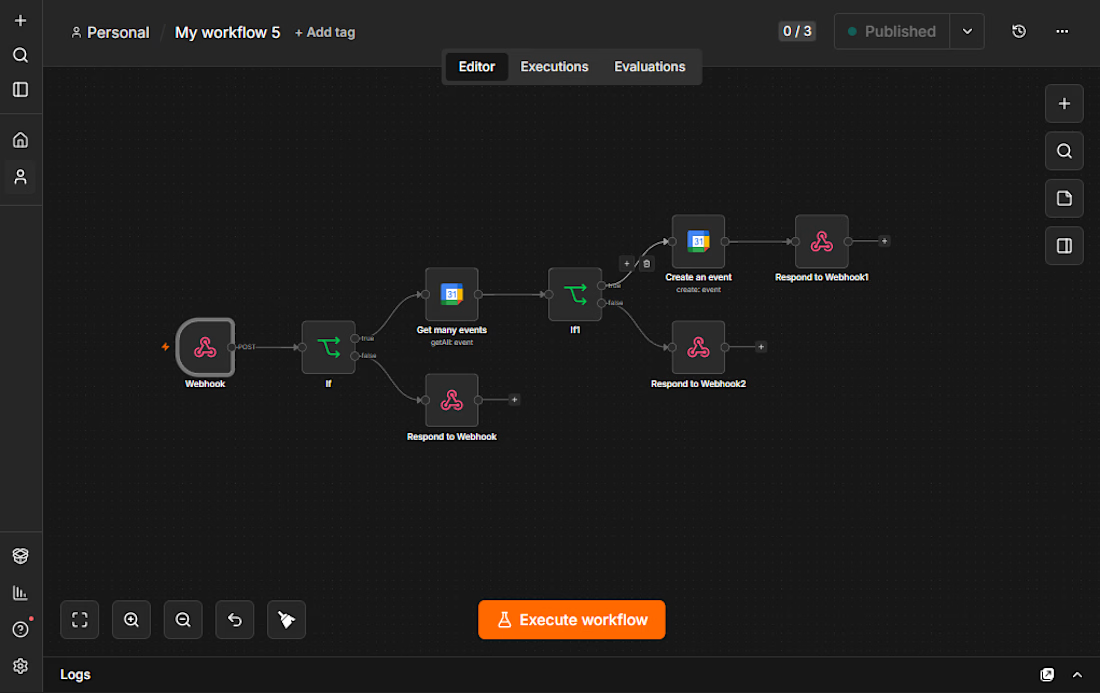
Built with: Retell AI (conversational voice layer), n8n (workflow automation and business logic), Google Calendar API (scheduling)
Available for: Custom builds for real estate agencies, brokerages, or property management companies looking to stop losing leads to missed calls



Beautiful workflow by the way. My nicheeee

The Museum of the Impossible | Surreal Architecture in Motion
This film explores how a change in the rules of space can change the way we feel inside it.
A stone arch becomes weightless. Water hangs overhead. A staircase opens towards the sky. These impossible elements invite the viewer to pause and reconsider familiar materials and forms.
I connected the scenes through warm stone, blue light and slow camera movement. The restrained visual language gives each unusual event room to register and creates a sense of calm curiosity.
My work included concept development, visual direction, AI scene generation and animation through Higgsfield, editing, titles and an original instrumental soundtrack.
For galleries, digital art projects, design studios and architecture brands, films like this can introduce a creative direction, communicate the atmosphere of an imagined space or become part of an exhibition’s visual identity. They make an abstract idea easier to see and experience.
Have a spatial concept or an idea for an art project? Send me a message to discuss how we could develop it into a film.
20 seconds · Full HD · Independent AI portfolio concept featuring imagined architecture.


Designed a clean and modern AI-powered Project Management Dashboard for Oripio Ai.
This interface helps design teams organize UX/UI project kickoffs with clear status tracking (Not started, Started, In progress), project details, assigned members, budgets, and timelines — all in one simple and professional workspace.


the project cards look handy. nice job!