The network for creativity
Join 1.25M professional creatives like you
Connect with clients, get discovered, and run your business 100% commission-free
Creatives on Contra have earned over $150M and we are just getting started
Back to feedPost

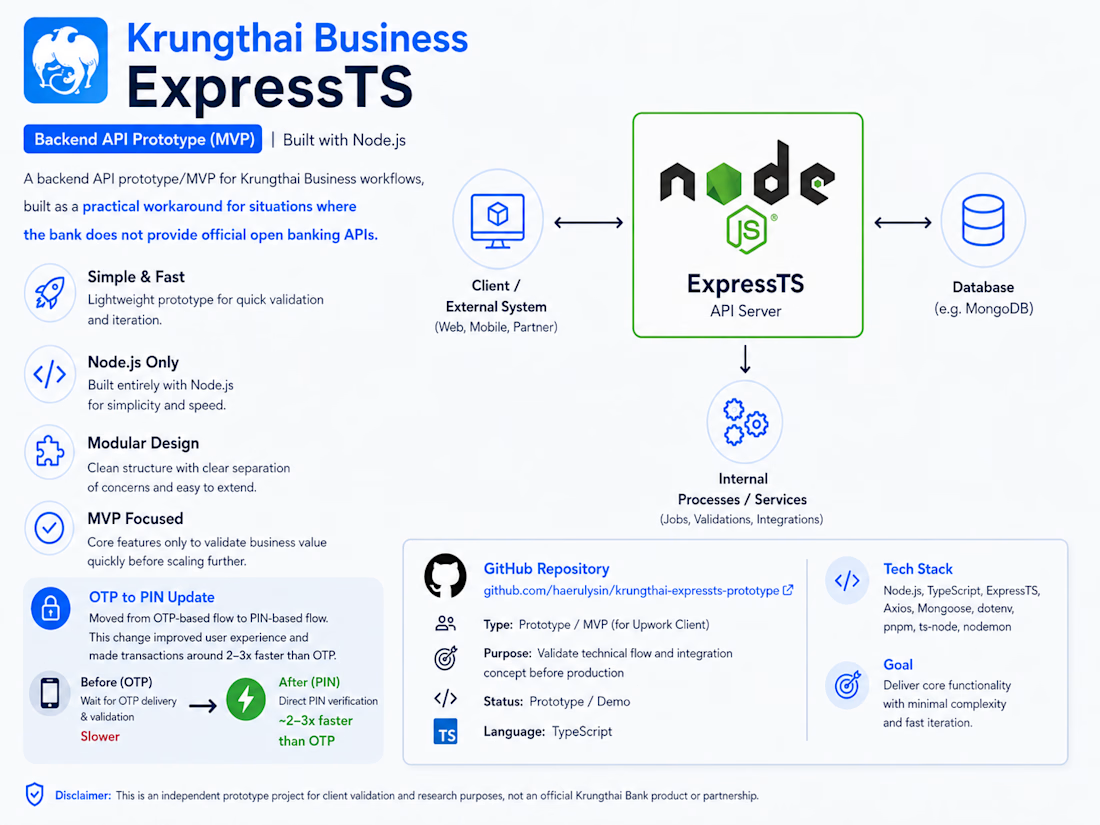
In 2024, I built Krungthai Business ExpressTS, a backend API prototype/MVP for an Upwork client working around Krungthai Business workflows. The goal was to validate how an end-to-end business banking flow could be automated while the bank does not provide official open banking APIs.
My approach started with reverse engineering the mobile app flow to understand the real request/response behavior, session handling, authentication steps, and the app’s end-to-end encryption flow. This included analyzing how encrypted payloads were structured, how secure client-server communication was handled, and how the mobile client interacted with backend services during the transaction process.
From there, I designed an ExpressTS-based API layer that could reproduce the core E2E flow in a cleaner backend structure, making it easier to test, automate, and integrate with external systems. The prototype focused on validating the technical flow first before moving toward a more production-ready implementation.
The first approach used an OTP-based transaction flow, but I later updated the implementation toward a PIN-based flow. This made the transaction process faster and smoother for repeated usage, with the PIN flow becoming around 2–3x faster than the OTP flow because it removed the delay of waiting for OTP delivery and validation.
The GitHub repository was used as a prototype/demo version for the Upwork client, focused on validating the feasibility of automating Krungthai Business workflows.
Tech stack: Node.js, TypeScript, ExpressTS, Axios, Mongoose, MongoDB, dotenv, pnpm, ts-node, nodemon.
If you need someone who can build backend API prototypes, reverse engineer mobile/web flows, automate complex business processes, or create integration layers when official APIs are limited or unavailable, I can help turn the flow into a clean, testable, and scalable backend system.
This was an independent prototype project for client validation and research purposes, not an official Krungthai Bank product or partnership.


The network for creativity
Join 1.25M professional creatives like you
Connect with clients, get discovered, and run your business 100% commission-free
Creatives on Contra have earned over $150M and we are just getting started



Related posts

I recently built VoltEdge Electronics as a sample project to explore how e-commerce operations can be automated beyond the storefront.
The challenge was connecting multiple business processes: order processing, pricing, payment tracking, customer notifications, and support into one seamless system without relying on manual intervention at every stage.
How I approached it:
Built the storefront website.
Used n8n to orchestrate order processing and business logic.
Integrated Supabase for structured data storage.
Automated pricing, including promotional discount calculations.
Connected Gmail and Slack for customer and internal notifications.
Integrated an AI customer support assistant with human escalation.
One of the biggest lessons from this project was that automation isn't simply about connecting tools. It's about designing reliable workflows, handling different outcomes, maintaining data consistency, and ensuring that each process works as expected.
The result is a connected e-commerce system where the storefront, backend, notifications, and customer support work together.
I'm always interested in helping businesses identify repetitive processes that can be simplified or automated.
If you're looking to automate your business operations, workflows, or customer processes, feel free to reach out.


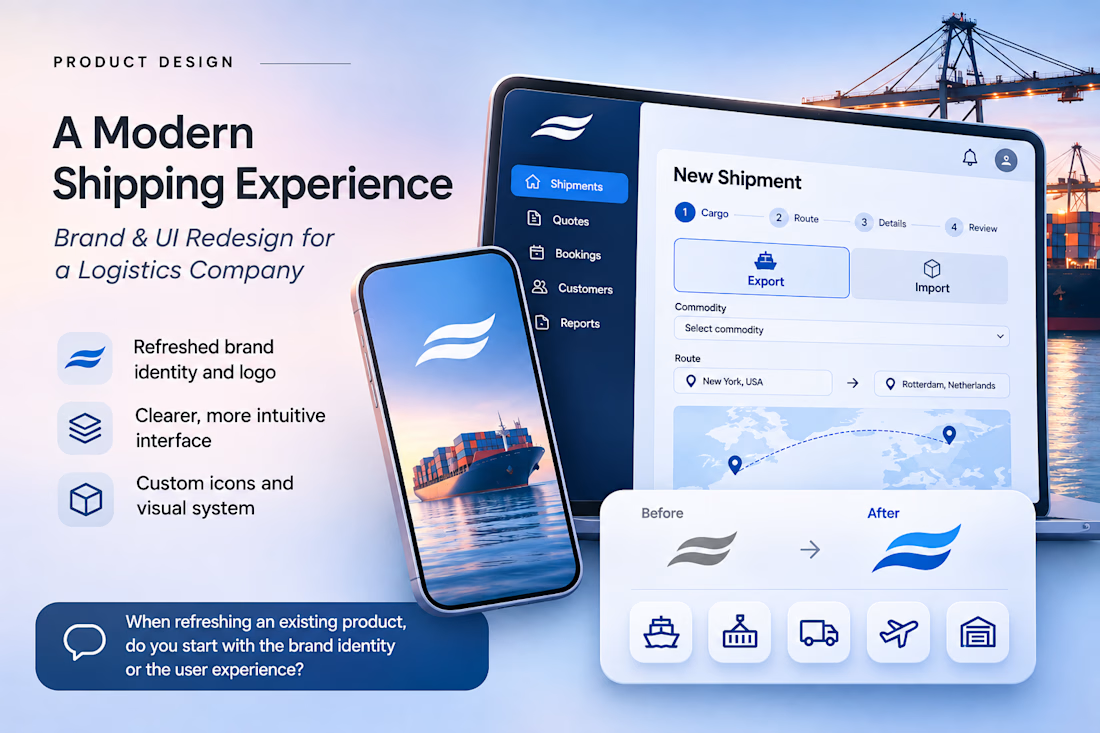
🚀 When working on a digital product for a logistics company, the challenge goes beyond designing functional interfaces.
Every visual element, from the company logo to the smallest shipment tracking icon, should communicate clarity, reliability, and professionalism.
My design approach focused on:
• Refining the logo and visual identity.
• Creating a consistent, custom icon system.
• Improving visual hierarchy and readability.
• Unifying colors, typography, and UI components.
• Making complex logistics workflows feel more intuitive.
The goal is not simply to modernize the appearance but to create a consistent visual language that connects the brand with the product experience.
Good design makes complex things feel simple.
💬 When redesigning an existing digital product, where do you start: brand identity or user experience?


Good point that everything from the logo to the small tracking icons should say clarity and reliability. That consistency matters a lot in logistics products.

Bringing FinTech to life with motion design! ⚡
A glimpse into SternPay, a mobile banking experience I designed to simplify money transfers and currency exchange.
Exploring new ways to bring my UX/UI designs to life through motion.
Designed in Figma. Animated in Jitter.
#ProductDesign #MotionDesign #FinTech #UIUX #Figma