The network for creativity
Join 1.25M professional creatives like you
Connect with clients, get discovered, and run your business 100% commission-free
Creatives on Contra have earned over $150M and we are just getting started
Back to feedPost


Custom AI Agent Development Company: Building Smarter Business Automation
Businesses are moving beyond traditional automation toward intelligent systems that can understand context, make decisions, and take action. This shift has increased demand for a Custom AI Agent Development Company that can build AI agents tailored to specific business workflows, data, and operational goals.
Unlike basic chatbots or rule-based automation tools, AI agents can analyze information, interact with software systems, execute tasks, and adapt their actions based on changing conditions. For startups, SMEs, and enterprises, this creates new opportunities to automate complex processes while improving productivity and customer experiences.
What Is a Custom AI Agent?
A custom AI agent is an intelligent software system designed to perform specific tasks or business processes with a degree of autonomy.
Depending on its purpose, an AI agent can:
Understand natural-language instructions
Analyze structured and unstructured data
Make decisions based on predefined business objectives
Connect with APIs, CRMs, databases, and enterprise applications
Automate repetitive workflows
Generate reports and recommendations
Communicate with customers or employees
Monitor processes and trigger actions automatically
For example, a sales AI agent could qualify leads, update a CRM, prepare follow-up messages, and notify sales representatives when a prospect demonstrates strong buying intent.
Why Businesses Need Custom AI Agent Development
Off-the-shelf AI tools can be useful for general tasks, but they may not understand a company's unique workflows, data structures, security requirements, or industry processes.
Custom AI agent development addresses these limitations by creating solutions around the organization's actual requirements.
1. Business-Specific Automation
Every organization has different processes. A custom agent can be designed around specific workflows instead of forcing a company to adapt its processes to generic software.
2. Integration With Existing Systems
AI agents become significantly more useful when they can work with existing business infrastructure. Custom development can connect agents with CRM platforms, ERP systems, helpdesk software, databases, APIs, and internal applications.
3. Greater Operational Efficiency
AI agents can handle repetitive activities such as data collection, document processing, customer queries, scheduling, reporting, and workflow coordination.
This allows employees to spend more time on strategic and creative responsibilities.
4. Improved Customer Experiences
Customer-facing AI agents can provide instant responses, understand conversational context, recommend relevant information, and escalate complex issues to human teams when required.
5. Scalability
A properly architected AI agent solution can evolve as business requirements change. Organizations can start with one workflow and gradually introduce additional agents, tools, integrations, and capabilities.
How Custom AI Agent Development Works
Developing an effective AI agent requires more than connecting a language model to a chatbot interface. The development process typically includes several stages.
Step 1: Identify the Business Use Case
The first step is determining where an AI agent can create measurable value.
Common use cases include:
Customer support automation
Sales lead qualification
Employee assistance
Document analysis
IT service management
Financial workflow automation
Research and data analysis
Supply chain coordination
Marketing automation
The best use cases usually involve repetitive, information-intensive, or multi-step workflows.
Step 2: Design the Agent Architecture
Developers determine how the agent will process information, use tools, access knowledge, and make decisions.
Depending on the application, the architecture may include:
Large language models
Retrieval-augmented generation (RAG)
Vector databases
Knowledge bases
API integrations
Workflow engines
Memory systems
Guardrails
Monitoring and evaluation systems
Step 3: Connect Business Data and Tools
An intelligent agent needs access to reliable information and business tools.
For example, an enterprise support agent might retrieve information from a knowledge base while also checking customer details in a CRM and creating a support ticket through an external system.
This tool-use capability is what allows AI agents to move beyond simply generating text.
Step 4: Train, Test, and Evaluate
AI agents need extensive testing before deployment.
Teams should evaluate:
Accuracy
Response quality
Hallucination risk
Tool execution
Security
Reliability
Response time
Cost per interaction
Human escalation
Testing should include both normal business scenarios and unexpected inputs.
Step 5: Deploy and Continuously Improve
After deployment, organizations can monitor agent performance and identify areas for improvement.
Business teams can use performance data to refine prompts, workflows, knowledge sources, integrations, and decision rules.
Key Technologies Used in AI Agent Development
A modern AI agent ecosystem can combine several technologies.
Large Language Models: Provide natural-language understanding, reasoning, and content generation.
RAG: Allows agents to retrieve relevant information from approved knowledge sources before generating responses.
APIs and Tool Calling: Enable agents to interact with external applications and execute actions.
Vector Databases: Help agents retrieve semantically relevant information from large knowledge collections.
Workflow Automation: Coordinates multi-step business processes and actions.
AI Guardrails: Help control agent behavior, data access, and potentially unsafe or unauthorized actions.
The technology stack should be selected according to the business use case rather than following a one-size-fits-all approach.
AI Agents vs. Traditional Automation
Traditional automation generally follows predefined rules:
Trigger → Rule → Action
AI agents can handle more dynamic workflows:
Goal → Understand Context → Reason → Select Tool → Execute → Evaluate
This difference makes AI agents particularly useful for processes where inputs vary and decisions require contextual understanding.
However, traditional automation remains valuable for deterministic tasks. The strongest enterprise solutions often combine conventional automation with AI agents instead of replacing every workflow with AI.
Industries Using Custom AI Agents
AI agents can be adapted to many industries.
Healthcare
AI agents can assist with administrative workflows, appointment coordination, document processing, and information retrieval while operating within appropriate privacy and compliance requirements.
Finance
Financial organizations can use agents for document analysis, customer support, fraud-related workflows, reporting, and internal knowledge assistance.
Manufacturing
AI agents can support production information retrieval, quality workflows, maintenance coordination, procurement processes, and operational reporting.
Retail and E-commerce
Retail businesses can use AI agents for customer support, product discovery, order assistance, inventory-related workflows, and personalized interactions.
Logistics
Agents can assist with shipment coordination, documentation, customer communication, exception handling, and operational monitoring.
How to Choose a Custom AI Agent Development Company
Selecting the right development partner is an important decision. Businesses should evaluate potential providers based on more than technical skills.
Look for a Custom AI Agent Development Company that understands:
Your industry and business workflows
AI agent architecture
LLM and RAG implementation
API and enterprise system integration
Data security
AI evaluation and monitoring
Scalability
Human-in-the-loop workflows
Long-term maintenance
A strong development partner should also be able to explain where AI agents are appropriate—and where conventional software or automation would be a better solution.
Why KriraAI for Custom AI Agent Development?
KriraAI helps businesses explore and implement AI-driven solutions designed around their operational requirements. Instead of treating AI agents as standalone chat interfaces, the focus can be placed on connecting intelligent systems with real business workflows, applications, and data.
From customer-facing assistants to enterprise workflow automation, a custom approach can help organizations build AI capabilities that are practical, scalable, and aligned with measurable business objectives.
For businesses evaluating AI agent adoption, the goal should not simply be to deploy an AI model. The real objective is to build an intelligent system that solves a meaningful business problem.
The Future of AI Agents in Business
AI agents are becoming an important part of the next generation of business software. As models become more capable and integrations become easier to implement, organizations will increasingly use specialized agents to coordinate tasks across departments and applications.
The future is likely to involve networks of specialized AI agents working alongside human employees and traditional software. One agent may handle customer interactions, another may analyze data, while another coordinates internal workflows.
Businesses that approach this transition strategically can use AI agents not only to reduce repetitive work but also to create faster, more responsive, and intelligent operations.
Final Thoughts
A Custom AI Agent Development Company can help organizations move from generic AI experimentation toward business-specific intelligent automation. By combining AI models, enterprise data, APIs, workflow automation, and appropriate security controls, companies can create agents capable of performing meaningful tasks rather than simply answering questions.
For organizations considering AI adoption, the best starting point is a clearly defined business problem. Once the use case, data requirements, integrations, and success metrics are understood, a custom AI agent can be designed around those objectives.
The result is not simply another AI tool—it is an intelligent business capability built to support how the organization actually works.

The network for creativity
Join 1.25M professional creatives like you
Connect with clients, get discovered, and run your business 100% commission-free
Creatives on Contra have earned over $150M and we are just getting started
Trending
retrofuturism
Share your favorite designs from the past exploring the distant future. Or your own take on the aesthetic 🚀
halftone
Dots. Texture. Grain. Let's see your designs using the halftone technique.

Midjourney
Creatives are showing off what they're making with Midjourney.
colorgrade
Video editors sound off: How do you enhance the mood of your video in color grading?


Related posts

AgentFlow10 — AI Agent & Automation Platform
Lead Engineer · Self-hosted AI agent platform with a visual workflow builder
The problem
Automation tools are built for businesses that already have a card on file, reliable bandwidth, and a Slack workspace. That leaves most of the world out. In markets where WhatsApp is the customer channel and mobile money is the payment rail, the standard automation stack either doesn't connect or is priced in currencies that make it a non-starter.
There was a second problem. Every serious automation platform is someone else's cloud. If your data is sensitive, or your compliance rules keep it in-country, or you just don't want to hand your customer records to a vendor, your options run out fast.
What I built
AgentFlow10 is an AI agent and automation platform you can run on your own infrastructure. A visual builder lets you compose agents and multi-step workflows without writing code, connect them to the tools you already use, and deploy them where your data lives.
The design goal was to make AI agents something a small team can actually operate — not a research project requiring an ML engineer on staff.
What I did
I built and run it end to end: product direction, backend architecture, LLM orchestration, integration layer, the workflow engine, frontend, brand system, and go-to-market. Everything from the database schema to the landing page copy.
Notable pieces of engineering:
A workflow execution engine that handles branching, retries, and failure states — because an agent that dies silently mid-run is worse than no agent
LLM orchestration with prompt management and output validation, so results are structured and usable rather than free text
A self-hosting path that a non-specialist can actually deploy
Integration architecture designed for channels that matter outside Silicon Valley, including WhatsApp and mobile money flows
Why it matters for clients
This is the project I point to when someone asks whether I can build AI systems rather than just call an API. Running a platform means I've dealt with the parts that break in production — cost control, rate limits, non-deterministic model output, failure recovery. That experience is what I bring to client work.
Built with: Python, TypeScript, React, Next.js, Node.js, PostgreSQL, LLM APIs, Docker


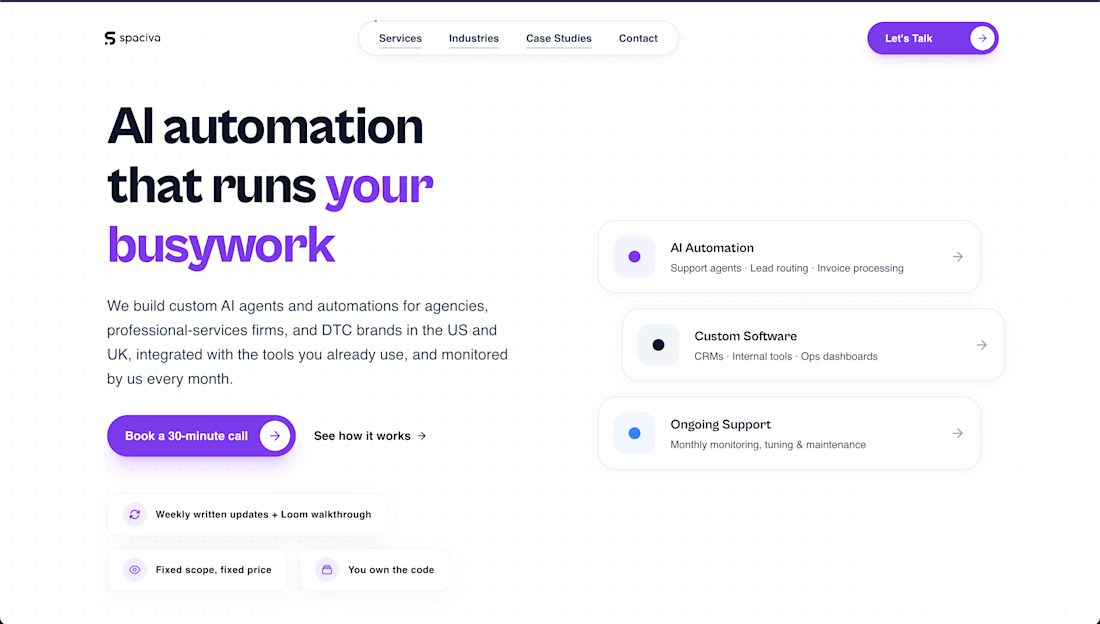
Spaciva — AI Automation & Technology Solutions
Designed and developed the Spaciva website to position the company around AI automation, custom software, and technology solutions for businesses.
The website is structured around a clear service-led journey, helping visitors understand what Spaciva builds, who it serves, and how projects are delivered. The experience focuses on communicating complex technical services in a simple, conversion-oriented way.
Key Features
AI automation service presentation
Custom software development positioning
AI agent and workflow solutions
Business-focused service architecture
Conversion-focused landing page
Clear service and solution navigation
Responsive and modern UI/UX
Lead-generation focused CTAs
Structured content and information architecture
Ongoing support and maintenance positioning
My Role
I handled the website strategy, UI/UX direction, frontend development, content structure, and implementation, creating a digital experience designed to turn technical capabilities into clear business value.
Technology
Next.js · React · TypeScript · Tailwind CSS · Responsive Web Development
Focus: AI Automation · Custom Software · AI Agents · Business Solutions · Web Development · Conversion Optimization



App Name
Switchboard
Tagline
The exchange where AI agents hire apps.
Explain What You Built And Why
Switchboard is a live capability exchange where AI agents discover services, invoke them, pay per call, and automatically credit the app builder who provided the capability.
Today’s AI agents can reason, but acting in the real world still requires custom integrations and weeks of backend work. At the same time, millions of applications already contain useful data and workflows, but agents cannot discover or use them. Switchboard connects those two sides.
A new user can create an account and immediately receive an API key and 100 credits. From one natural-language console, they can request something like “Book a table for four at Nkoyo tonight.” Switchboard reads its live catalogue, lets the model select the correct action and parameters, authenticates the caller, charges the listed price, routes the request to the provider, and records the result. The booking appears inside a completely separate Bubble application and database.
The same endpoint can then answer a weather request by selecting a different service, charging a different price, and paying a different builder. This proves that Switchboard is not a collection of hard-coded demos. It is reusable infrastructure for discovering and purchasing application capabilities dynamically.
The platform includes:
• Self-serve signup, API-key issuance, and starter credits
• A machine-readable catalogue of services, actions, parameters, and prices
• AI-powered action selection from plain-language requests
• Authenticated, metered execution through a central proxy
• Automatic credit transfers from agents to builders
• A live call ledger with status, price, and latency
• A publishing workflow for builders to list new capabilities
• Failure-safe billing: invalid or unsuccessful calls are not charged
I built the complete exchange in Bubble using database types for users, services, actions, and calls; backend API workflows for authentication, routing, metering, and settlement; and responsive interfaces for the live exchange board, catalogue, console, accounts, and publishing.
The visual design treats the product like real infrastructure: a live operator’s switchboard where every connection represents an executed, paid call.
Switchboard turns existing apps into an economy of reusable capabilities. Builders gain a new customer class that may never be human, while agents gain one key, one catalogue, and one endpoint through which they can act.