The network for creativity
Join 1.25M professional creatives like you
Connect with clients, get discovered, and run your business 100% commission-free
Creatives on Contra have earned over $150M and we are just getting started
Back to feedPost

Your API doesn't need to be hacked to become expensive.
If a bot can hit an expensive endpoint 50,000 times, you could end up paying for the damage even though your authentication is working perfectly.
I see SaaS teams put a lot of effort into protecting passwords and auth tokens, while overlooking things like rate abuse, brute-force requests, and automated scraping.
For a Laravel + Vue application, these are some of the things I'd put in place:
Rate-limit the expensive stuff
Don't use the same limit for every endpoint.
A search endpoint might allow 60 requests/minute, while an endpoint that generates PDFs or triggers an AI workflow should have a much tighter limit.
Laravel's RateLimiter makes it easy to define limits based on the user, route, subscription, or other conditions.
For example:
Free users: 30 requests/minute
Paid users: 200 requests/minute
Expensive AI/PDF operations: much stricter limits
Redis is a good choice when you're running multiple application servers.
Protect SPA authentication properly
If your Vue frontend talks to Laravel through Axios or Inertia, Laravel Sanctum's cookie-based authentication is usually a better fit than storing JWTs in localStorage.
Sanctum + Laravel's CSRF protection gives you a solid foundation for browser-based authentication without having to build your own token storage system.
Don't return your Eloquent models blindly
This:
return $user;
might work, but it can also expose fields that your frontend never needed.
Use API Resources to explicitly control what gets returned:
return new UserResource($user);
That makes your API response intentional and reduces the chance of accidentally exposing internal fields.
Validate everything coming from the client
Don't trust request payloads just because they came from your own Vue application.
Use Form Requests to handle validation before your business logic runs.
Validate things like:
UUIDs
maximum lengths
allowed values
required fields
numeric ranges
file types and sizes
Your frontend validation is for user experience. Your backend validation is for security and correctness.
The important part is that API security isn't just about authentication.
It's also about controlling what can be called, how often it can be called, what data can be returned, and what the server is allowed to process.
If you're building a Laravel web application, these are things worth thinking about before the API starts getting real traffic.
The network for creativity
Join 1.25M professional creatives like you
Connect with clients, get discovered, and run your business 100% commission-free
Creatives on Contra have earned over $150M and we are just getting started











Related posts

Built SpeedPulse AI — an automated website performance teardown and local client acquisition engine.
Most local businesses lose over 35% of their mobile conversions due to slow load times and missing Google SEO schema. Auditing each client manually took hours, so I automated the entire process on Base44:
⚡ Real-time Core Web Vitals, Local SEO & UX friction score dials
🔄 Dynamic Before/After sprint projections (gliding scores from 45 to 91+)
📄 Automated Executive PDF brief generation
🤖 Built-in Agency CRM that captures incoming leads, tracks stages, and auto-drafts client proposals with one-click copy
Live App: https://speedpulse-flow.base44.app


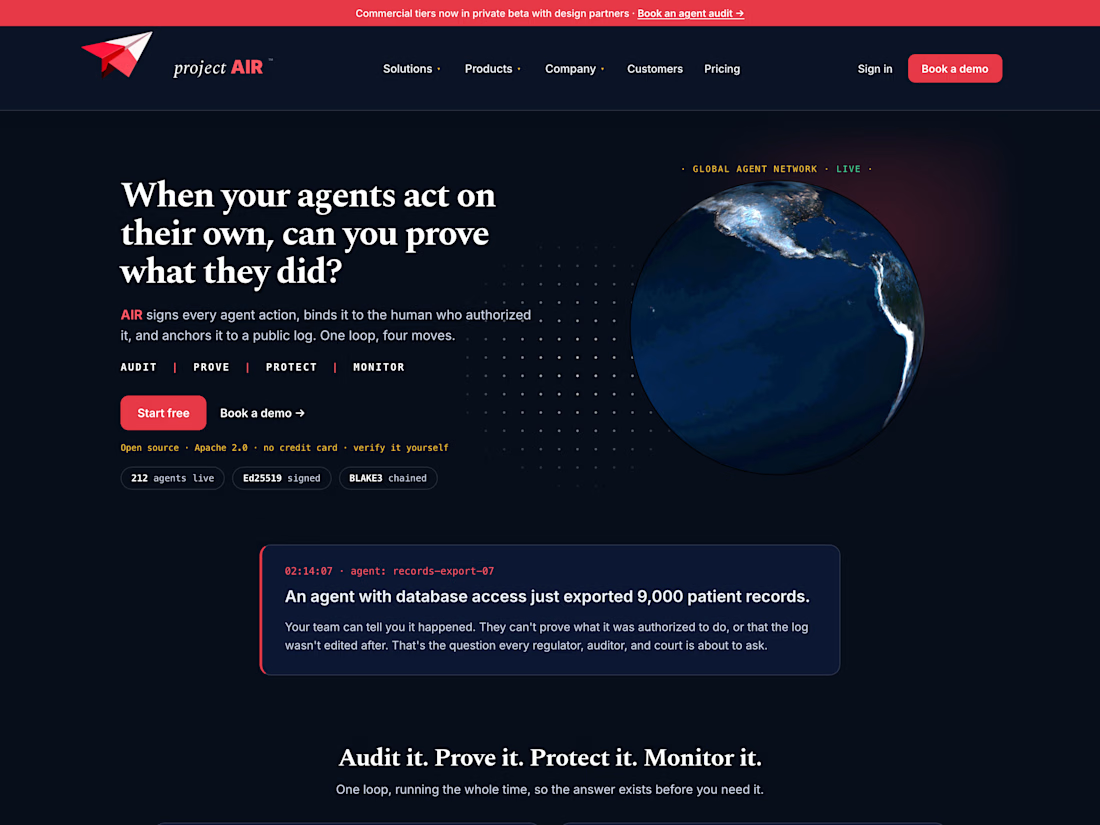
Project AIR is an open-source toolkit that keeps a tamper-proof record of what AI agents do. Every action an agent takes gets signed, chained to the step before it, and tied to the person who authorized it. The chain is anchored to Sigstore Rekor, a public transparency log, so anyone can check later that nothing was changed or deleted. When something goes wrong, you can show exactly what happened and who approved it, instead of just saying it happened.
It also runs 16 detectors over every record, covering all ten risks on the OWASP Top 10 for Agentic Applications, three from the OWASP list for LLM apps, and three of its own. It can stop an agent mid-action until a person signs off. It plugs into LangChain, LlamaIndex, and the OpenAI, Anthropic and Gemini SDKs with a line or two of code.
I built the Python library and command-line tool, published on PyPI as projectair (now at version 1.3.1) under the Apache 2.0 license, plus the website and dashboard in SvelteKit. We run it on our own infrastructure too: every request to vindicara.io is recorded and anchored to Rekor every minute.



Impressive work! 👏 Excellent approach to AI agent security, tamper-proof audit trails, and human oversight for more trustworthy AI systems.

I was scammed.
Back in 2022, I paid a vendor for a mobile phone I wanted to buy, I had worked hard to earn that money, and losing it like that was painful.
And it wasnt the only time it happened.
i couldn't let go of that experience, because I know I'm not the only person who has gone through something like this.
Think about it.
You see a product on Instagram, WhatsApp, X, or another social platform.
You want to buy it, but then the questions start coming.
“Will this person actually deliver my order?”
“Can I trust them with my money?”
And the vendor has their own fears, too. They dont want to send out goods without knowing they'll get paid.
So both sides are afraid to trust each other, and a transaction that should be simple becomes a risk.
That's the problem I'm exploring with JUTPAY.
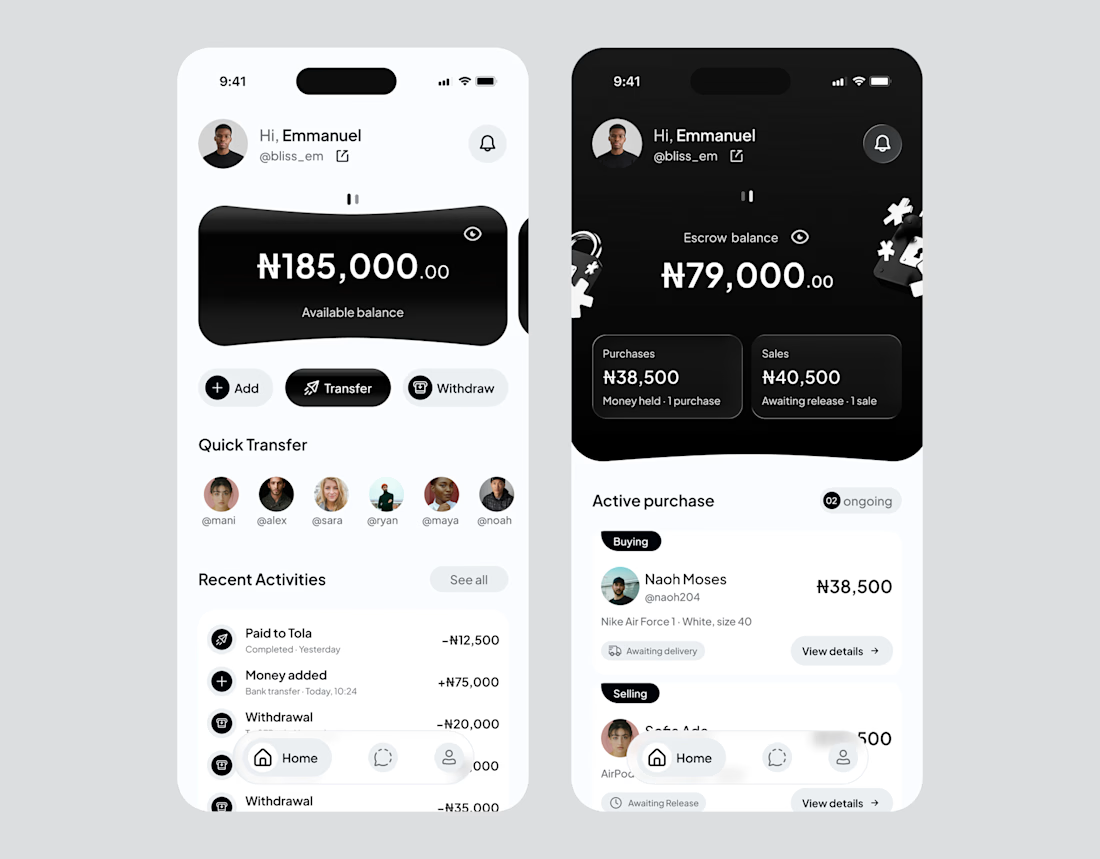
JutPay is an escrow payment solution designed to bridge that trust gap between buyers and vendors.
The buyer pays into escrow, the vendor delivers the goods, and once the buyer confirms delivery, the money is released to the vendor.
Both sides get a little more peace of mind.Ive been working on the product experience, and heres a little look at what it looks like.
I'll share more about the thinking behind the design soon.
We can make buying and selling online feel safer, one transaction at a time.


Sorry you went through that, but a good problem to design around. Love the black balance card in both light and dark.