The network for creativity
Join 1.25M professional creatives like you
Connect with clients, get discovered, and run your business 100% commission-free
Creatives on Contra have earned over $150M and we are just getting started
Back to feedPost

Standard RAG is a search engine. It is not a memory system.
If you are building AI agents designed to work with a user for months, standard vector databases eventually degrade into noise generators. Here is why:
RAG finds similarity, not logic. If you switched from Python to Rust, and you ask about optimization today, RAG retrieves based on keyword similarity, not logical context.
RAG doesn't consolidate. Every interaction adds a new vector. Over time, the database grows, and old, outdated information competes with current context.
RAG hides contradictions. If you tell an AI you want minimal dependencies, but have 47 packages in your requirements.txt, RAG passes both to the LLM. Reconciling contradictions during generation fails under pressure.
How do we solve this?
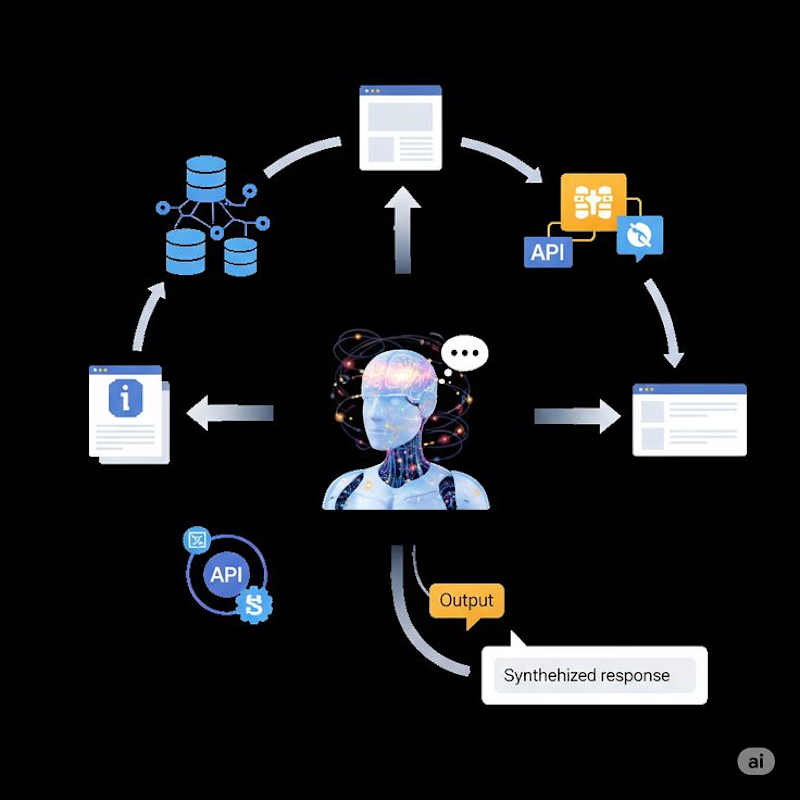
For our agent VYN, we built a hybrid cognitive memory engine:
• Vector Search handles turn-level semantic retrieval.
• A Causal Knowledge Graph handles reasoning, mapping entities, and identifying contradictions in storage.
• A weekly "consolidation cycle" (like human sleep) clusters episodic memories and abstracts them into semantic principles, archiving the noise.
Stop building agents that just query databases. Build agents that understand relationships.
I wrote a technical deep dive on how we architected this memory system:
https://openyf.dev/blogs/knowledge-graphs-vs-rag
#AIAgents #RAG #Nextjs #AI


Completely agree
The network for creativity
Join 1.25M professional creatives like you
Connect with clients, get discovered, and run your business 100% commission-free
Creatives on Contra have earned over $150M and we are just getting started





Related posts

Framer skills are fun and useful.
Check out how I create a new page + CMS for this website.
You'll get 5 skills with the template from @Framer Marketplace https://www.framer.com/marketplace/templates/oda/


Bundling the skills with the template is a smart move, feels like you're selling the workflow and not just the layout. Does the agent keep the page consistent with the existing CMS styles on its own, or do you still end up nudging spacing by hand?


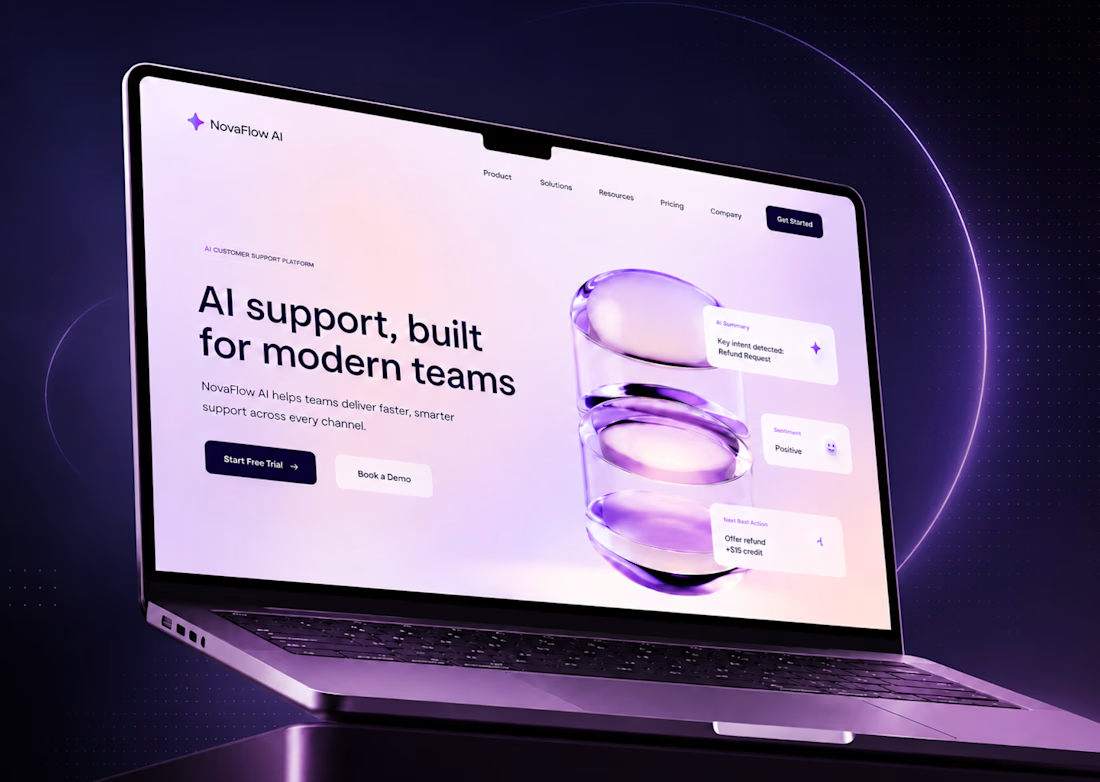

The product flow stays clear across the web and motion elements.

This project focused on building and testing a practical AI security assessment lab for evaluating LLM defenses against prompt injection and jailbreak attacks.
I integrated Spikee by Reversec with a locally hosted cybersecurity model running through LM Studio, then added NVIDIA NeMo Guardrails to compare model behavior under three conditions: no guardrails, input filtering, and combined input/output protection.
The work included configuring the local model environment, building a custom FastAPI gateway, integrating NeMo Guardrails, troubleshooting model latency and timeout issues, creating a reusable Spikee target, and analyzing attack results using Spikee’s built-in reporting tools.
The project also explored different adversarial testing approaches, including prompt injection datasets, obfuscation, encoded attacks, Best-of-N testing, synthetic canary leakage tests, and structured benchmark comparisons.
The objective was to measure how much the guardrails reduced successful attacks while keeping the model, dataset, and testing conditions consistent.
Tools used: Spikee, NVIDIA NeMo Guardrails, LM Studio, Python, FastAPI, PowerShell, Parrot OS, local LLMs, JSONL datasets, and custom security testing scripts.
This project demonstrates a hands-on approach to LLM red teaming, AI safety testing, prompt-injection assessment, and guardrail validation for organizations deploying generative AI systems.


pretty cool tbh. testing the same attacks with different guardrail setups makes the results way more interesting.