The network for creativity
Join 1.25M professional creatives like you
Connect with clients, get discovered, and run your business 100% commission-free
Creatives on Contra have earned over $150M and we are just getting started
Back to feedPost

Most sellers approach Amazon FBA Wholesale backwards.
They find a product first, then worry about suppliers, invoices, and Amazon requirements afterward.
That’s where problems usually begin.
A more sustainable approach is to start with the supply chain:
→ Identify legitimate manufacturers and authorized distributors
→ Confirm they can provide valid commercial invoices
→ Understand brand and category requirements
→ Check whether the products are eligible for your account
→ Then evaluate the product’s demand, margins, and competition
And don’t overlook competition.
A product can have strong sales and attractive margins on paper, but if the listing is already crowded with established sellers, your numbers can change quickly.
Before committing capital, analyze:
• Number of active sellers
• Buy Box competition
• Sales velocity
• FBA fees and landed cost
• Net profit margin
• Brand restrictions
• Supplier reliability
• Inventory requirements
The goal isn’t simply to find a product that sells.
The goal is to build a repeatable sourcing system around reliable suppliers, valid documentation, healthy margins, and manageable competition.
It may not be the flashy side of Amazon FBA, but getting the fundamentals right is what makes wholesale sustainable.
Do the research first. Invest second.
That’s all. ✌️


The network for creativity
Join 1.25M professional creatives like you
Connect with clients, get discovered, and run your business 100% commission-free
Creatives on Contra have earned over $150M and we are just getting started



Related posts

A lead who doesn't buy today isn't necessarily a lost opportunity. 🏡
Imagine someone inquires about a property but tells you they're not ready to buy yet.
What do you do?
Do you move on to the next lead and forget about them?
Or do you keep the relationship alive?
Here’s an important lesson about lead nurturing:
Not every lead is ready to buy at the same time.
Some people need to save more money. Others are still comparing properties or waiting for the right opportunity.
As a real estate professional, you can:
→ Understand what the person needs.
→ Share relevant information when appropriate.
→ Follow up at a suitable time.
→ Keep accurate notes so you remember the conversation.
A CRM can help you organize these interactions and remind you when it's time to reconnect.
The goal isn't to pressure people into buying.
It's to be helpful and stay connected until they're ready to take the next step.
Question: How do you stay in touch with potential buyers who aren't ready to purchase yet?
#RealEstate #LeadNurturing #CRM #HubSpot #LeadManagement

Most inbound bottlenecks aren't caused by low lead volume—they happen during triage.
When inquiries roll into a Google Sheet or CRM, operations teams often waste 10–15 minutes per submission reading through messy paragraphs, deciphering budget mismatch, and manually deciding who gets an immediate call vs. a standard rate sheet.
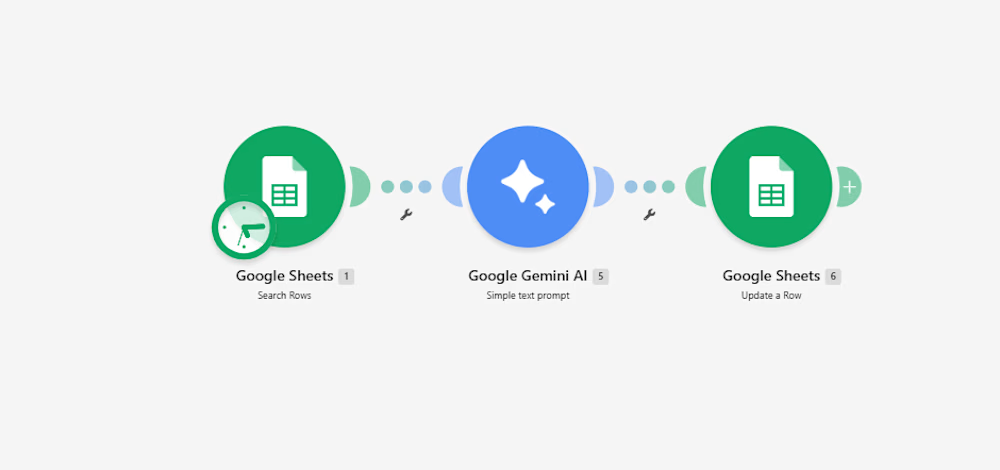
Instead of adding a bulky CRM add-on, I documented a lightweight 3-step automation pipeline built inside Make:
Intake & Extraction: An active listener triggers immediately upon a new submission, extracting core variables: client scope, target deliverables, timeline, and stated budget.
Context-Aware Evaluation (Gemini 2.5 Flash): The payload passes through an AI evaluation node with strict guardrails:
Evaluates budget against minimum agency criteria.
Assigns a triage score: Hot (immediate priority), Warm (nurture), or Cold (disqualified/template reply).
Generates a strict 15-word operational summary—no long paragraphs.
Determines an automated next step (e.g., routing to an account lead or flagging for asynchronous follow-up).
Data Return & Clean Pipeline: Appends the structured classification directly back to the master operational tracker, keeping the sheet filterable and clean.
The outcome: The sales and operations team can filter the entire board by priority status in two clicks, cutting first-touch response time to minutes without manually reading every single submission.
I’ve documented the full scenario map, execution logic, and data schemas below.
Curious how other agency operators and automation leads here handle their lead enrichment layer—are you doing AI scoring at the form level, or later in the CRM pipeline?:


For the budget gate, I'd keep an unstated budget separate from one explicitly below your minimum. Does the Make route ask for clarification when the amount or currency is missing, so a potentially suitable lead doesn't fall into Cold by default?

A course website is the shop window. The business also needs a working stockroom, checkout and delivery system.
That was the scope of my work with Andrea Maxim.
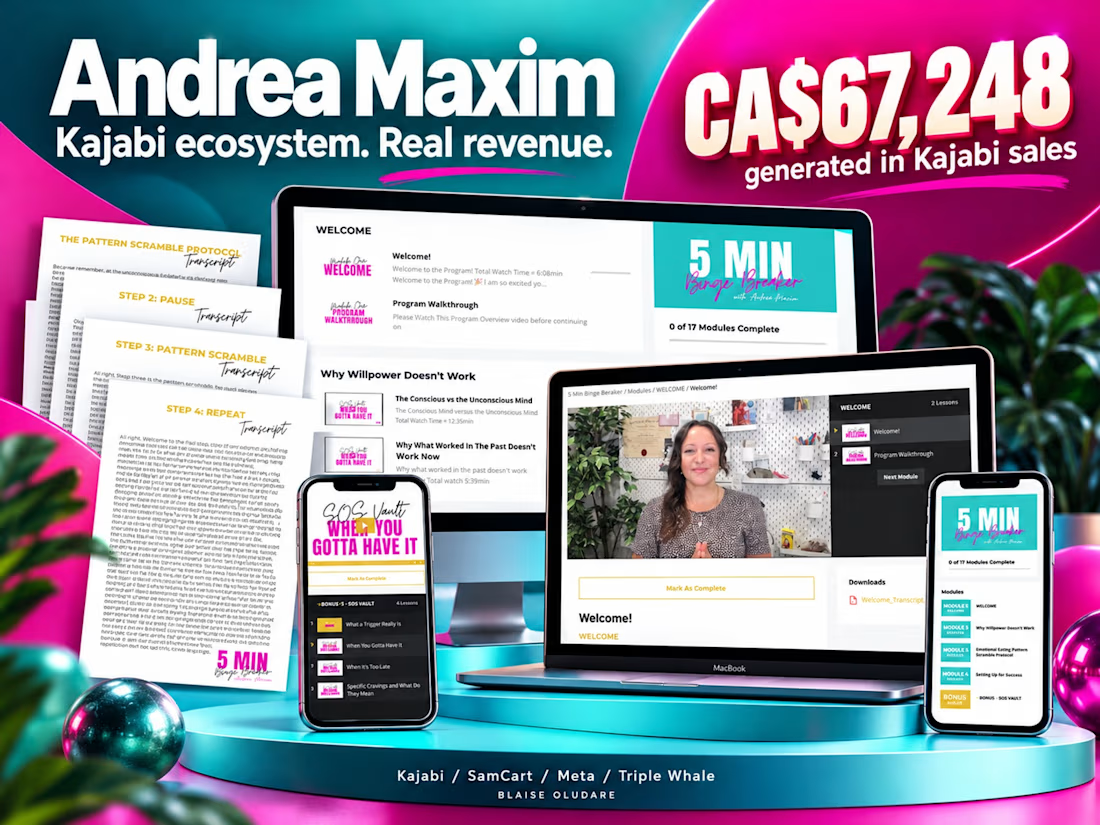
I built and operated the Kajabi website and learning experience, configured 30+ SamCart products, connected automations, ran Meta campaigns and repaired conversion tracking.
Together, that work generated CA$67,248 in Kajabi sales for Andrea.
The useful lesson for course creators: review the whole journey before investing in more traffic.
Can someone understand the offer, buy the right product, receive the right emails and access what they paid for?
Then check whether you can measure that journey.
Those connections deserve as much attention as the homepage.

CA$67K in Kajabi sales is a strong result, and repairing the conversion tracking is the part most course creators never think about. Great reminder that the site is only the shop window.