The network for creativity
Join 1.25M professional creatives like you
Connect with clients, get discovered, and run your business 100% commission-free
Creatives on Contra have earned over $150M and we are just getting started
Back to feedPost

🪁 THE SKY IS A LOOM One Kite. One Strand. One Shared Sky.
What if a kite festival were more than a beautiful sky?
THE SKY IS A LOOM turns individual creations into a shared, living tapestry while giving festival organizers a real system to manage participation.
Visitors can design a kite, request a place in the sky, track their request, and choose whether to share their creation with the community.
Behind the experience is a more complex operational layer: capacity planning, conflict handling, human-reviewed decisions, recovery workflows, and real weather forecasts used as planning references.
How I built it:
Base44 the application, persistent workflows, participant experience, and festival operations.
Krea handmade silk-and-paper art direction and visual storytelling.
SVGator state-driven kite animation.
Figma experience design and interface exploration.
The biggest challenge was balancing two goals: making the experience feel magical for visitors while keeping the operational system trustworthy and understandable.
The result is a creative experience with a functional system behind it.
🌐 Explore the live app: https://silk-sky-loom.base44.app
🎬 Watch the 30-second walkthrough below.
Built for the @Base44 × Contra Challenge.
#Base44Challenge #Base44 #CreativeTechnology #NoCode #ProductDesign

The network for creativity
Join 1.25M professional creatives like you
Connect with clients, get discovered, and run your business 100% commission-free
Creatives on Contra have earned over $150M and we are just getting started





Related posts

The Prop Room: prop rental and shoot planning, built with Base44
* Description:
The Prop Room is a playful prop-rental and shoot-planning web app for photographers, stylists, art directors and brands planning shoots.
The problem: Choosing props is visual, but rental catalogues aren’t. People imagine how isolated objects will look together, then rebuild item lists, quantities, costs and prep notes in separate tools.
* What it does
Collection: 16 props with filters, search, detail views and a tray with live daily totals.
Canvas: a scene editor with drag, resize, rotate, flip, one-step layering, per-object locking, snapping, undo/redo, background colours, PNG export, sharing and presentation mode.
Scene Stylist (AI): use, mood, budget and an optional brief become a catalogue-valid, budget-checked scene that opens straight into the canvas. Prices come from app data, not model text, and there’s a curated fallback plus an honest no-match state.
Inspiration and My Scenes: ready-made templates and saved, named scenes.
* Automation
One scene drives everything. Quantities and dates recalculate the daily and period estimate. A prep checklist is generated from the selected props (lighting power, backdrop support, fragile items, furniture access), and only the affected checks reset when the scene changes. The scene also produces a print-ready shoot pack and a calendar (ICS) file. Inquiries are saved as their own snapshot, so later edits never silently change a submitted request. Planning that usually takes a spreadsheet, a calculator and a checklist happens automatically while you compose.
* Process
Figma first. A brand guide came from a reference palette, with Stack Sans Notch and Stack Sans Text. Prop imagery was generated, cut out and art-directed, and desktop and mobile screens were designed and revised by hand. The approved designs were then built for real in Base44 and refined through rounds of side-by-side checks against Figma and real interaction testing at 1440, 390 and 320 px. The landing page’s brand film was made in Higgsfield with Seedance 2.0.
Live site: https://figma-the-prop-room-9b66831b.base44.app
Built with Base44 · Designed in Figma · #Base44Challenge


Hey there, my code doesn't seem to work, can I get some help please?


My code is not working either.

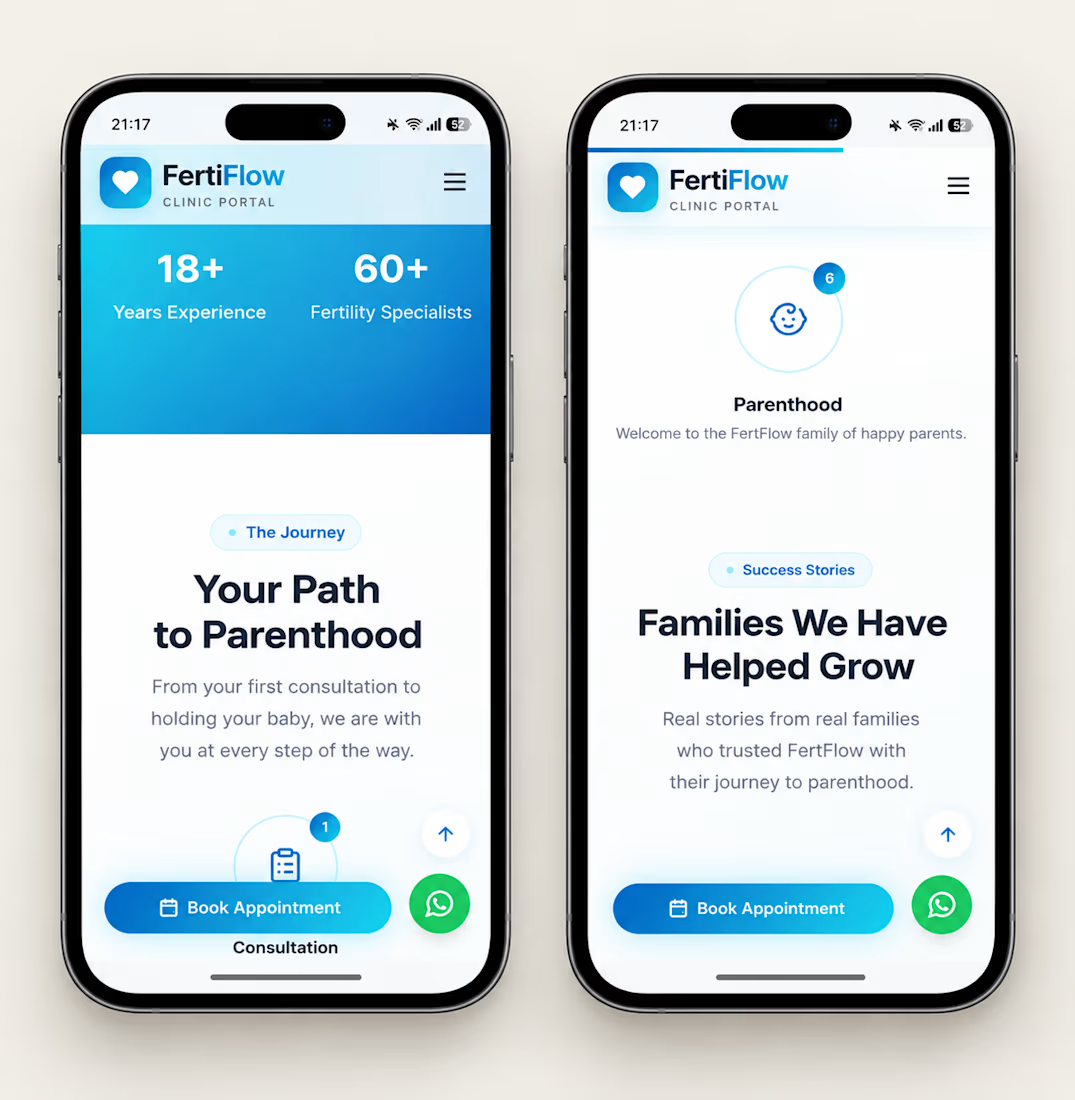
🚀 Meet FertiFlow — a fertility-care platform I designed and built using Base44.
The goal was to create a clean, approachable digital experience that brings together fertility information, specialist profiles, assessments, and appointment requests in one place.
From the visual design to the user flows, this project was an opportunity to explore how design and AI-powered tools can come together to build functional digital products.
Designed, built, and shipped ✨

Awesome