The network for creativity
Join 1.25M professional creatives like you
Connect with clients, get discovered, and run your business 100% commission-free
Creatives on Contra have earned over $150M and we are just getting started
Back to feedPost

Automated YouTube Content Ideas Intake (Typeform → Slack Canvas)
Overview:
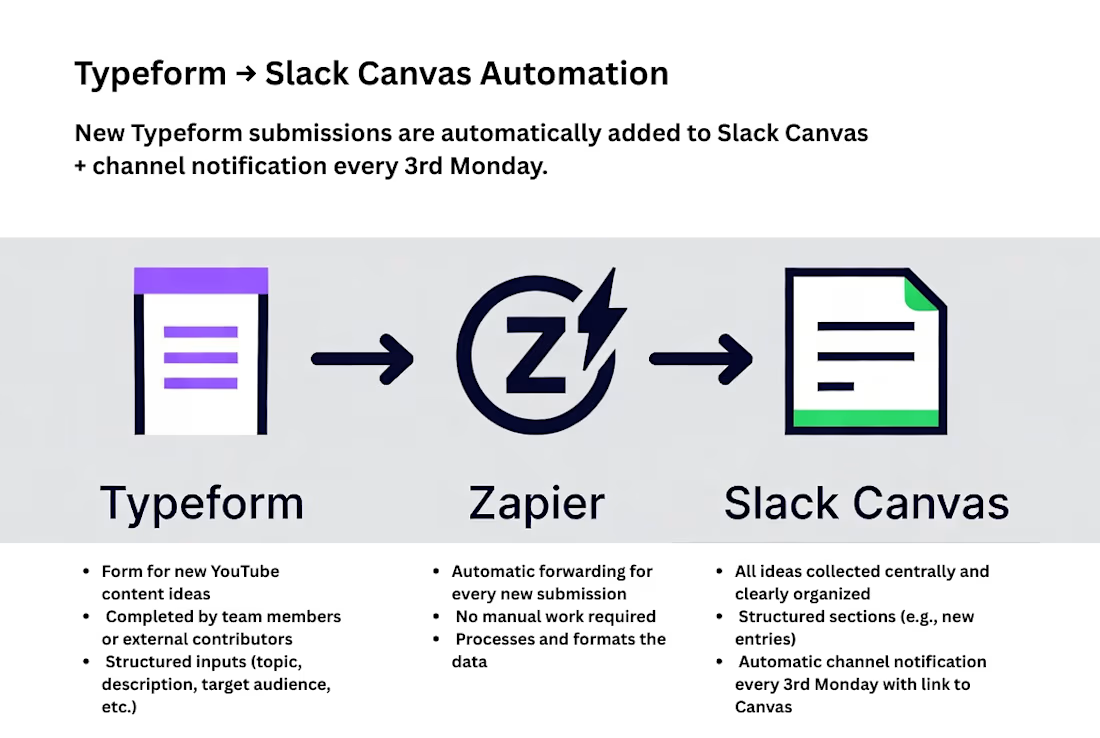
Designed and implemented an automated content intake system for the YouTube Content Ideas use-case.
New submissions are instantly structured, centralized, and made accessible to the team inside Slack Canvas — without any manual processing.
The Challenge:
Content ideas were collected via Typeform but handled through a manual workflow:
- CSV export from Typeform
- Import into Excel
- Manual formatting and structuring
- File storage and retrieval
- Recurring task to ensure updates
This created a repetitive, error-prone process tied to a single responsible person and limited real-time visibility for the team.
The Solution:
- Built a Zapier-based automation that connects Typeform with Slack Canvas and introduces a structured, low-maintenance system:
- Every new submission is automatically captured and processed
- Data is formatted into a consistent structure
- Entries are appended directly into Slack Canvas
- A scheduled notification keeps the team aligned without constant interruptions
Zap Architecture (Technical Setup):
Trigger:
Typeform → New Entry
Step 1 – Data Processing (Zapier Formatter):
- Clean and normalize inputs (text fields, formatting)
- Combine relevant fields into structured sections
- Optional: timestamp formatting for readability
Step 2 – Content Structuring:
- Build a consistent entry format (e.g. idea title, description, target audience)
- Prepare output for Slack Canvas (clean text blocks)
Step 3 – Slack Integration:
- Action: Append content to Slack Canvas
- Placement within predefined section (e.g. “New Ideas”)
- Ensures continuous, chronological documentation
Step 4 – Scheduled Notification (Zapier Schedule):
- Trigger: Every 3rd Monday
- Action: Send message to Slack channel with Canvas link
- Purpose: Batch visibility instead of constant notifications
Key Features:
- Fully automated end-to-end workflow
- Structured and centralized idea repository
- Asynchronous team visibility without notification overload
- Clean, consistent formatting of all entries
- Reliable system independent of individuals
Results & Impact:
- Removed all manual data handling steps
- Reduced operational overhead and cognitive load
- Eliminated single-point-of-failure risk
- Increased transparency and accessibility of content ideas
- Established a scalable system for ongoing content collection
Tools Used: Typeform · Zapier · Slack Canvas


The network for creativity
Join 1.25M professional creatives like you
Connect with clients, get discovered, and run your business 100% commission-free
Creatives on Contra have earned over $150M and we are just getting started
Related posts

UGC ads usually mean finding a creator, sending a brief, waiting a week, then paying per video. I wanted to see how much of that an n8n workflow could handle.
The video in this post was not filmed. It was generated end to end by a workflow I built.
How it works:
I drop in a product, a short brief and a target audience
An LLM writes the UGC-style script with a hook, the body and a call to action
Veo generates the video in a natural, creator-style look
The workflow publishes it to TikTok, Reels and Shorts [and schedules it for the best time]
So the whole path from brief to published video runs without me touching an editor.
What I learned:
The prompt matters more than the model. Specific lighting, camera and tone details made the difference between “obvious AI” and “believable creator”.
Hooks decide everything. I generate several hooks per product and test them.
Always label AI-generated content where the platform requires it. It’s the right thing to do and it avoids trouble later.
If you run a brand, an e-commerce store or an agency and want a steady stream of short-form content without the cost of manual production, I build these workflows. Message me and I’ll show you how it would work for your product.
Would you trust an AI-generated UGC ad for your brand? Curious where people stand on this.
#n8n #Veo #AIVideo #UGC #AIAutomation #ContentCreation #ShortFormVideo #Ecommerce #MarketingAutomation #GenerativeAI #NoCode #SocialMediaMarketing


Elegant

Byline, a Framer template for newsletters and podcasts.

A Few Months Back, Everything Changed. 🚀✨
A few months back, a client reached out to me, frustrated with how their Instagram was performing.
They had the content, the passion, and the vision, but their growth wasn't reflecting the effort they were putting in.
I took a closer look and realized the problem wasn't how often they posted. It was the strategy behind the content.
So, I got to work.
I revamped their visual identity, refined their content strategy, optimized their profile, and focused on creating content that truly connected with their audience.
Fast forward a few months, and the transformation was incredible.
📈 2X growth in Instagram engagement!
But beyond the numbers, their page finally had the professional presence and consistency they had always wanted.
The lesson? Sometimes your brand doesn't need more content. It needs the right strategy.
And that's exactly what I help brands achieve. 💚
Sample client story | Illustrative results
#SocialMediaStrategist #InstagramGrowth #SocialMediaManagement #ContentStrategy #BrandTransformation


