The network for creativity
Join 1.25M professional creatives like you
Connect with clients, get discovered, and run your business 100% commission-free
Creatives on Contra have earned over $150M and we are just getting started
Back to feedPost


The network for creativity
Join 1.25M professional creatives like you
Connect with clients, get discovered, and run your business 100% commission-free
Creatives on Contra have earned over $150M and we are just getting started





Related posts

Project Title:
AÉVRA — AI-Driven Horological Conservation Atelier & Dual Cockpit
The Hook (Opening line that grabs attention):
"Every mechanical watch has thousands of micro-components—and usually, a customer experience stuck in 2004. We rebuilt the horological conservation pipeline from scratch."
Overview & Story:
Most watch restoration platforms alienate customers with esoteric technical jargon and static forms. AÉVRA was created to preserve timepieces for what they mean, not just what they cost—combining editorial Swiss atelier aesthetics, real-time 3D motion, and AI-driven intake.
The Problem:
Customers with heirlooms or vintage pieces don't know reference numbers or movement calibres.
Atelier watchmakers spend hours manually triaging vague emails before diagnosing a single watch.
The Solution & Key Features:
Natural Language Horological Intake: Clients describe their watch issue in plain English (e.g., "losing time and scratched crystal"). The system automatically maps symptoms to mechanical calibres, delivering immediate clarity on services, timeline, and preliminary cost estimates.
Cinematic 3D Photographic Scroller: A high-fidelity scroll journey that physically disassembles and reassembles the movement's case, bezel, balance wheel, and gear train at 60fps.
The Conservator’s Owner Cockpit: A private, real-time management dashboard allowing atelier owners to view incoming requests, evaluate AI diagnostic breakdowns, and accept or decline repair commissions with instant, seamless switching between client and owner views.
Tech Stack & Craft:
Platform: Lovable
Frontend: React, TypeScript, Tailwind CSS
Motion & 3D: GSAP ScrollTrigger, Three.js / Canvas, Lenis Smooth Scroll
State Management: Zustand with local persistence
Live Project Link:

Nice design

Complete stack RAG driven document intelligence assistant developed using FastAPI and React. Features multi-format ingestion support (PDF, DOCX, and scanned images through EasyOCR), with FAISS vector indexing, and 6 LLM driven modes operating on Groq’s Llama 3.3 70B model. Dockerized application via GitHub actions CI pipeline for automatic linting and build validation with sub-2 second response time in local tests. FAISS is chosen over Pinecone for quick in-memory computation without relying on cloud infrastructure, while Groq is selected over other options for quicker and cheaper inference than GPT-4 alternatives.


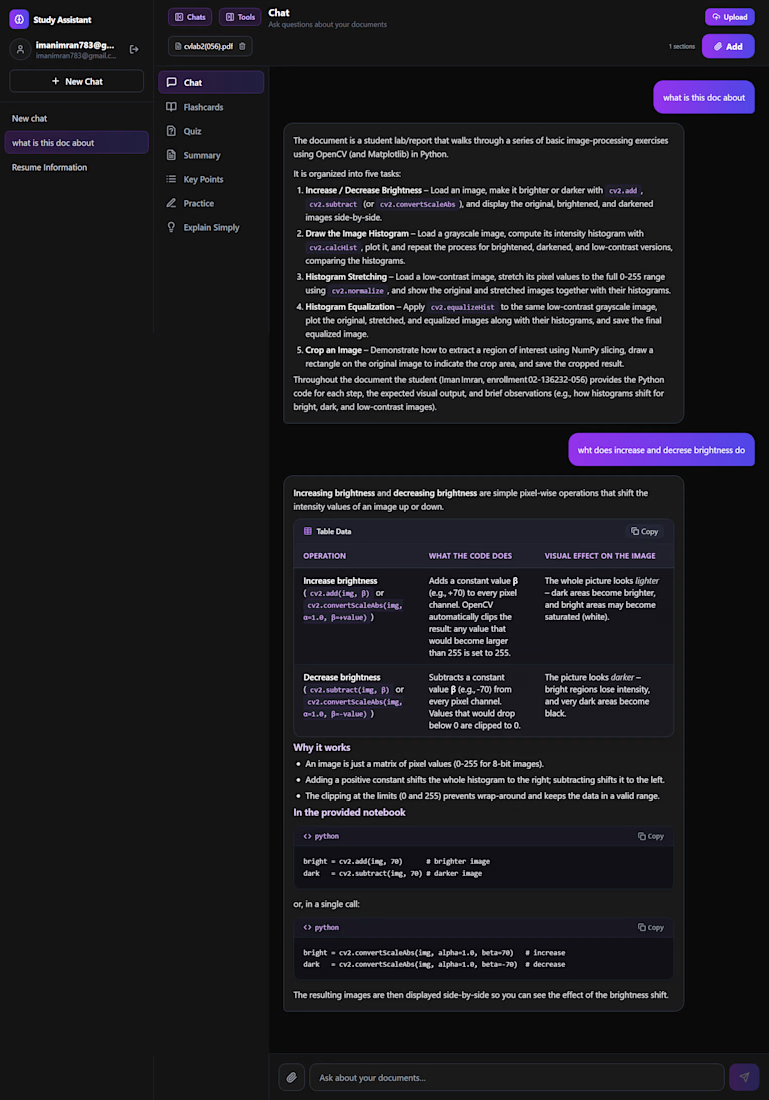

How do you persist the FAISS index across Docker restarts?


MessyAPI is a production-ready developer infrastructure platform I built to eliminate repetitive data utility work. It gives developers one API to clean, validate, match, transform, protect, and analyze messy data instead of rebuilding those capabilities for every application.
I designed the platform around real production requirements, including API-key authentication, tenant isolation, usage metering, rate limiting, idempotency, asynchronous jobs, retries, webhooks, observability, and secure data handling.
MessyAPI also includes JavaScript and Python SDKs, OpenAPI, MCP support, CLI tooling, RapidAPI integration, interactive testing, and composable workflows for chaining multiple data operations together.
The goal was simple: turn common data infrastructure developers repeatedly build themselves into one reliable API.


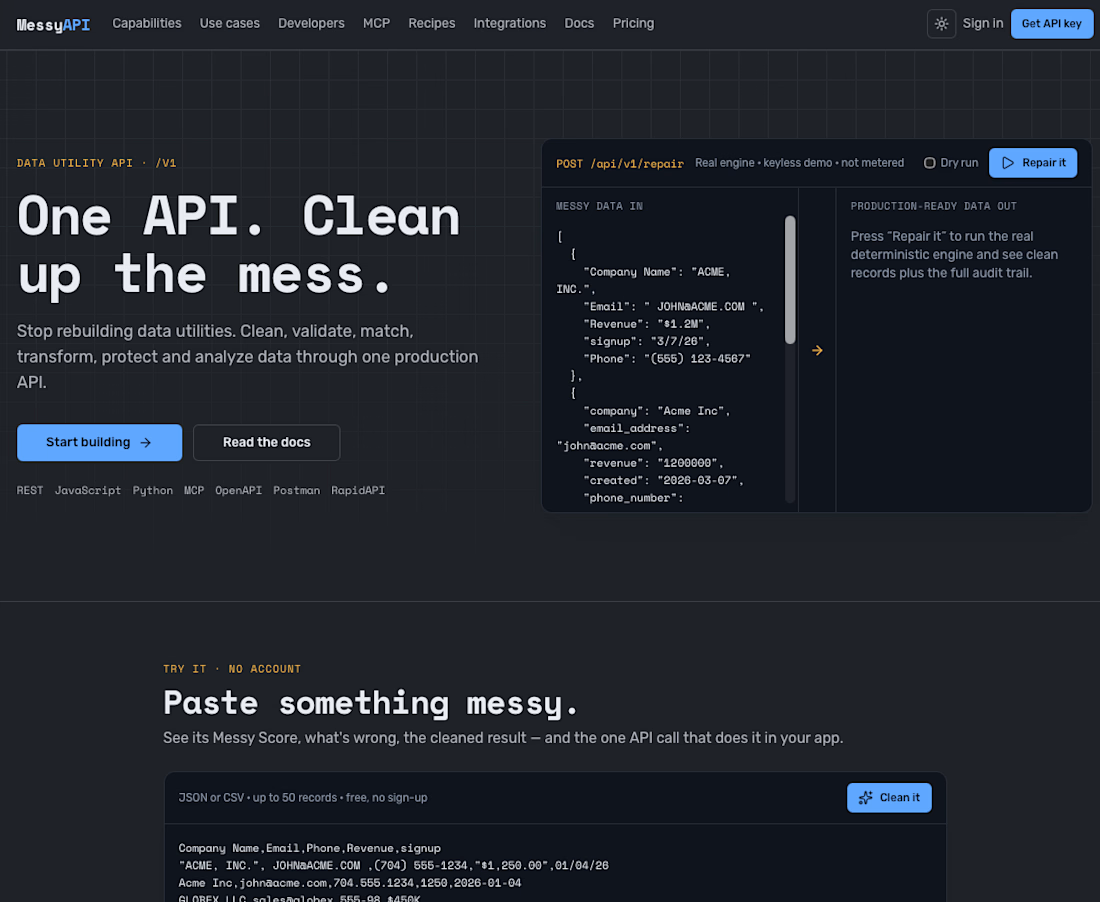

one API for messy data instead of rebuilding it every project is a big win