The network for creativity
Join 1.25M professional creatives like you
Connect with clients, get discovered, and run your business 100% commission-free
Creatives on Contra have earned over $150M and we are just getting started
Back to feedPost

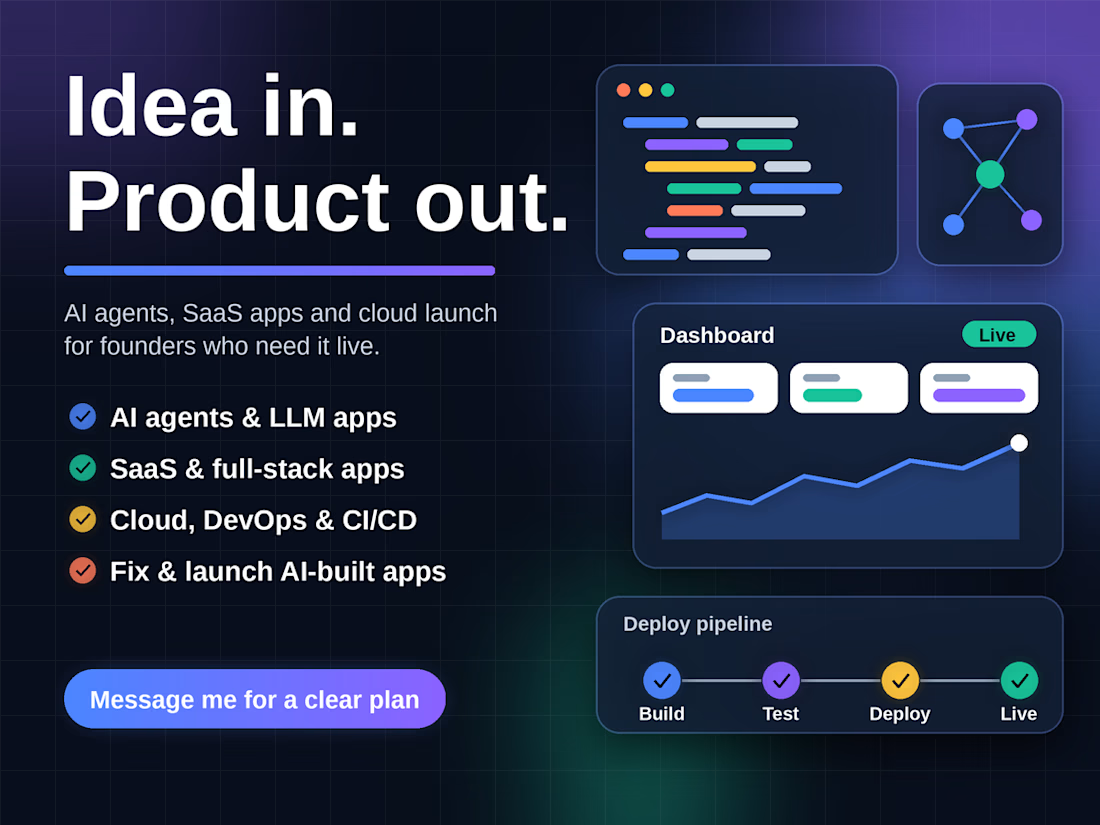
I help founders turn ideas into live products.
I build:
✅ AI agents and LLM apps (OpenAI, Claude, RAG)
✅ SaaS and full-stack web apps (Next.js, Nest.js, PostgreSQL)
✅ Cloud deployment with AWS, Docker, Kubernetes, and CI/CD
✅ Fixes and launches for apps built with Cursor, Lovable, or Claude Code
Recent work includes an AI agent platform on Google Cloud, a time-tracking SaaS with a desktop app, and an AI document platform.
Have a project in mind? Send me a message and I’ll reply with a clear plan.
#AI #SaaS #FullStack #DevOps #AWS #NextJS
The network for creativity
Join 1.25M professional creatives like you
Connect with clients, get discovered, and run your business 100% commission-free
Creatives on Contra have earned over $150M and we are just getting started
Related posts

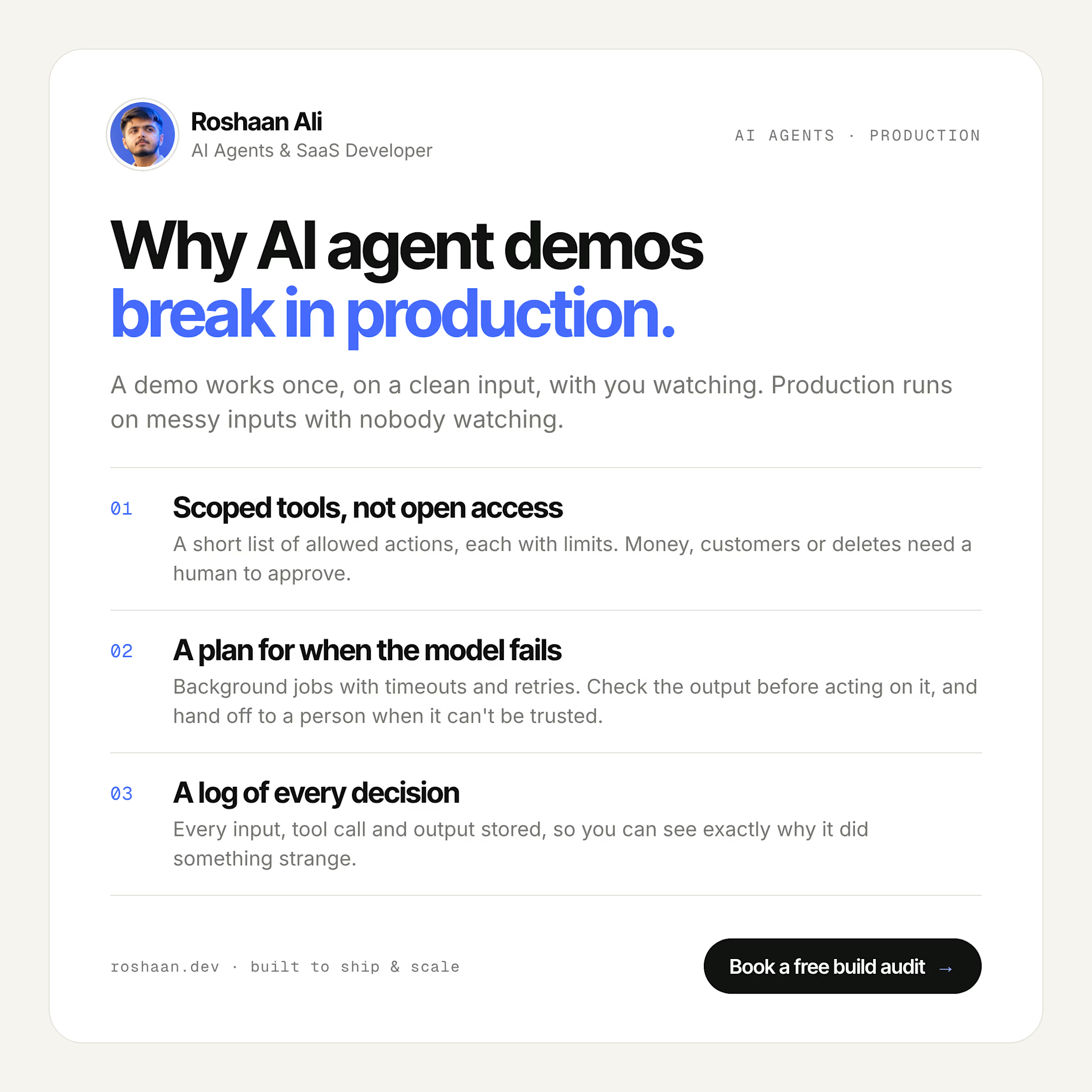
Why AI Agent Demos Break in Production
An AI agent demo only has to work once, on a clean input, with you watching. In production it runs again and again on messy real inputs, and nobody's watching.
I've built AI into real products, from a repricing engine that runs 24/7 for a US Amazon seller to a voice automation platform for a company in Germany. These are the three things I put in place before any agent goes live:
1. Scoped tools, not open access
Give the agent a short list of actions it's allowed to take, each with its own limits, instead of raw access to your database or APIs. Anything that touches money, customers or deleting data needs a human to approve it.
2. A plan for when the model fails
Model calls are slow, they time out, and sometimes they return something that makes no sense. Run agent work in background jobs with timeouts and retries, check the output before acting on it, and hand the task to a person when it still can't be trusted.
3. A log of every decision
Store every input, tool call and output. When the agent does something strange (and at some point it will), you can see exactly why and fix it instead of guessing.
None of this shows up in a demo. All of it decides whether the agent is still running a month later.
Planning an AI agent for your product? I offer a free build audit: calendly.com/roshaanali-business

"Works once with you watching" is the best way I've heard it put. Timeouts and a human fallback are the parts most demos skip.

I wanted to see how far I could take an idea using AI, so I built something.
Meet Instant CSV Dashboard 🚀
It's an experiment in making data easier to explore by turning CSV files into interactive dashboards.
I built it using AI tools, moving beyond static designs to create something people can actually try.
I'm sharing a short demo of the experience, and I'd love to hear what you think.
Have a look: https://interactive-csv-dashboards.ai.studio/
If you work with data regularly, what would you want a tool like this to do for you?
#ProductDesign #AI #DataVisualization
@Google USA

Nice one. I'd want it to pick the right chart for each column on its own. That's where most people get stuck.

Everyone is shipping AI agents right now. Almost no one is testing them — and that is the whole problem.
A demo agent and a production agent are different animals. The demo works because you walked it down the happy path. Production breaks on the paths you never imagined.
A real example from my own work: a support assistant correctly handed a conversation to a human when someone wrote "I want to talk to a person" in Spanish — but not in English, because one phrase was missing from a rule. Every automated test passed. It only surfaced when I ran real conversations through it.
That is the gap the "agents will replace everything" wave keeps skipping. The hard part was never making an agent act. It is making it:
• say "I don't know" instead of guessing,
• hand control back to a human at the right moment,
• and prove, with tests, that it still behaves when the input gets strange.
Autonomy is cheap. Trustworthy autonomy is the real engineering.
Before you let an AI agent near real users or real data — what is the first thing you check?


