The network for creativity
Join 1.25M professional creatives like you
Connect with clients, get discovered, and run your business 100% commission-free
Creatives on Contra have earned over $150M and we are just getting started
Back to feedPost
Why Revenue Management Belongs to Finance, Not Marketing
The org chart decision most companies never revisit — and the margin it quietly costs them.
Ask a revenue management team how they're doing, and they'll show you bookings growth, win rates, average deal size. Ask the finance team the same question a quarter later, and you'll often get a different answer: margin compression nobody flagged in real time, discounting that pushed payback periods past what the business can actually carry, and a P&L that doesn't match the growth story everyone was celebrating three months earlier. That gap isn't a communication problem. It's an org chart problem, and it's one most companies never go back and fix.
Revenue management usually sits inside marketing or sales — which made sense when it was mostly about yield and volume. But every pricing decision a revenue management team makes is also a capital allocation decision: a discount changes cash conversion timing, a packaging change shifts unit economics, a usage-based tier resets the payback period on every customer acquired under it. Marketing and sales are the right owners for market positioning. They're the wrong owners for decisions with direct, immediate consequences for margin and cash — because the incentive on that side of the org is, correctly for their function, to close the deal. Nobody in that reporting line is structurally rewarded for saying no.
What changes when finance owns it
When commercial finance and revenue management report to the same leader, the pricing conversation stops happening after the fact and starts happening at the point of decision. A few things follow almost automatically:
Discounting gets a hurdle rate, not just an approval threshold. Most companies have a discount approval matrix — above X percent, a director signs off; above Y percent, a VP does. That's governance, not discipline. A finance-owned revenue management function replaces "who can approve this" with "does this discount still clear an acceptable payback period," which is a fundamentally different — and much harder — question to answer yes to.
Bookings growth stops being the headline metric on its own. Growth weighted by cash conversion and gross margin tells you whether the business is getting better or just getting bigger. A commercial finance-led revenue function reports both numbers together by default, because separating them is exactly how margin erosion hides in a growth narrative for two or three quarters before anyone notices.
Pricing decisions get modeled with the same rigor as capital projects. A new pricing tier or packaging change is, functionally, a bet on future cash flows — the same category of decision as a capex approval. Once it's owned by finance, it tends to get evaluated the same way: scenario modeling, sensitivity to churn and expansion assumptions, and an honest look at downside cases, rather than a single optimistic forecast built to support the launch.
The mechanics of making it work
This isn't just a reporting-line change — it requires real structural work. A deal desk with actual authority to hold a line on margin, not just log exceptions. A pricing committee that meets on a fixed cadence rather than convening only when a big renewal is at risk. And critically, sales compensation that rewards margin-adjusted revenue, not just closed bookings — because if the incentive structure downstream still rewards volume alone, moving the org chart accomplishes nothing; the discounting behavior won't change just because the approval sits one level higher.
The resistance to this is predictable and, to be fair, not unreasonable. Sales and marketing leaders worry — correctly, sometimes — that finance ownership of pricing will slow deals down and prioritize margin protection over market share at moments when share genuinely matters more. That's a real trade-off, not a strawman, and it's why this only works when the finance leader running it understands commercial strategy well enough to know when speed matters more than the hurdle rate, not just when to say no.
The strategic case
In an environment where the cost of capital is real again and every dollar of cash conversion timing actually matters, letting the function that sets prices operate structurally disconnected from the function that understands what those prices cost the business is an expensive way to run a company. The fix isn't more reporting or more dashboards — those already exist in most organizations and still don't close the gap. It's putting revenue management and commercial finance under one leader who's accountable for both the growth number and the margin behind it, so the trade-off gets made on purpose, in the room, before the price goes out — not discovered in the numbers a quarter later.
https://about.me/sergio.p.mendes
https://finance.yahoo.com/economy/policy/articles/sergio-p-mendes-highlights-data-180000112.html
https://www.msuexponent.com/sergio-p-mendes-proposes-a-30-day-standard-for-stronger-financial-data-literacy/
https://www.sergio-mendes.com/about/
https://www.sergio-mendes.com/


The sales comp point is the one that gets skipped in most of these reorgs — moving the reporting line without touching commission structure just adds a layer of friction sales learns to route around. The companies that actually see the margin benefit are the ones that changed...

I'd push on the framing that marketing/sales ownership structurally can't say no. Plenty of strong CMOs and CROs hold margin lines fine — the real variable isn't which function owns it, it's whether any function owning it is measured on margin at all. Move revenue management to...

The line about a deal desk needing "actual authority to hold a line, not just log exceptions" is doing a lot of work and deserves more detail. Most deal desks I've seen have veto power on paper and none in practice, because the moment a VP of Sales escalates a blocked deal to...

The line about a deal desk needing "actual authority to hold a line, not just log exceptions" is doing a lot of work and deserves more detail. Most deal desks I've seen have veto power on paper and none in practice, because the moment a VP of Sales escalates a blocked deal to...

"The trade-off gets made on purpose, in the room, before the price goes out — not discovered in the numbers a quarter later." That's the whole argument for the reorg in one sentence, and it's the test every pricing governance structure should be measured against.
The network for creativity
Join 1.25M professional creatives like you
Connect with clients, get discovered, and run your business 100% commission-free
Creatives on Contra have earned over $150M and we are just getting started
Trending
retrofuturism
Share your favorite designs from the past exploring the distant future. Or your own take on the aesthetic 🚀
halftone
Dots. Texture. Grain. Let's see your designs using the halftone technique.

Midjourney
Creatives are showing off what they're making with Midjourney.
colorgrade
Video editors sound off: How do you enhance the mood of your video in color grading?
Related posts

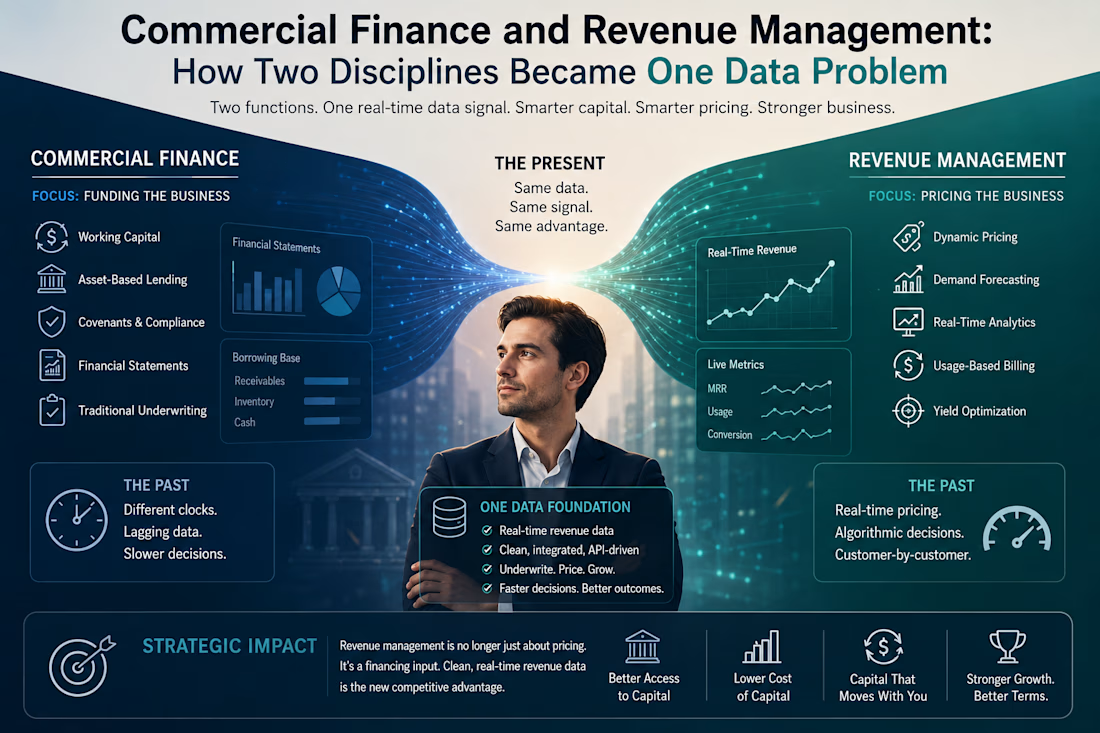
Commercial Finance and Revenue Management: How Two Disciplines Became One Data Problem
For most of their history, commercial finance and revenue management didn't talk to each other. One decided how a business got capital; the other decided how a business priced what it sold. They're now converging — not because anyone planned it that way, but because both run on the same real-time data.
The past: two disciplines, two clocks
Commercial finance is old. Factoring — selling receivables at a discount for immediate cash — has roots in merchant trade going back centuries, and became a formal financing tool for American textile manufacturers in the 19th century who needed working capital faster than customers paid their invoices. Asset-based lending followed the same logic at larger scale: banks lending against receivables and inventory rather than a company's overall creditworthiness, which became a mainstream financing route through the leveraged-buyout wave of the 1980s, when highly indebted companies needed capital that didn't depend on an investment-grade balance sheet.
Revenue management is much younger and has a specific birthday: 1978, when the Airline Deregulation Act let U.S. carriers set their own fares. American Airlines, under Robert Crandall, built dynamic yield management on top of its SABRE reservation system in the early 1980s — splitting seats into fare buckets and adjusting availability against real-time demand and overbooking risk. It was the first serious industrial-scale attempt to price a perishable inventory dynamically, and it spread from there: hotels adopted RevPAR-driven pricing in the 1990s, e-commerce brought algorithmic pricing in the 2000s, and Uber's 2012 launch of surge pricing brought the same math to a mainstream consumer app.
For decades these ran on different clocks. Revenue management operated in real time — hour by hour, sometimes minute by minute. Commercial finance operated on financial-statement time — quarterly covenant tests, monthly borrowing-base certificates, underwriting built on trailing twelve months of audited numbers. A lender saw a business's revenue the way a photograph shows motion: a frozen frame, weeks old by the time anyone acted on it.
The present: the underwriting clock caught up to the pricing clock
That gap is closing because the infrastructure changed. Stripe, Shopify, and QuickBooks turned transaction-level revenue into an API-accessible data stream, and lenders started underwriting directly against it. Revenue-based financing — pioneered by firms like Clearco (formerly Clearbanc), Pipe, Capchase, and Wayflyer — sizes and repays capital as a function of live revenue rather than a fixed amortization schedule: the more a business sells, the faster it repays; the slower a month is, the more the repayment flexes with it. Embedded lenders inside platforms — Shopify Capital, Square's merchant lending — go further, using a business's own transaction history on the platform as both the underwriting signal and the collateral, collapsing weeks of loan-application diligence into a same-day offer.
The same shift is happening from the pricing side. Usage-based billing at companies like Snowflake and Twilio means revenue itself is now generated algorithmically, continuously, against live consumption — which means the "revenue" a lender underwrites against is no longer a static line item but a moving, queryable signal. A commercial finance team assessing a SaaS company's borrowing base today is, functionally, reading the same real-time data the revenue management team uses to forecast next month's billings.
Rates staying higher for longer accelerated this further: traditional debt got more expensive at the same time non-dilutive, revenue-linked capital became easier to underwrite precisely because the data got better — so more mid-market and venture-backed companies turned to financing structures that flex with the business rather than fight it.
What this means strategically
The old boundary — finance decides how you fund the business, revenue management decides how you price it — doesn't hold when both run on the same live feed. The businesses winning capital on the best terms right now aren't the ones with the strongest trailing financials; they're the ones whose revenue data is clean, real-time, and legible enough for a lender to underwrite against it directly. Revenue management stopped being a pricing function and started being a financing input. Treating the two as separate disciplines is now a reporting-lag problem masquerading as an org chart.
https://finance.yahoo.com/economy/policy/articles/sergio-p-mendes-highlights-data-180000112.html
https://about.me/sergio.p.mendes
https://www.msuexponent.com/sergio-p-mendes-proposes-a-30-day-standard-for-stronger-financial-data-literacy/
https://www.crunchbase.com/person/sergio-mendes-6e60
https://www.24-7pressrelease.com/press-release/533973/sergio-p-mendes-shares-a-practical-framework-for-turning-data-into-decisions

LEAKLENS - revenue-risk dashboard
What it does
LeakLens is a revenue-risk dashboard that turns raw billing and usage data into a live account health view, flagging which customers are quietly drifting toward churn before it shows up in MRR.
The problem it solves
According to MGI Research, 42 percent of businesses experience revenue leakage, and SMB-focused SaaS companies face annual churn as high as 31 to 58 percent, often because billing and usage signals sit in disconnected systems no one is watching in real time. LeakLens closes that gap by turning scattered data into one clear risk view, before the cancellation happens.
How I built it
Built entirely in Bubble, using Bubble AI to scaffold the initial page layout and design system, then hand-refined the data model, workflows, and logic. The core architecture mirrors patterns from tools like Stripe (billing event ingestion) and Amplitude (usage event tracking). Two workflows handle CSV upload and parsing, feed the data into a unified account record, and trigger the dashboard build once both sources are loaded.
How to use or test it
There are two ways to get a live dashboard running:
Demo mode: Click Create Dashboard, then click Load Demo Data. Once the confirmation reads "Demo Data Loaded," click Build Dashboard.
File data: Upload the billing CSV and usage CSV (Download CSV here), click Upload CSV. Once it reads "Billing and Usage Data Loaded," click Build Dashboard.
Click on the account in Dashboard to get more details and recommendation on it.
What's next
LeakLens is currently an MVP, built to prove the core risk-detection logic end to end. The roadmap includes:
Live integrations with Stripe and Amplitude, replacing manual CSV uploads with real-time billing and usage data feeds
An AI response layer that turns each risk flag into action: drafting a personalized outreach email, suggesting a check-in call, or pinging the account's CSM directly, based on what the risk signal actually indicates.
Thank You!
😍 #BuiltWithBubble #NoCode #RevOps #ChurnPrevention

Impressive! Works very well...Wish you the best.

I design high-performance, conversion-optimized finance thumbnails engineered to scale channel revenue. By pairing clean typography with aspirational visual hooks like trend charts, precise lighting, and crisp asset compositing I maximize Click-Through Rates (CTR) while maintaining strict audience retention alignment.