The network for creativity
Join 1.25M professional creatives like you
Connect with clients, get discovered, and run your business 100% commission-free
Creatives on Contra have earned over $150M and we are just getting started
Back to feedPost

Behind the scenes on how our build process actually changed this month.
For most of this year we ran AI under a budget constraint, and that constraint quietly shaped everything. Which problems we pointed AI at. Which we did by hand. How much of a codebase we were willing to let a model read. Scarcity was the organising principle and we had stopped noticing it was there.
Then it lifted. Here is what actually broke.
The problem nobody warned us about. Freed from budget pressure, sessions got long and deep. A model will happily work a huge problem in one sitting. But the sitting ends — timeout, full context, or you go to bed. And everything it worked out along the way vanishes. The dead ends it ruled out. The constraint it discovered in hour two. The reason it chose one approach over another.
When sessions were short, we held that context in our heads. When they got long, we couldn't. We started losing more to forgotten context than we had ever lost to rate limits.
What we built to fix it:
Exit interviews. Before closing any meaningful session, we prompt the model for a handover briefing — what it did, what it decided, what the next instance needs. Not a commit message. An actual briefing. That output becomes the opening context next time. This is the single highest-leverage thing we changed and it took an afternoon to adopt.
Browser session stability. Long builds kept dying when whoever was driving switched tabs. Moving active sessions into the Chrome extension fixed it. Unglamorous. Recovered more hours per week than any clever prompting.
Logic only, no UI. We kept fighting the same battle — strong architecture and logic coming back attached to cluttered, incoherent interfaces. So we stopped asking. We now prompt for logic and architecture and explicitly block frontend generation. Structural foundations go to a human who builds the interface natively. Restricting the model made the output better, which is not what I expected.
Two-stage handoff. Fast rough first pass to kill ambiguity, often straight from a client scope document — one was 125 pages fed through in a single stretch. Then a different person takes the careful second pass.
The part I did not expect. More capacity meant more verification, not less. We increased the QA burden at the same time we removed the ceiling, deliberately, because an agentic system will always find something to report and the report will always sound like progress.
The tools were the easy part. The reorganisation was the work.

infiniteup.dev
The Bottleneck Moved: How We Rebuilt Our Workflow Around MCP and Fable - InfiniteUp
We removed our AI capacity ceiling expecting to get proportionally faster. Instead the bottleneck moved somewhere less convenient. How InfiniteUp rebuilt its development workflow around MCP and Fable.

budget shaping the whole process, good honest writeup
The network for creativity
Join 1.25M professional creatives like you
Connect with clients, get discovered, and run your business 100% commission-free
Creatives on Contra have earned over $150M and we are just getting started



Related posts

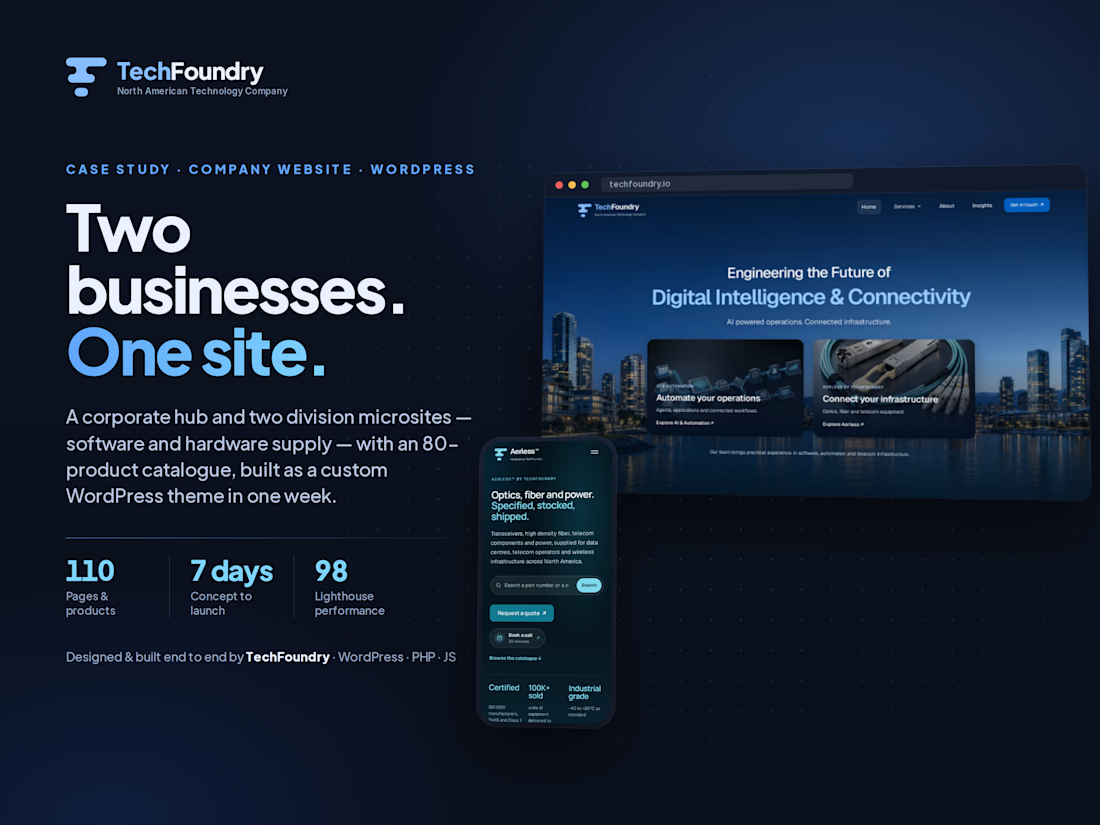
We rebuilt TechFoundry's website in a week. The brief that mattered most wasn't "make it look good". It was "make ChatGPT and Gemini able to find us".
Buyers ask an AI before they search now. So all 110 pages (26 pages, 80 Aerless™ hardware parts, 4 articles) are server-rendered with real content and structured data a model can cite: Product schema with SKU and MPN on every part, BlogPosting on articles, CreativeWork on case studies, and a robots.txt that lets AI crawlers in.
Three other decisions I'd make again.
1) One hand-coded WordPress theme, three "surfaces": corporate hub, /ai, /aerless. Each gets its own nav, palette and CTAs; the same codebase decides which company you're looking at. No page builder, no front-end framework. Homepage Lighthouse: 98 / 100 / 100 / 100.
2) Leads go where the team already is. Every form posts straight into a Microsoft Teams channel and creates a record in a lightweight CRM I built inside WordPress. Nothing lives only in an inbox.
3) Claude Code and ChatGPT alongside hand-written PHP and JS. That's how one person ships 110 pages in seven days.
What I'd fix on day one next time: reserve space for the animated heroes so mobile doesn't shift layout, and ship an llms.txt next to the sitemap.
If you're rebuilding a site this year: are you designing for AI search yet, or still just Google?

Appreciate the honesty on the mobile layout shift. Are you fixing it with explicit CSS aspect ratios to push that mobile score back above 90?

Most businesses don’t need more AI. They need fewer manual problems.
I work at the intersection of data, AI, and software, turning repetitive workflows, disconnected data, and operational challenges into practical business solutions.
From data analytics and intelligent automation to AI-powered systems, my focus is simple: use technology where it creates measurable value.
Here’s a quick look at what we’re building at D-SAi.
What’s one repetitive process in your business you’d automate if you could?

🚀 How I Use AI in UX/UI Design: 7 Real Workflows from My Projects
There’s a lot of hype right now around AI replacing designers.
I don’t think that’s the case. In the right hands, AI can complement a good designer and make them stronger and more efficient.
In this article, I want to share my experience using AI in UX/UI design.


Good read! ❤️