The network for creativity
Join 1.25M professional creatives like you
Connect with clients, get discovered, and run your business 100% commission-free
Creatives on Contra have earned over $150M and we are just getting started
Back to feedPost

When did speed become more important than the creative process?
Recently, I experienced something that made me reflect on how AI is changing the way businesses approach design.
My team and I were working on a creative project. We explored different directions, presented our work, received feedback, and made the requested adjustments.
At one point, we understood that the design was almost finalised. But shortly after, the direction changed, and the decision was made to move forward with an AI-assisted alternative because it was faster.
And that got me thinking.Are we starting to value how quickly something can be produced more than the thought that goes into producing it?Don't get me wrong, I use AI too. It's an incredible tool, and I believe it has a place in the creative industry. But I also believe there's a difference between generating something that looks good and developing something with a clear purpose.
Behind every design decision, there's research, discussion, experimentation, feedback, and sometimes a lot of trial and error. Not every creative direction will be accepted. That's part of the job. And I understand that businesses have deadlines. Speed matters.
But I wonder whether we're slowly losing patience for the creative process itself. AI can accelerate execution. But speed alone doesn't guarantee the right direction. As someone running a small creative studio, I'm still learning how to balance creativity, efficiency, and client expectations in this changing industry.
I'm curious how other creatives and business owners see this.
Are we becoming too focused on producing things quickly, rather than understanding why we're producing them in the first place?


The network for creativity
Join 1.25M professional creatives like you
Connect with clients, get discovered, and run your business 100% commission-free
Creatives on Contra have earned over $150M and we are just getting started



Related posts

AI can generate content in seconds. But can it actually feel like your brand?
That’s the question I explored in our latest article.
I’ve just published a new piece on The Ash Studio blog about AI-generated content for social media - how brands can use it to speed up content creation without losing their identity, consistency, or visual quality.
Using a beauty brand as an example, we explore where AI fits into the creative process, what it can bring to content production, and what to consider before making it part of your brand’s social media strategy.
If you’re exploring AI for your brand or looking for new ways to approach content creation, this might be a useful read.
👉 Read the full article: https://www.theash.design/blog/ai-generated-content-for-social-media-beauty-brand
What do you think, can AI-generated content truly feel on-brand?

theash.design
AI-Generated Content for Social Media: A Beauty Brand Case
How we use AI for a lip care brand’s social and website visuals: what AI generates, what stays real, and the checks every visual passes.

THE ART OF AUTHORITY — A Motion Design Experiment
Attention is easy to get. Authority is earned.
An experimental motion design project crafted in Adobe After Effects, combining kinetic typography, dynamic transitions, geometric animations, and cinematic visual storytelling.
Focused on precision, creativity, and impactful visual communication.
Don't just get noticed. Be remembered.
Skills: After Effects · Motion Graphics · Kinetic Typography · Visual Storytelling · Creative Direction


The brushed metal ATTENTION on black with the small line under it sets the pause nicely. That grey sub line is quite dim and small, brighter would read better on a phone. Do you build the kinetic type from scratch each time?

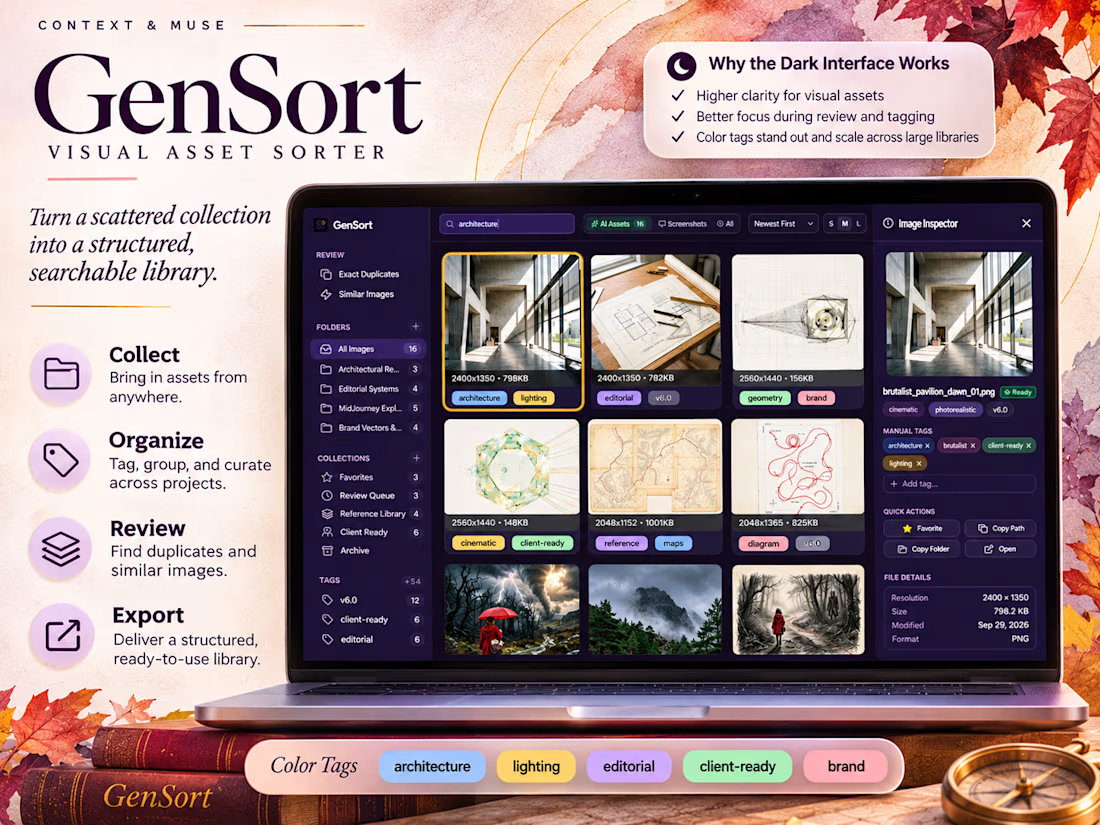
A creative tool should reduce the work, not become more work.
Visual assets accumulate quickly. Finding the right one shouldn't require remembering filenames, opening dozens of folders, or rebuilding a system every time.
I designed GenSort around a simpler question:
What if organizing visual work felt as intuitive as working with it?
GenSort explores a visual-first approach to asset sorting, organization, and export, with an emphasis on reducing friction between collecting inspiration and actually using it.
A look at the product thinking, interface decisions, and experience behind the build.
Product Design · UX/UI · Creative Tools