The network for creativity
Join 1.25M professional creatives like you
Connect with clients, get discovered, and run your business 100% commission-free
Creatives on Contra have earned over $150M and we are just getting started
Back to feedPost

Engineering Case Study: Deterministic Script Failure vs. Context-Aware AI Agents
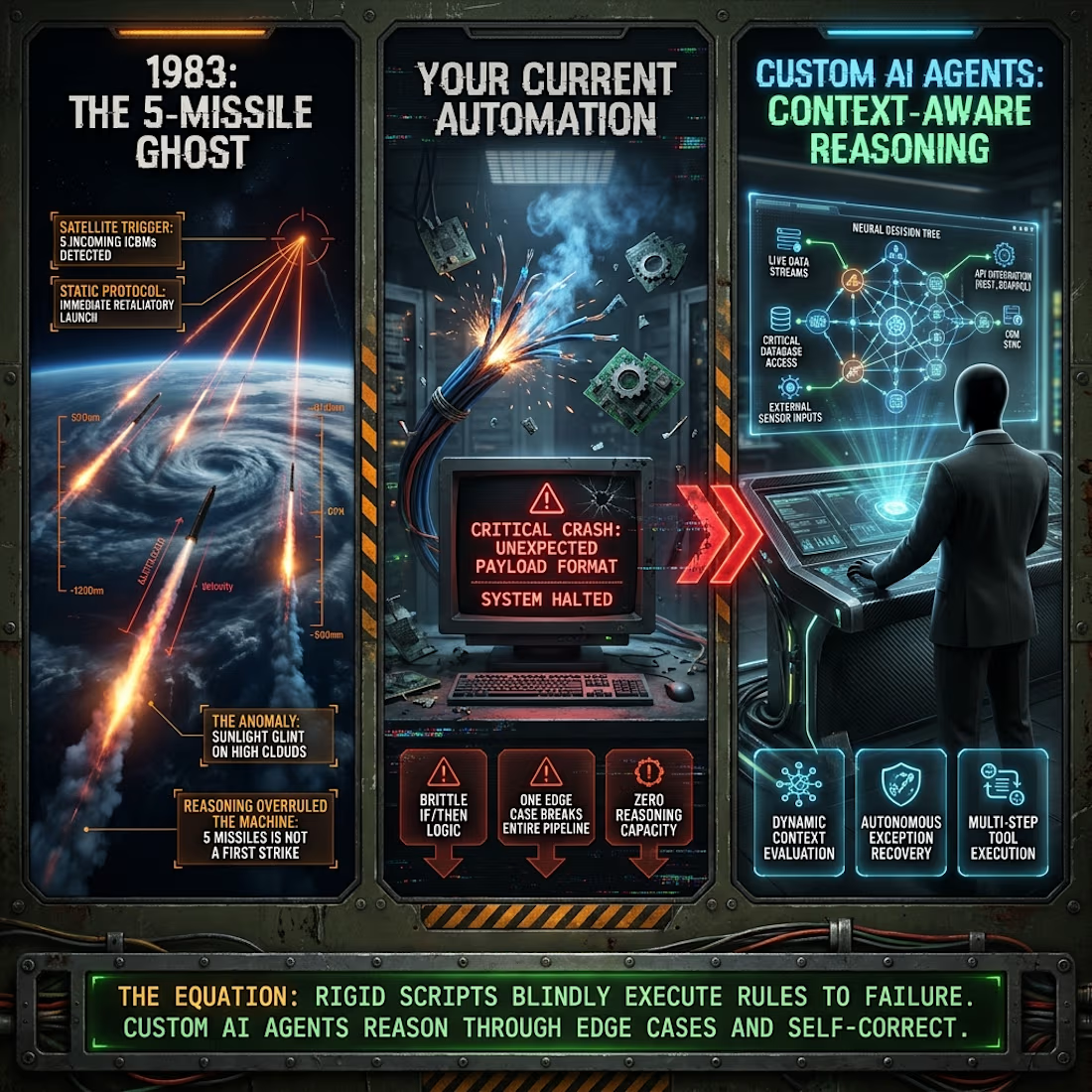
On September 26, 1983, the Soviet Union’s Oko nuclear early-warning satellite system flashed an emergency alert: five US intercontinental ballistic missiles had launched toward Moscow.
The system’s automated protocol was binary and non-negotiable: report an active strike to trigger immediate retaliation.
Duty officer Stanislav Petrov refused to execute the protocol. His reasoning was contextual rather than mechanical: a real nuclear first strike would involve hundreds of simultaneous warheads to overwhelm defensive infrastructure, not an isolated salvo of five. Post-incident technical reviews revealed that the satellite sensors had misinterpreted sunlight reflecting off high-altitude clouds as missile rocket plumes.
The automated system executed its code without error. It nearly precipitated a catastrophe because deterministic scripts cannot evaluate real-world context.
Four decades later, digital enterprise infrastructure still suffers from the exact same structural vulnerability.
The Operational Ceiling of Linear Automation
Most companies run critical operations on deterministic "if-this-then-that" scripts, basic webhooks, or rigid iPaaS pipelines:
Zero Exception Resilience: A slight format shift in a supplier PDF, an unmapped CRM field, or an unexpected edge-case payload halts the entire workflow.
Compounding Maintenance Debt: Internal engineering teams spend recurring sprints patching brittle logic gates and writing band-aids for every unhandled edge case.
Blind Downstream Execution: When corrupted or ambiguous data bypasses basic validation rules, scripts blindly trigger incorrect downstream API calls, corrupting databases and client-facing systems.
Modern System Architecture: Custom Autonomous AI Agents
Bridging the gap between rigid software rules and human operational bandwidth requires replacing deterministic automation with autonomous, context-aware AI agents.
Rather than following hardcoded, brittle execution trees, a custom agent acts as an adaptive runtime decision engine:
Contextual Input Evaluation: Before triggering actions, the agent inspects incoming data against historical patterns, parsing unstructured text, messy documents, or anomalous payloads with human-grade comprehension.
Dynamic Multi-Tool Orchestration: Rather than relying on static linear paths, agents plan multi-step execution graphs—querying private vector databases, invoking REST APIs, and updating CRMs based on dynamic runtime variables.
Self-Healing Logic & Anomaly Quarantine: When an out-of-bounds error or missing parameter is encountered, the agent attempts semantic self-correction, flags anomalies with structured audit trails, and alerts human operators only when genuine edge cases require manual sign-off.
Rigid automation executes rules blindly to the point of failure. Custom AI agents interpret nuance, isolate anomalies, and execute complex workflows reliably.
Curious how other teams are approaching the transition from brittle rule-based pipelines to resilient agentic architectures.
Let’s connect on Contra to discuss custom agent workflows, or leave your thoughts below to open a technical discussion.
The network for creativity
Join 1.25M professional creatives like you
Connect with clients, get discovered, and run your business 100% commission-free
Creatives on Contra have earned over $150M and we are just getting started



Related posts

🚀 Turning Manual E-commerce Order Processing into an Automated Workflow with n8n
Manual order management may seem simple, but copying customer details, checking information, preventing duplicate orders, and sending confirmation emails can quickly become repetitive and error-prone.
I recently built an end-to-end order processing automation using n8n to solve these challenges for a handmade products store.
Here's what I implemented:
🔹 Automated Order Capture: Receive new orders through a webhook.
🔹 Data Validation & Cleaning: Validate required fields, email formats, quantities, and prices before processing.
🔹 Duplicate Prevention: Detect existing Order IDs to prevent duplicate records.
🔹 Google Sheets Integration: Automatically store valid orders and calculate order totals.
🔹 Email Notifications: Send order updates to the store owner and confirmation emails to customers.
🔹 Error Monitoring: Capture failed executions, log error details in a dedicated Google Sheets tab, and send email alerts.
The goal was simple: reduce repetitive administrative work, improve data accuracy, and make order operations more reliable.
This is what I enjoy about building with n8n — turning complex, repetitive business processes into practical automation systems.
Have a repetitive workflow in your business that could be automated? Let's connect!
#n8n #WorkflowAutomation #EcommerceAutomation #BusinessAutomation #NoCode #Automation


Using AI Automation workflow in business , not only save the time ,also increase work Efficiency

Exploring the listening state for an AI voice interface.
Which direction would you ship, A or B?
10 voted
29%
25 voted
71%
35 votes
Closed

The particle field looks more polished and beautiful🔥

This year’s YC Fall batch is for us creatives. 🎯
As a product designer, I’ve never felt like our field was changing as rapidly as it is right now. Tools emerge, you adapt, they disappear. Processes that took hours can now be largely automated, and overall, I feel like a big part of the fun gets lost because of a communication issue: I struggle to tell the tools exactly what I want in enough detail.
I recently stumbled across a few interesting and promising startups that might bring some of that joy back and take the pain out of parts of our work.
Proto is building an IDE specifically for product designers, bringing design and AI workflows closer together. 👩🏻💻
Simulithic uses AI agents to test your app across devices, browsers, and account types, automating test creation and maintenance. 🤳🏼
Composal uses swarms of AI agents to explore product flows and edge cases, finding what breaks before release. 🕵🏻♂️
Native helps marketers decide what to create by ranking ideas based on brand context, performance, trends, and creative feedback. 🦖

The edge case testing sounds promising.