The network for creativity
Join 1.25M professional creatives like you
Connect with clients, get discovered, and run your business 100% commission-free
Creatives on Contra have earned over $150M and we are just getting started
Back to feedPost

You hired a freelance developer abroad. The product ships, the invoice is paid, everyone is happy.
Then an investor asks: "Who owns the code?"
This is the gap I see most in cross-border tech contracts.
→ The ideal: you pay, you own. The IP in the work passes to your company, clearly and in writing.
→ The problem: in many countries, copyright stays with the author unless a contract says otherwise. A chat agreement or a silent contract can leave you with a license at best, and a hole in your due diligence at worst.
→ The solution: one clause. An IP assignment that takes effect on payment (so the freelancer is protected too), covering code, designs and deliverables, with a clear carve-out for their pre-existing tools and open-source components.
Short clause, big difference. It makes the deal safe for both sides.
I'm a lawyer based in the Argentina-Paraguay-Brazil Triple Frontier, working on cross-border contracts for startups and founders in LatAm. Rules vary by country, so this is general information, not advice for your case.
Have you ever had to prove you owned something you paid for? What happened?
The network for creativity
Join 1.25M professional creatives like you
Connect with clients, get discovered, and run your business 100% commission-free
Creatives on Contra have earned over $150M and we are just getting started



Related posts

For freelancing which one will you choose, I will choose contra.
1 voted
4%
24 voted
96%

25 votes
Closed


A multi-page Kajabi website, built with AI.
Meet Tideline, a fictional freediving brand created with Pro Studio. In this walkthrough, I show the site, how the AI chat helps refine it, the mobile layout and the export.
This example would cost $525 to export. That’s about 90% less for the self-service export, though it’s a different service from hiring an expert.
See what’s possible: https://tryprostudio.com


Nice walkthrough, Kraig. Seeing the AI chat refine the Tideline pages and then the mobile layout makes the whole workflow easy to follow.

Most small businesses lose clients in the gap between "new request" and "someone replies".
This year I shipped 5 projects that close that gap.
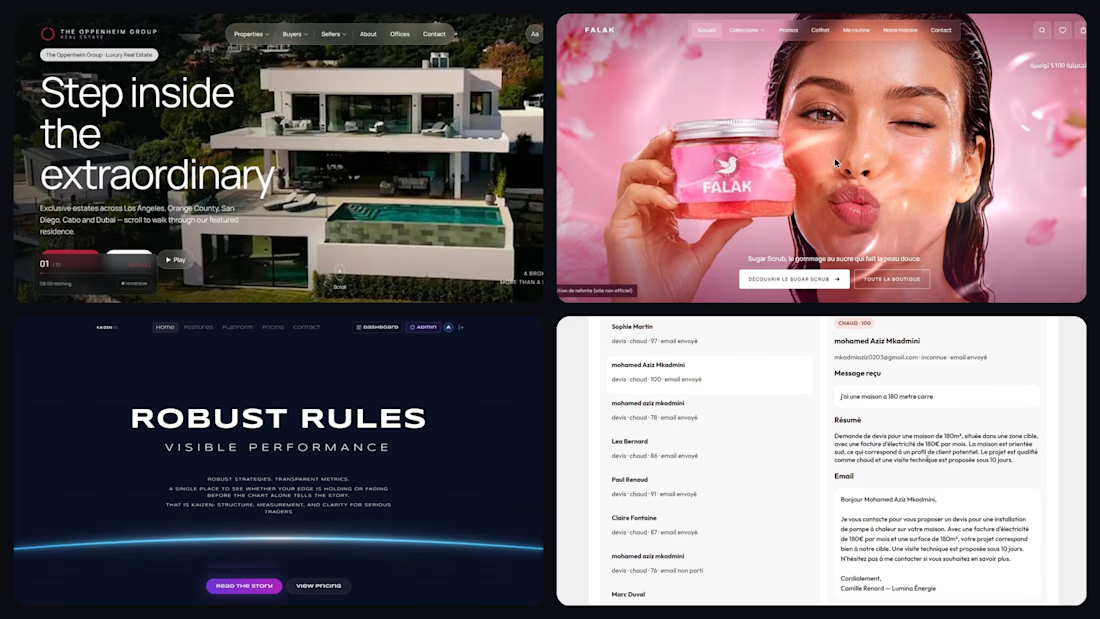
→ n8n AI agents that score every lead and reply with a personalised email in seconds
→ MedAssist AI, a SaaS that lets patients book and get answers 24/7
→ Kaizen Kyoto Capital, a crypto SaaS live with Paddle billing, 2FA and 43 automated tests
→ Two premium redesigns (luxury real estate in 3D, a cosmetics brand) with before/after
I'm a full-stack & AI automation developer, available now for websites, SaaS MVPs and n8n automations. French, English, Arabic. I reply within 24h.
Got a process that eats your team's time? Send me a message and I'll map your first automation for free.

Good work, keep going