The network for creativity
Join 1.25M professional creatives like you
Connect with clients, get discovered, and run your business 100% commission-free
Creatives on Contra have earned over $150M and we are just getting started
Back to feedPost

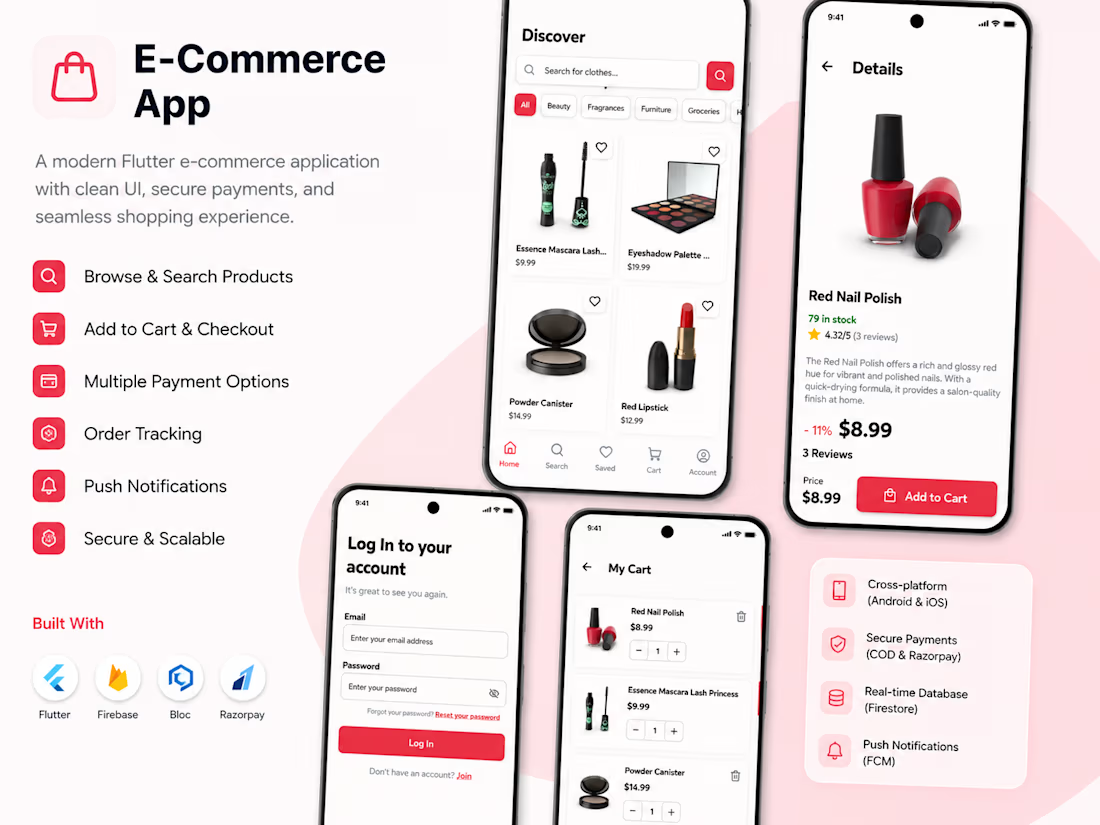
Full-stack Flutter e-commerce app with category browsing, cart, checkout, Razorpay payment gateway, Firebase backend, push notifications, and BLoC state management throughout.


The network for creativity
Join 1.25M professional creatives like you
Connect with clients, get discovered, and run your business 100% commission-free
Creatives on Contra have earned over $150M and we are just getting started



Related posts

A push notification model usually breaks in one of two ways: a second phone stops receiving anything, or notifications keep arriving for the account that just signed out. Both come from storing one push address per user. Store one row per app installation instead, with the user ID as a field, and someone with a phone and a tablet has two rows that a single query returns.
The sign-out half has an ordering trap. Delete the installation row while the user is still signed in, then call signOut. A security rule that compares the row owner to the signed-in user refuses the delete once there is no user left to compare against, and the device keeps pointing at the previous account.
The full write-up covers the Firestore rules, the Flutter registration listener, a server cleanup that handles both unregistered error codes, and an acceptance sequence to run on two test installations.

duskolicanin.com
Keep Flutter Push Tokens Correct Across Devices
Fix Flutter push notifications that miss a second device or follow the previous user: store one FCM installation ID per device and prune unregistered IDs.

Great technical breakdown! Handling multi-device FCM tokens and secure sign-out correctly is essential for reliable push notifications. I appreciate the focus on both architecture and real-world edge cases. 👏

Afterhours is a portfolio you can explore.
Built for my friend Stanislav Pogorskii, a full-stack developer, it connects his background in games journalism, his work as a Laravel developer, and his next steps in game development.
Switch on the radio. Open a console. Explore the workspace, browse real projects and published articles, or step onto the balcony. Each interaction reveals something about the person behind the work.
As usual, the process involved a few different tools, hehe. I developed and iterated on the project locally using my own CLI setup, pushed it to GitHub, then brought it into Base44, where I connected a CRM system.
The experience also leads to a practical next step: a short project quiz that turns a visitor’s answers into an editable email draft.
Personal details spark curiosity. Real work builds confidence. A useful interaction can help you see who you are and where you could go next.
Created for #Base44Challenge with @Base44.


I feel seen! Love this so much.

I built a Shopify store auditor with Base44 to solve a problem I face almost every day as a freelancer.
As a Shopify and Full Stack Developer, I regularly inspect storefronts to identify conversion issues, UX friction, missing HTML tags, SEO problems, and opportunities to improve the shopping experience.
The problem? Doing all of this manually takes time. A lot of time.
So I thought, why not build a tool that does the heavy lifting for me?
That idea became my Base44 Challenge project.
Here’s how it works:
→ Enter your Shopify store URL
→ Choose between AI-powered and rule-based auditing
→ Get an instant report highlighting critical issues and areas for improvement
→ Discover problems across your storefront and identify what needs attention
→ Use AI-powered insights to guide your optimization process
→ Download and share your audit reports with clients, agencies, or your team
The goal is simple: make Shopify store audits faster, more accessible, and less repetitive.
Whether you're an e-commerce brand owner trying to improve conversions, an agency auditing client stores, or a freelancer managing multiple projects, this tool is built around a real problem we face in our daily work.
I built it with Base44, starting with a problem I understand firsthand as a Shopify developer.
Sometimes, the best ideas aren't complicated. They're the ones that solve problems you deal with every day.
🔗 Try it here: https://storesignal-audit-flow.base44.app/
Built for the Base44 Challenge.
I'd love to hear what you think and what you'd add next!
#Base44 #Shopify #Ecommerce #AI #WebDevelopment #SaaS #ConversionOptimization #BuildInPublic

Amazing work