The network for creativity
Join 1.25M professional creatives like you
Connect with clients, get discovered, and run your business 100% commission-free
Creatives on Contra have earned over $150M and we are just getting started
Back to feedPost

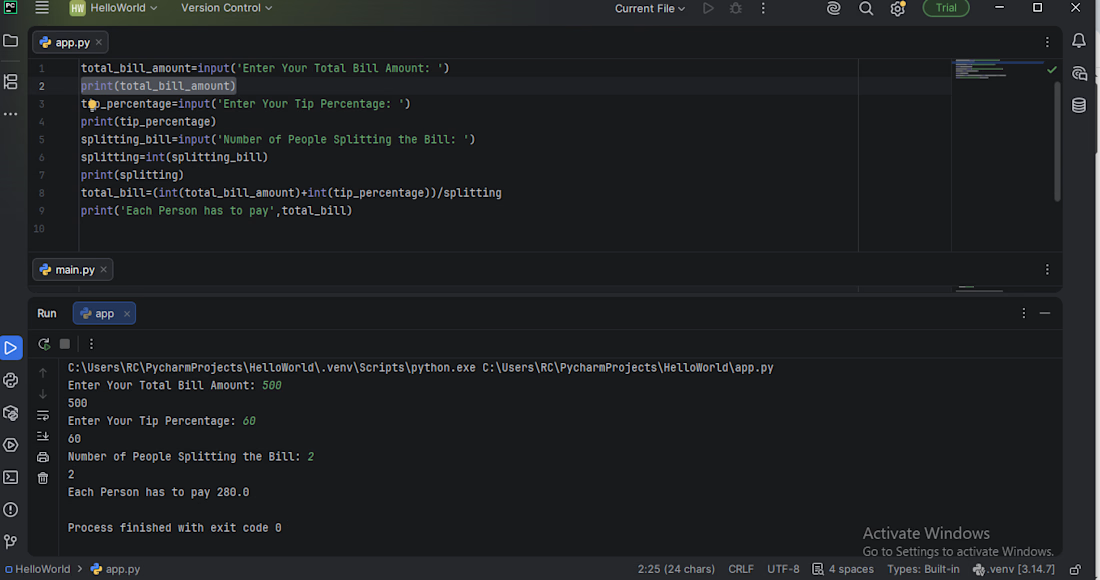
Automated Financial Logic & Enterprise Calculation Engines
The Problem Solved: Eliminates costly revenue leakages and human billing mistakes caused by error-prone manual spreadsheets and rigid legacy systems.
The Solution: Custom, bulletproof algorithmic engines that instantly automate multi-variable calculations, transaction splitting, and backend commercial arithmetic with zero error margins.
Business Impact: Accelerates billing cycles, guarantees 100% calculation compliance, and secures transactional data integrity across your entire business.
Universal Scale: Built with clean, modular logic that integrates seamlessly into your SaaS platforms, e-commerce checkouts, internal CRMs, or enterprise tools.
Want to bulletproof your business math and billing flows? Message me here on Contra with your specific parameters, and let’s engineer a high-performance calculation engine tailored to your stack.
Algorithmic Identity ArchitectureDot Net Backend DevelopmentFinancial AnalysisPythonVisual Studio Code


The network for creativity
Join 1.25M professional creatives like you
Connect with clients, get discovered, and run your business 100% commission-free
Creatives on Contra have earned over $150M and we are just getting started
Related posts

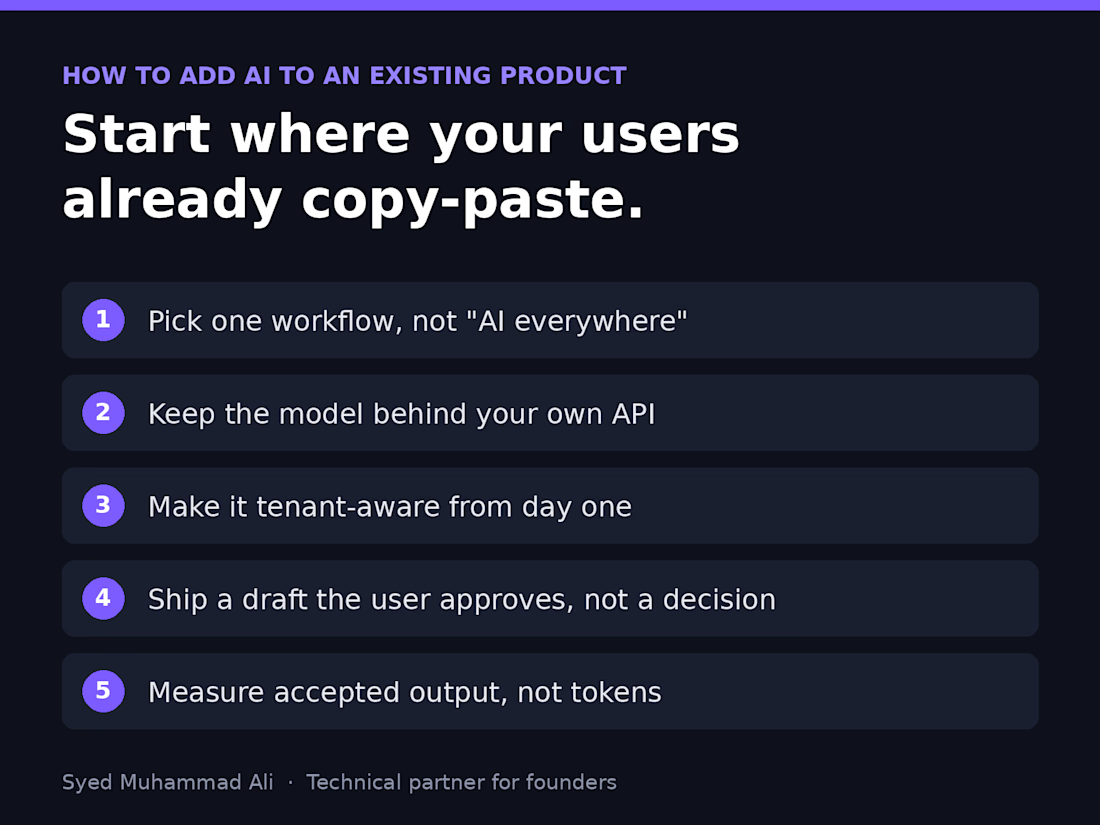
Before you add AI to your product, find the screen where your users already copy and paste.
That's usually where the real AI feature lives. Not a chatbot in the corner, but a step people already do by hand: summarising a ticket, drafting a reply, tagging an upload, pulling fields out of a PDF.
Here's the order I follow when a founder asks me to add AI to an existing SaaS:
1. Pick one workflow, not "AI everywhere." Watch where users leave your app to paste something into ChatGPT and come back. That round trip is your feature.
2. Keep the model behind your own API. One service owns prompts, retries, logging and cost limits, so you can switch providers without touching the frontend.
3. Make it tenant-aware from day one. Each customer's data, prompts and usage stay scoped to their account, or the first enterprise security review will stop you.
4. Ship a draft, not a decision. Let the AI suggest and the user approve. You earn trust and get real feedback before you automate anything.
5. Measure accepted output, not tokens. If users rewrite most of what it produces, the prompt or the context is wrong, and that's your real roadmap.
Most AI features that flop didn't fail because of the model. They were bolted onto the wrong step.
What's the one task your users still copy into ChatGPT?

Watching where users paste into ChatGPT and come back is such a practical way to find the real feature. Most teams start with the chatbot instead.

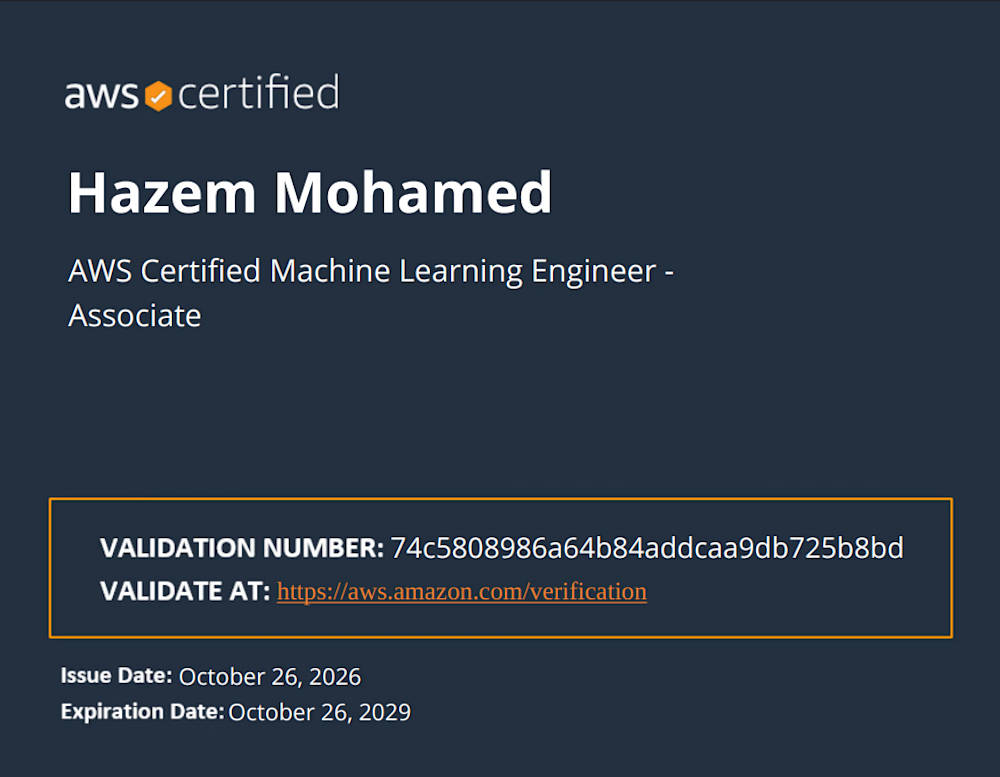
Proud to officially add the AWS Certified Machine Learning Engineer - Associate certification to my toolkit!
Building robust machine learning pipelines and scaling AI workloads securely on the cloud has always been a key focus of mine. Earning this certification has been a great deep-dive into mastering AWS ML infrastructure, MLOps best practices, and production-grade architectures.
Ready to bring these advanced capabilities to upcoming data science and engineering projects! Let's build something impactful. 💡💪
🔗 Verify Certificate:
Validation Number: 74c5808986a64b84addcaa9db725b8bd
Verification Link: https://aws.amazon.com/verification
#AWS #MachineLearning #AI #CloudComputing #DataAnalysis #MLOps


Congratulations on earning the AWS Machine Learning Engineer certification, Hazem khaled! Robust pipelines and cloud automation make all the difference for production-grade AI systems.

Vibe coding looks easy… until your app breaks. 😅
“Just tell AI what you want and it will build it.”
Sounds great.
Until you spend credits asking it to fix the same bug 10 different ways.
Then another feature breaks.
You fix that one.
Something else stops working.
Then you're staring at the same error for hours thinking:
“Why is this still happening?”
That's the part people don't show you about vibe coding.
AI can write code incredibly fast, but fast code doesn't automatically mean good code.
You still need to understand:
→ How the application is structured
→ Where the bug is actually coming from
→ How different features affect each other
→ When an AI-generated solution is making things worse
→ How to debug instead of blindly regenerating code
And sometimes the biggest time killer isn't building a feature.
It's getting stuck on one tiny bug that refuses to die.
That's why I don't see vibe coding as:
“Tell AI what to build.”
I see it as:
Human problem-solving + AI development.
The AI can help you move faster.
But you still need someone who knows where to go when things stop working.
That's where the real skill comes in.
What has been your biggest headache with vibe coding? 👇
— Optimum Studio


the same bug fixed 10 different ways is painfully accurate lol