The network for creativity
Join 1.25M professional creatives like you
Connect with clients, get discovered, and run your business 100% commission-free
Creatives on Contra have earned over $150M and we are just getting started
Back to feedPost

Migrating
a Legacy Community Platform Without Losing Its History
A
DLE-to-WordPress migration involving 17,000+ users, years of community data, a
large people database, a full responsive redesign, and a surprising amount of
Korean name research.
This was supposed to be a website migration
My first serious technical project started
with a fairly ordinary goal: move a long-running media and community website
from DataLife Engine to WordPress. I had never done a migration of this scale
before, and I was not coming into it as a traditional programmer. What looked
like a CMS replacement quickly turned into a much broader systems and data
project, because the site already had years of accumulated user history that
could not simply be discarded.
The platform had more than 17,000
registered users, comments, favourites and multiple viewing-status lists, along
with roughly 700 content records and nearly 4,000 actor and director records.
The real requirement was therefore not 'build a new WordPress site.' It was to
replace the underlying platform while making the result still feel like the
same community to the people who had been using it for years.
Migration meant preserving behavior, not just copying rows
Moving the obvious content was only the
beginning. User accounts had to remain usable, comments had to stay attached to
the right material, favourites and viewing states had to survive, and old
relationships between content and people had to be reconstructed in a different
data model. A technically successful import would still have been a failed
migration if users logged in and discovered that the history they had built on
the site was gone or attached to the wrong records.
That forced me to think about the migration
as a mapping between two systems rather than a database dump. I had to
understand what each old field actually meant in the product, decide where that
meaning belonged in WordPress, test edge cases, compare source and destination
data, and repeatedly correct transformations when something that looked valid
structurally was wrong in practice. AI helped write much of the implementation
and repetitive migration logic, but the rules, validation and decisions had to
come from the actual behavior of the old site.
The redesign could not erase the old identity
At the same time, I did not want to rebuild
the old interface pixel for pixel. The previous site had grown over many years
and used separate assumptions for different devices. I redesigned it as one
responsive interface, kept the recognizable identity of the original project,
added a dark theme and rebuilt a number of site-specific modules and
administrative tools around the new WordPress structure.
The difficult part of a legacy redesign is
that familiarity has value. A cleaner interface is not automatically better if
regular users suddenly cannot find the things they use every day. I therefore
treated the existing site as a source of product requirements rather than as
something to throw away. The visual system could change, but the important
workflows and the mental model behind them needed to remain understandable.
Performance became its own project
Once the migration was working, performance
became another substantial phase of the job. Early Google PageSpeed results
were roughly in the 60–70 range. After repeated profiling, cleanup and
optimization, the same pages were reaching the mid-to-high 90s in testing, with
some individual measurements reaching 100.
That improvement did not come from one
magic setting. It was the result of many small decisions across the rebuilt
site: removing unnecessary work, changing how assets and page elements were
handled, fixing problems introduced by plugins or custom functionality, and
repeatedly measuring the result instead of assuming that a change had helped.
The main migration took about a month; refinements, debugging, performance work
and follow-up improvements continued for roughly another month.
Then the database turned into a linguistics project
The most unexpected part of the migration
had almost nothing to do with WordPress. The people database contained nearly
4,000 actor and director records, many of them Korean and Japanese. Years of
additions had left duplicate entries, junk records, inconsistent spellings and
names transcribed according to different conventions. More than a thousand
obsolete, duplicate or otherwise incorrect entries were eventually cleaned out.
Automating that cleanup completely was
tempting, and also a bad idea. Names that look similar are not necessarily
duplicates, different transliterations can refer to the same person, and a
plausible Russian spelling can still be wrong when checked against the original
Korean. I ended up learning to read Hangul, studying the relevant Korean
phonology and the Kholodovich–Kontsevich transcription system, and manually
checking almost every questionable name against its original spelling and
external reference data. Japanese names required their own normalization rules
as well.
This became one of the clearest lessons
from the entire project: data quality is often a domain-knowledge problem
disguised as a technical one. A script can find candidates very quickly.
Someone still has to understand what the data is supposed to mean.
What AI actually changed
AI made a project like this accessible to
me far earlier than it otherwise would have been. It wrote migration scripts,
helped inspect old structures, generated WordPress code, accelerated debugging
and removed an enormous amount of repetitive implementation work. Without that
layer, I would not have been able to take on the project in the same form.
But it also made convincing mistakes. A
transformation could be technically clean and still map the wrong concept. A
generated fix could repair one page while quietly breaking another.
Name-normalization rules that looked consistent could fail on real Korean
names. The useful workflow was therefore not 'describe the desired website and
accept the output.' It was a continuous cycle of defining behavior, generating
an implementation, comparing it with the real system, identifying what was
wrong, and changing either the implementation or the underlying assumption.
Why this project mattered to me
By the end, the result was not simply a
WordPress replacement. The community data had been preserved, the content and
people databases had been migrated and cleaned, the interface had been rebuilt
responsively, performance had improved dramatically, and the new system had
custom tools for the workflows the site actually needed.
More importantly, this was the project that
changed my understanding of what I could build with AI-assisted development. I
started with basic HTML/CSS knowledge and a migration problem. A few weeks
later I was dealing with data models, legacy behavior, performance profiling,
custom product logic and Korean transcription rules in the same project. That
mixture still describes the kind of work I find most interesting: problems
where the implementation is only one part of the job, and understanding what the
system is actually supposed to preserve is the harder part.

The network for creativity
Join 1.25M professional creatives like you
Connect with clients, get discovered, and run your business 100% commission-free
Creatives on Contra have earned over $150M and we are just getting started





Related posts


The lime and purple pairing with the mono type works nicely for Remotlin.

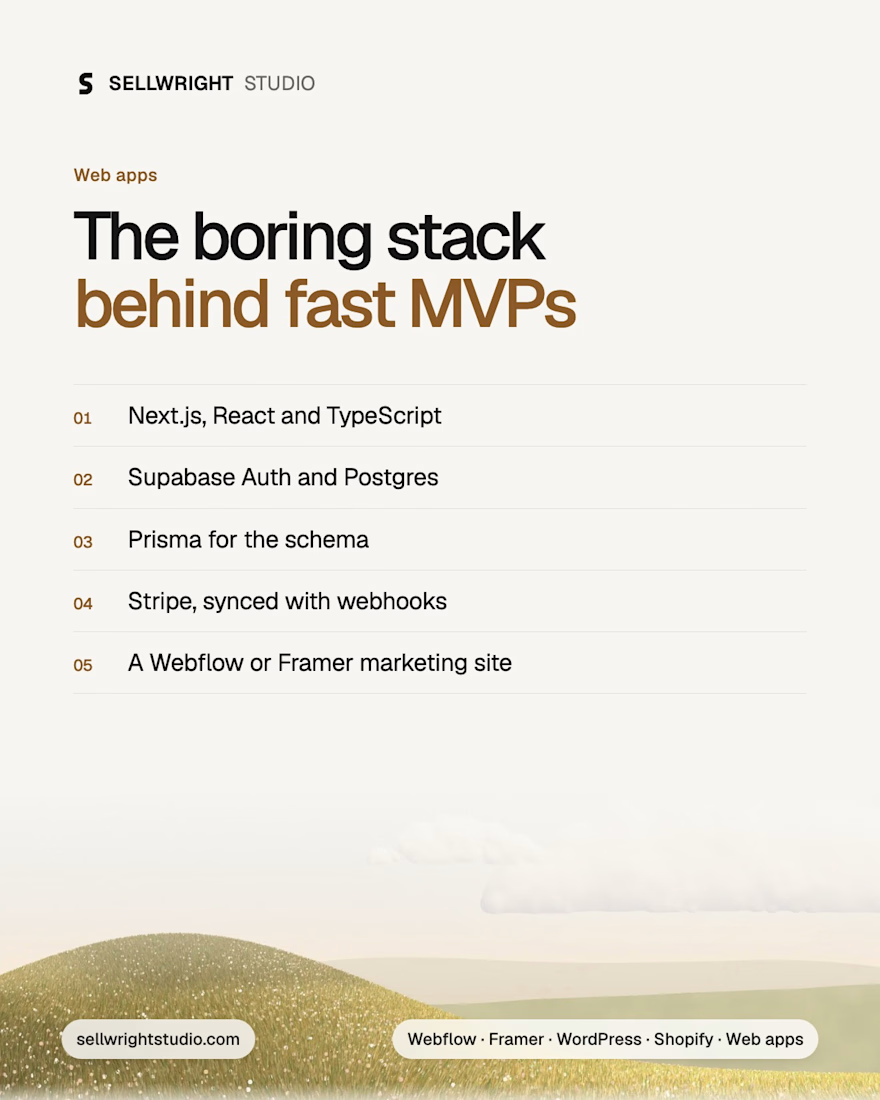
The fastest SaaS products we've built didn't use the newest stack. They used the most boring one.
What we reach for when a founder needs a working product:
• Next.js App Router, React, TypeScript and Tailwind
• Supabase Auth and Postgres, Prisma for the schema
• Stripe subscriptions kept in sync with webhooks
• Transactional email for the moments that matter
• A marketing site in Webflow or Framer the team can edit
What we skip at MVP stage: microservices, Kubernetes and anything the first 100 users won't notice.
Every novel choice is one you'll debug at 2 a.m. Save the novelty for the part customers pay for.
Founders: what did you over-build in your first version?

Really agree with keeping the stack simple early on. Curious, how do you decide when a SaaS product has outgrown its MVP architecture? Would love to exchange thoughts on this in DMs.

Another project from the archive: a website refresh for Ecorp Systems.
The team had already chosen a Webflow template and mapped out the site structure. My job was to adapt it to their content and build the website.
I worked through the layouts in Figma first, turned the template sections into reusable components, and added a few custom sections where needed.
The result: 16 pages built in Webflow, with how-to videos to help the team make basic content updates.
Here’s a quick look.

The how-to videos for the team are the part most people would skip, and they're probably the most valuable thing in the whole project. A 16 page Webflow build means nothing if nobody dares touch it afterward. Did the team actually start making their own updates, or did they still come back to you?