The network for creativity
Join 1.25M professional creatives like you
Connect with clients, get discovered, and run your business 100% commission-free
Creatives on Contra have earned over $150M and we are just getting started
Back to feedPost

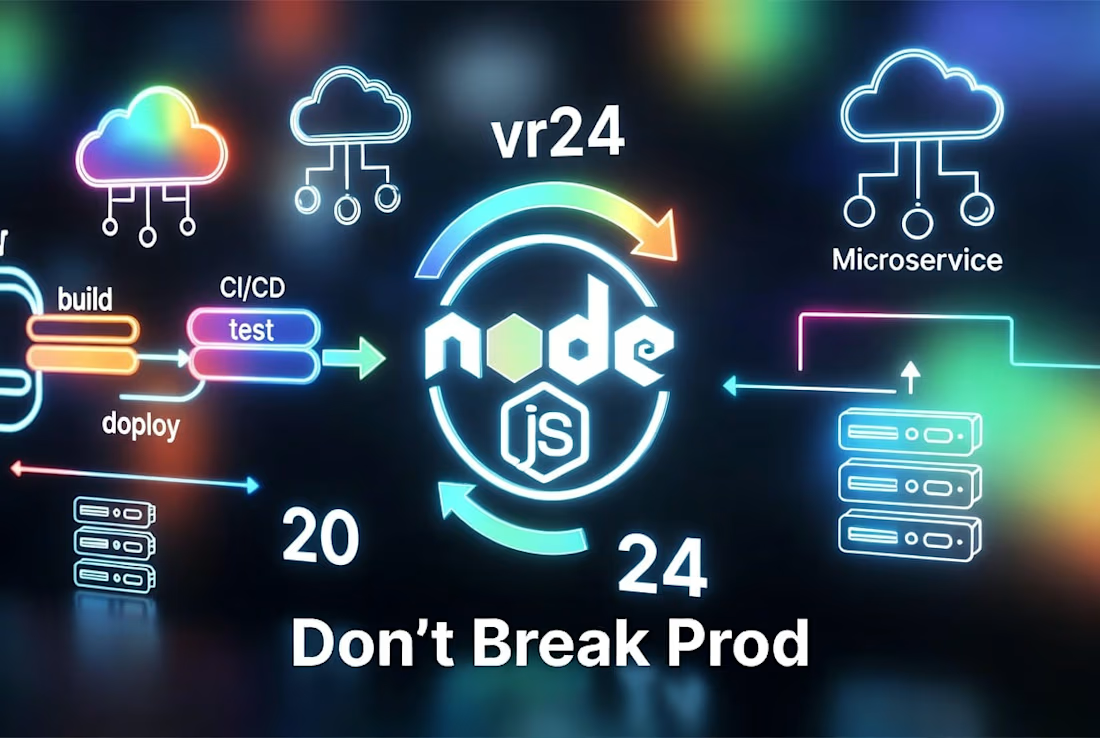
🚀 Upgrading Node.js in Production: A Real Case Study from a Microservices System 🚀
Node.js 20 is reaching its end of maintenance in April 2026.
If your system is still running on it, this is not just a “nice-to-have upgrade” anymore — it’s something you must plan carefully to avoid unexpected risks.
Recently, I was responsible for leading a Node.js upgrade across a large-scale production system — and I want to share how I approached it.
🚧 The Context
The project belongs to a large insurance group in Europe.
We’re running hundreds of microservices, and nearly 20 frontend applications are built with Node.js 20.
The good part?
We already have a solid CI/CD pipeline — fully automated from build → test → deploy.
The challenge?
Even with strong automation, upgrading runtime across distributed systems is never trivial.
🧠 Step 1 — Choosing the Right Target Version
One common mistake I’ve seen:
“Just upgrade to the latest version.”
That’s risky.
At the time:
Node 26 → not GA yet ❌
Node 25 → very short support window ❌
Node 24 → stable and long-term support ✅
So we aligned on Node 24 as the target.
Then comes the next critical question:
Which services are impacted?
Which teams need to be involved?
👉 This step is more about communication and alignment than technical work.
⚙️ Step 2 — Controlled Rollout via CI/CD
Instead of upgrading everything at once, I focused on controlled exposure.
Tested locally using nvm to validate compatibility
Updated CI/CD pipelines to:
Run Node 24 only for specific apps
Apply changes per environment (dev/staging first)
This approach helped:
Reduce cross-environment impact
Isolate issues early
Keep the system stable during transition
🤝 Step 3 — Communication is Everything
At higher environments, technical work becomes teamwork.
Before rollout:
Announced upgrade timeline clearly
Defined who owns testing for each service
Prepared support channels for quick issue handling
During rollout:
Worked closely with service owners
Fixed issues collaboratively in real-time
👉 In large systems, success = coordination, not just code
🚀 Step 4 — Production Deployment (with Safety First)
Even if everything looks perfect in staging…
Production is always different.
So before deploying:
Prepared a rollback strategy
Ensured we could quickly revert to Node 20 if needed
Because at the end of the day:
💯 Stability in production matters more than a successful upgrade.
This wasn’t just a version upgrade.
It was a reminder that in DevOps, how you deploy matters as much as what you deploy.
If you’re dealing with similar upgrades or scaling DevOps systems, I’d love to connect and exchange ideas.


The network for creativity
Join 1.25M professional creatives like you
Connect with clients, get discovered, and run your business 100% commission-free
Creatives on Contra have earned over $150M and we are just getting started
Related posts

Built an AI Security Scanner for GitHub Orgs in 2 Weeks
Engineered an end-to-end AI platform that scans entire GitHub organizations for vulnerabilities and auto-generates fix PRs.
What it does:
Crawls 100+ repos via GitHub GraphQL API in batch mode
Runs GPT-4 over real source code to detect SQL injection, XSS, hardcoded secrets, CSRF, auth bypasses
Scores by severity, generates secure code fixes, creates PRs automatically
Real-time WebSocket dashboard shows live progress
Tech: Next.js 15 · Node.js · Supabase · BullMQ · Redis · OpenAI · CrewAI
Open source, MIT licensed: github.com/aymandakir/org-code-ai
Shipped in under 2 weeks. Full stack, production-ready.

Great work! And it's open source too. 😄

About My Work
I specialize in engineering high-integrity smart contracts where security and automation are non-negotiable. My recent focus has been on mastering the Chainlink ecosystem to build decentralized systems that are truly autonomous.
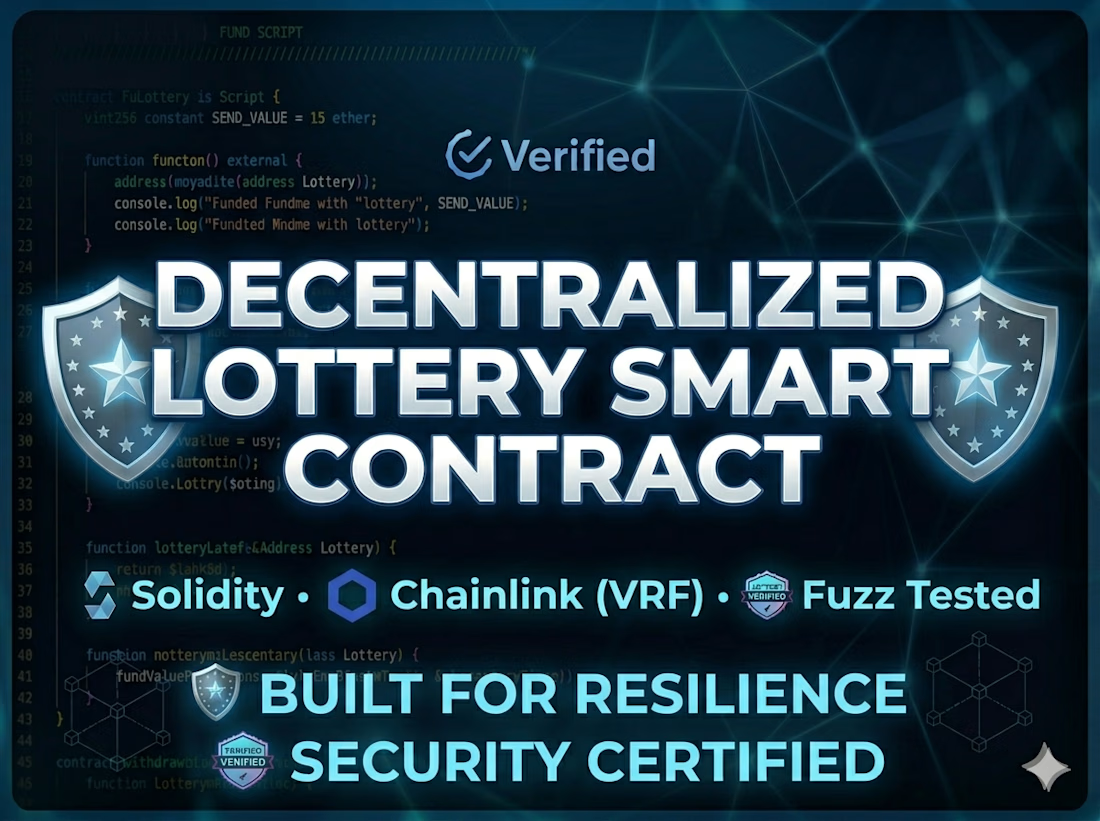
A prime example of my approach is my Decentralized Raffle Protocol. Rather than just writing a basic lottery, I architected a fully hands-off system using Solidity and Foundry. I integrated Chainlink VRF v2.5 to ensure winner selection is provably fair and tamper-proof, and utilized Chainlink Automation to handle the execution logic. This means the contract operates entirely on its own—opening, selecting winners, and distributing rewards based on a precise on-chain heartbeat without any manual intervention.
My development philosophy is rooted in rigorous verification. I don’t just write code; I "break" it first using Foundry’s advanced testing tools. From simulating complex time-based transitions with vm.warp to mocking VRF callbacks for local development, I ensure every state transition—from OPEN to CALCULATING—is bulletproof.
By combining the Checks-Effects-Interactions pattern with custom error handling, I deliver protocols that aren't just secure against common attack vectors like reentrancy, but are also optimized for gas efficiency. I build for the long term, ensuring every contract I deploy is resilient, verifiable, and ready for production.



For a long time, websites were treated as the final product.
Today, they are becoming the operational layer behind businesses.
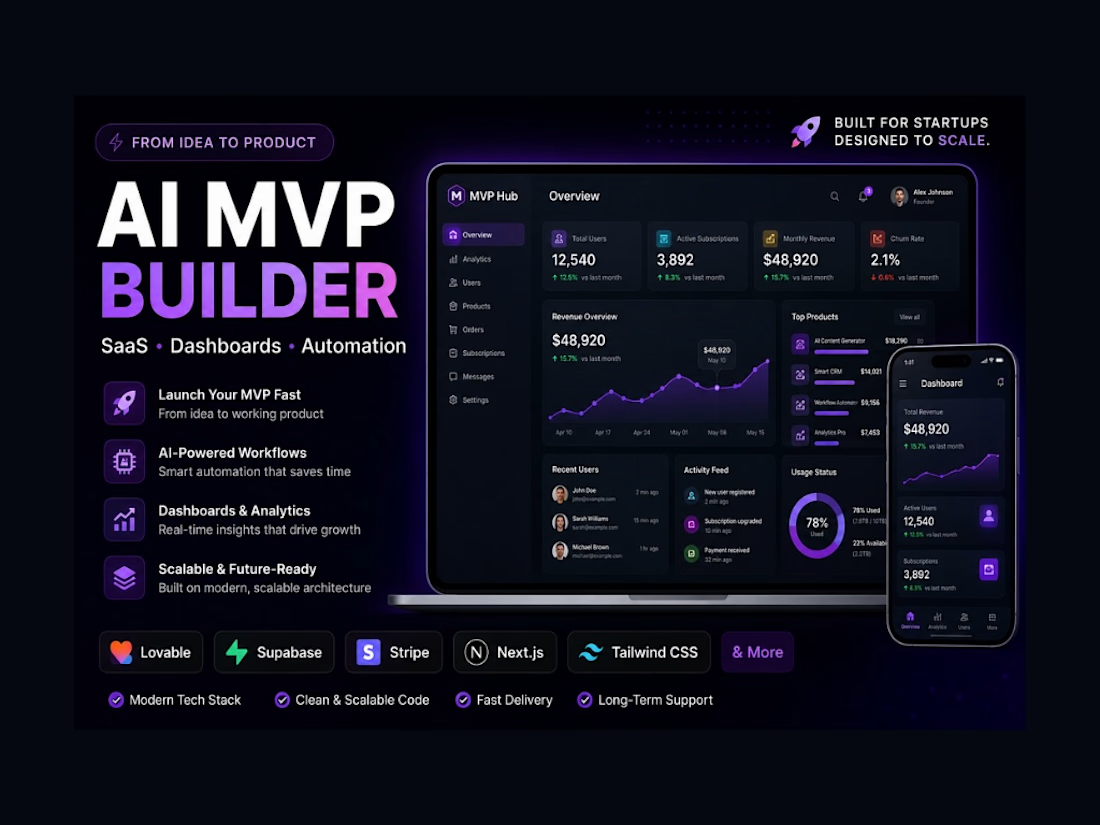
The most interesting projects I’ve been involved in recently are no longer “just websites.”
They are:
• AI-powered MVPs
• SaaS-style platforms
• dashboards & operational systems
• automation workflows
• CRM ecosystems
• scalable digital products
What’s changing fast right now is the relationship between strategy and execution.
The gap between:
idea → prototype → working product
…has become dramatically smaller.
AI-assisted workflows, modern development systems, and faster product iteration are allowing founders and businesses to move at a speed that simply wasn’t realistic a few years ago.
My own work has naturally evolved in that direction over time — combining:
digital transformation, operations, AI workflows, web infrastructure, UX systems, and growth-focused execution into scalable business platforms.
A big part of my current focus is helping businesses structure:
✔ MVPs
✔ internal systems
✔ automation workflows
✔ operational platforms
✔ scalable product ecosystems
…without overengineering the first version.
Still one of the most exciting spaces to be building in right now.












Trending

Claude
Claude has entered the design space. How are you using Claude Design?

Contra University
Learn from expert creatives how to earn more using next-gen AI tools.
creativeaiflow
Creative AI workflows are evolving. What tools do you use, and what are their strengths and weaknesses?
portfolioreview
The best portfolios tell a story, not just show a grid. Share yours for feedback.
freelancerlife
Freelancer life is wins, pivots, and everything in between. What’s yours right now?