The network for creativity
Join 1.25M professional creatives like you
Connect with clients, get discovered, and run your business 100% commission-free
Creatives on Contra have earned over $150M and we are just getting started
Back to feedPost

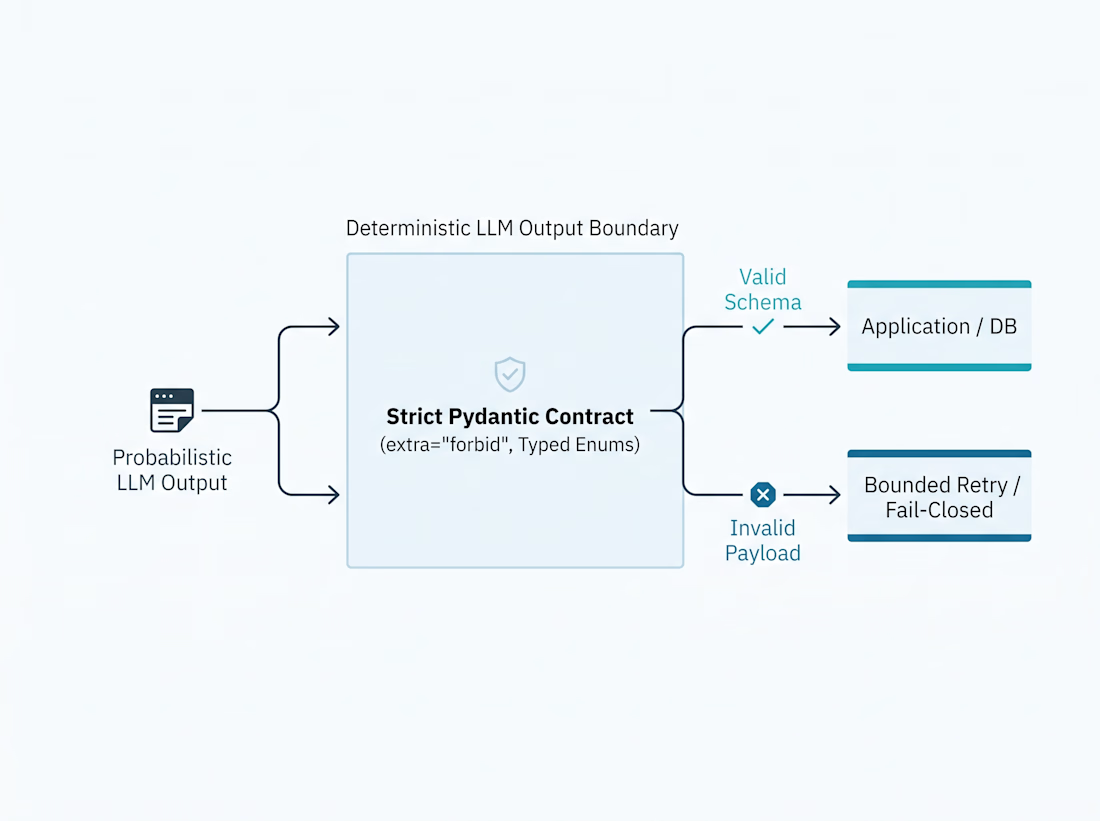
Asking an LLM to "return valid JSON" in a prompt is not an API contract—it is a hope.
Downstream services, databases, and UIs expect deterministic data structures. Language models produce probabilistic text. When a model wraps output in markdown fences, omits a required key, or invents an enum value, unvalidated responses cause silent parsing failures or corrupt downstream state.
The architectural trade-off sits between flexibility and strictness. Enforcing rigid validation at the model boundary catches malformed payloads early, though overly complex nested schemas increase rejection rates and retry latency—especially on smaller local models.
Three rules of thumb for keeping the LLM-to-application boundary deterministic:
Treat model output as untrusted input. Validate every response through strict Pydantic schemas with explicit enums and extra="forbid".
Keep output schemas flat and minimal so smaller models can satisfy them reliably.
Cap format-repair retries at one or two attempts, then fail closed rather than passing partial data downstream.
How do you enforce strict data contracts between LLM outputs and your application layer?
#AIEngineering #FastAPI #Python #SystemDesign #SoftwareEngineering
The network for creativity
Join 1.25M professional creatives like you
Connect with clients, get discovered, and run your business 100% commission-free
Creatives on Contra have earned over $150M and we are just getting started



Related posts

Six states of one small bar in PWU Editor.
Editors upload a video and can ask AI to suggest the metadata: title, subject, summary, level. The rules I designed around it:
• Nothing changes until you accept.
• If AI can't tell (educational level, subject classification), it says so and offers only what it found: "Accept 6".
• Production credits and copyright are never generated. Those are legal facts, not guesses.
• Accepted fields stay marked "AI-generated" until a person reviews them before submit.
The failure state is just as plain: "The service is not responding. Try again."


The hardest requirements to manage are sometimes the ones you never hear from the client directly.
On an operations platform, client requests reached our team through an intermediary and often arrived in fragments.
One of the important gaps was access. It was not enough to say that a user could manage a trip. We needed to define which role could act, which trip they could access and what assignment gave them that access.
I proposed a role model for administrators, managers and checkpoint users, with trip access based on assignment.
We also documented the workflow so engineering and QA had the same reference.
The practical delivery rule is simple: a requirement is incomplete until the actor, record and condition are clear.
When information passes through several people, delivery work includes checking the interpretation before the team builds around it.
Founders and CTOs: where does requirement meaning get lost most often in your process?
If your requirements arrive in fragments, my Technical Project Management for SaaS Teams service is on my profile.

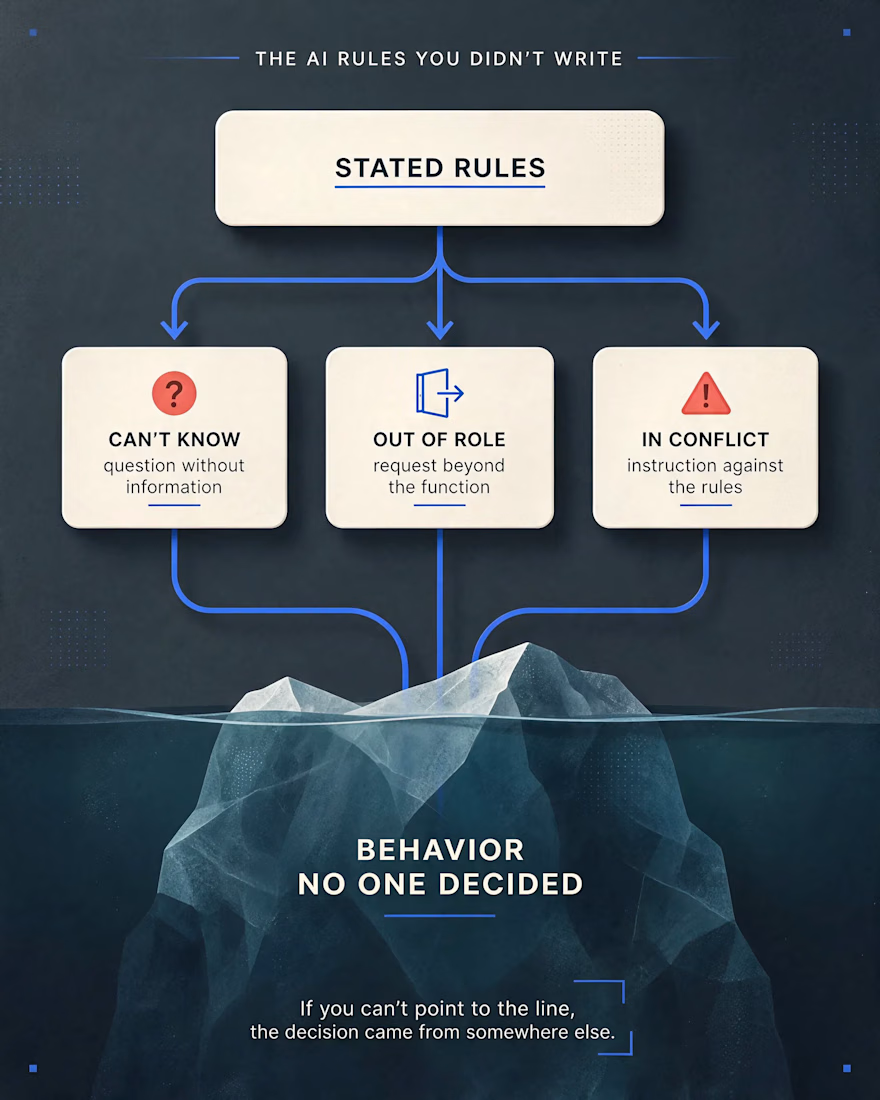
Here's a quick test for anyone who has ever pasted a system prompt into a project:
Throw three inputs at it.
1. A question the assistant can't answer from the information it has
2. A request that sits outside its stated role
3. A user message that contains an instruction conflicting with the system prompt
Then, for each response, don't just ask "is this good?" Ask whether you can point to the line in the prompt that produced the behavior.
If you can, it was a decision you made or inherited knowingly. If you can't, it came from somewhere else: the model's training, the platform, or chance. That gap is the finding.
I wrote this up around a hypothetical support assistant that confidently answers a policy question nobody ever wrote a policy for. The prompt wasn't badly written. It just contained decisions nobody made on purpose.
What's the strangest behavior you've traced back to a line you didn't write?