The network for creativity
Join 1.25M professional creatives like you
Connect with clients, get discovered, and run your business 100% commission-free
Creatives on Contra have earned over $150M and we are just getting started
Back to feedPost

Most AI startups don't have an AI problem. They have a systems engineering problem. And I suspect this distinction will become increasingly expensive to ignore.
We've reached an interesting point in the evolution of software. The intelligence available to developers is advancing faster than our ability to engineer reliable systems around it.
A sufficiently capable language model can reason through complex instructions, generate software, interpret documents, interact with tools and coordinate workflows.
Yet somehow, connecting that same model to an actual business process can produce a system that is fragile, unpredictable and extraordinarily difficult to maintain.
Why?
Because model capability and system reliability are fundamentally different engineering problems. A model can be remarkably intelligent while the system surrounding it remains architecturally incompetent.
Consider an AI agent that successfully processes 95% of customer requests. Impressive? Perhaps. Now consider what happens to the remaining 5%.
Does it recognise uncertainty? Does it escalate appropriately? Can it recover from partial execution? Does it maintain transactional integrity? Can its decisions be reconstructed? What prevents it from exceeding its authority?
And perhaps most importantly: Can you demonstrate that these properties hold beyond the handful of examples used in your product demonstration?
This is where the conversation becomes considerably more interesting. The problem is no longer simply whether a model possesses the capability to perform a task.
It is whether we can construct an environment in which that capability can be exercised predictably, economically and within explicitly defined boundaries.
This requires more than prompt engineering. It requires understanding distributed systems, state management, observability, evaluation, security boundaries, failure recovery and the economics of computation.
It requires thinking about AI systems as systems. Not as particularly impressive API calls. There's also a deeper architectural misunderstanding emerging across the industry.
Probabilistic intelligence does not eliminate the need for deterministic guarantees. It makes those guarantees more important. When software follows explicitly defined instructions, we can reason about its behaviour through established engineering methods.
When software delegates decisions to probabilistic components, the space of possible behaviours becomes substantially more difficult to characterise. That doesn't mean we should attempt to make intelligence deterministic. It means we need to engineer the surrounding infrastructure so that uncertainty does not become uncontrolled authority.
The distinction is subtle, but consequential. An agent deciding what action to propose is one problem. A system determining whether that agent is authorised to execute the action is another.
An agent generating an answer is one problem.A system establishing whether that answer is sufficiently supported to influence a consequential decision is another.
An agent completing a workflow is one problem. A system guaranteeing that a failed workflow doesn't leave the organisation in an inconsistent state is another.
These are not peripheral implementation details. They are the product. And this leads to a somewhat uncomfortable observation.
As foundational models become increasingly capable and accessible, raw intelligence becomes a less defensible source of differentiation for companies building on top of them.
The enduring advantage may instead come from everything surrounding that intelligence: The quality of the architecture. The precision of the evaluation system. The reliability of execution. The integration with real organisational processes. The ability to understand failures, recover from them and improve the system over time.
In other words, the competitive advantage shifts from merely accessing intelligence to engineering its application. I think we're entering a period where the ability to generate software will become increasingly commoditised, while the ability to reason rigorously about software systems becomes disproportionately valuable.
The companies that understand this distinction will have a meaningful advantage. Because the real question facing AI development is no longer just:
What can we make the model do? It's:
What can we prove the entire system will do, under which conditions, with what authority, at what cost, and what happens when it fails?
A successful demonstration establishes possibility.
Engineering establishes the conditions under which that possibility becomes dependable. And I suspect the next generation of serious AI companies will be defined by how well they understand the difference.
The network for creativity
Join 1.25M professional creatives like you
Connect with clients, get discovered, and run your business 100% commission-free
Creatives on Contra have earned over $150M and we are just getting started





Related posts

I designed and built this hero as a concept for Nation, an AI store builder for first-time sellers. You write one sentence, and Nation builds the store, runs the ads and ships the orders while you approve each step
The brief asked for “a nation, not a SaaS.” A nation is somewhere you travel to, so the hero is a boarding pass for one trip: JOB → OWN, from your 9-to-5 to your own store. The ticket’s only highlight is “First sale,” which promises money without promising a number
Before the ticket I tried a flag, a passport, a main street of shops and a shipping box. The box didn’t make it, but its airmail stripes ended up on the stub
On the live page the two torn halves of the ticket snap together, the page builds around it, and hovering flips it to the back. Below that, one real seller’s story explains the product with the interface set into the sentence
Live site: nation-site-xi.vercel.app
Concept work, not affiliated with Nation


The boarding pass idea for "JOB to OWN" is clever. Love that the ticket tears apart as the page builds.

I help founders and small businesses stop losing time and leads to manual work.
What I build:
→ AI automation: AI that reads every new lead, scores it, and routes the hot ones to your team in seconds (n8n, OpenAI, Claude)
→ GoHighLevel systems: pipelines, SMS and email follow-up, and stage gates, like the one I built for an insurance team so deals can't move without the sold value, policy details and documents
→ Bubble.io apps: MVPs, SaaS products, marketplaces and internal tools, with Stripe payments, APIs and AI features built in
→ Workflow pipelines: booking to payment to confirmation with no one touching it, like the n8n and Stripe flow I built for a cross-docking warehouse
The video shows it all in under a minute.
Not sure where to start? Book a free 30-minute automation audit: cal.com/jubril-toheeb-rgh9vp/30min


Impressive work! 👏 Great use of AI and workflow automation to save time, streamline operations, and help businesses convert more leads.

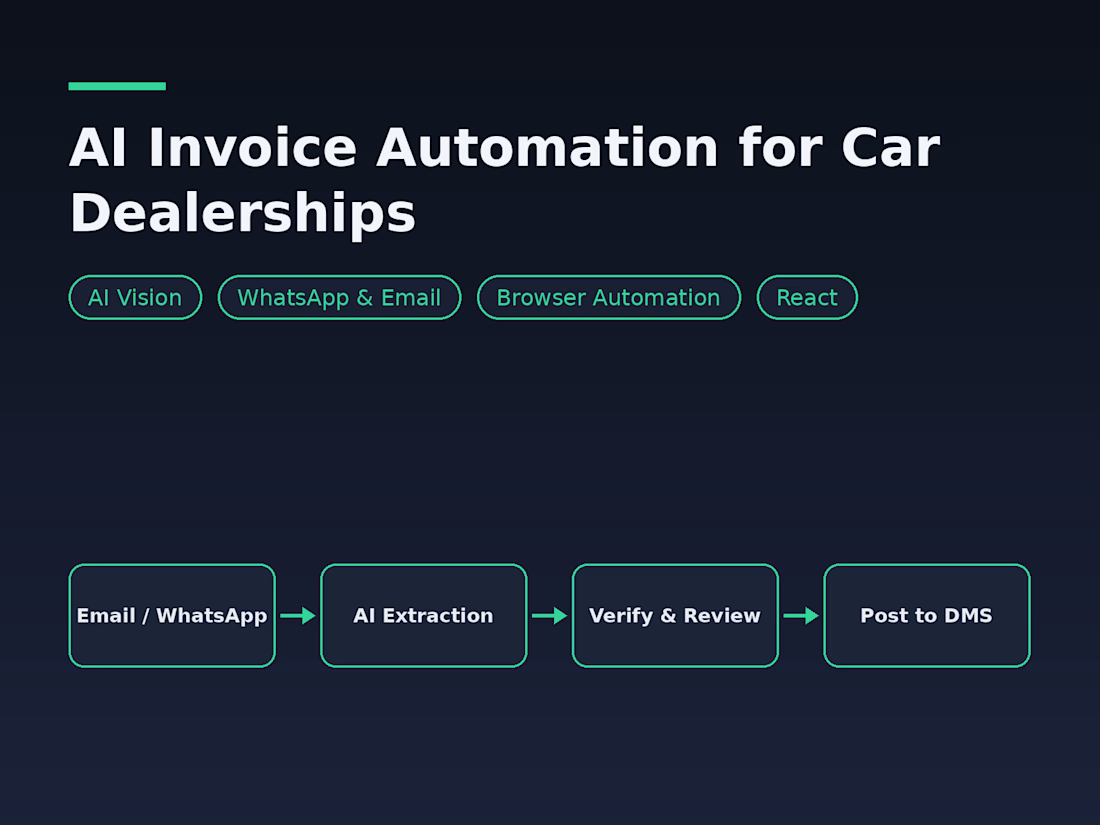
Built an AI system that reads supplier invoices and posts them straight into a dealer management system. No one retypes anything anymore.
The problem: a group of car dealerships was getting hundreds of supplier invoices by email and WhatsApp photos, and staff were keying every line into their DMS by hand.
What I built:
• Email and WhatsApp intake, auto-matched to the right dealership
• AI and vision extraction of vendor, tax details, and line items grouped by vehicle
• Verification and duplicate detection before anything gets posted
• A review dashboard for the few cases that need a human
• Browser automation that posts approved invoices into the DMS
• WhatsApp auto-replies that chase suppliers for missing details
Result: 280+ invoices processed so far, with zero exceptions.
Stack: Python, LLM and vision models, React, Selenium
If your team is still copying data from documents into another system, that's usually very automatable. Happy to take a look at yours.
#AI #Automation #AIAgents

The WhatsApp auto-replies that chase suppliers for missing details are the piece I like most, since that closes the loop instead of just flagging a gap. How do you decide when a missing field gets an automatic chase versus going to the review dashboard for a person?