The network for creativity
Join 1.25M professional creatives like you
Connect with clients, get discovered, and run your business 100% commission-free
Creatives on Contra have earned over $150M and we are just getting started
Back to feedPost

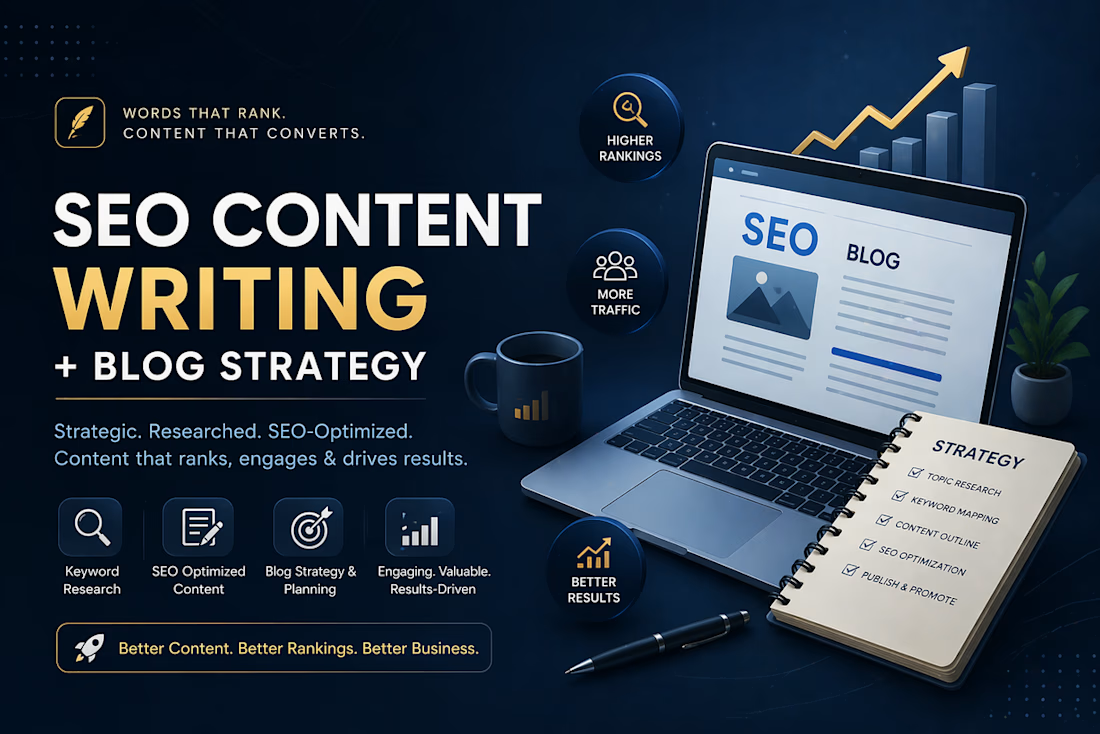
I am ready to help people discover you on search engines like Google with approximately 90% market share, Microsoft Bing, Yahoo, Yandex, and Baidu
There are only ten things I need to do. Want to know? Let's talk


The network for creativity
Join 1.25M professional creatives like you
Connect with clients, get discovered, and run your business 100% commission-free
Creatives on Contra have earned over $150M and we are just getting started





Related posts

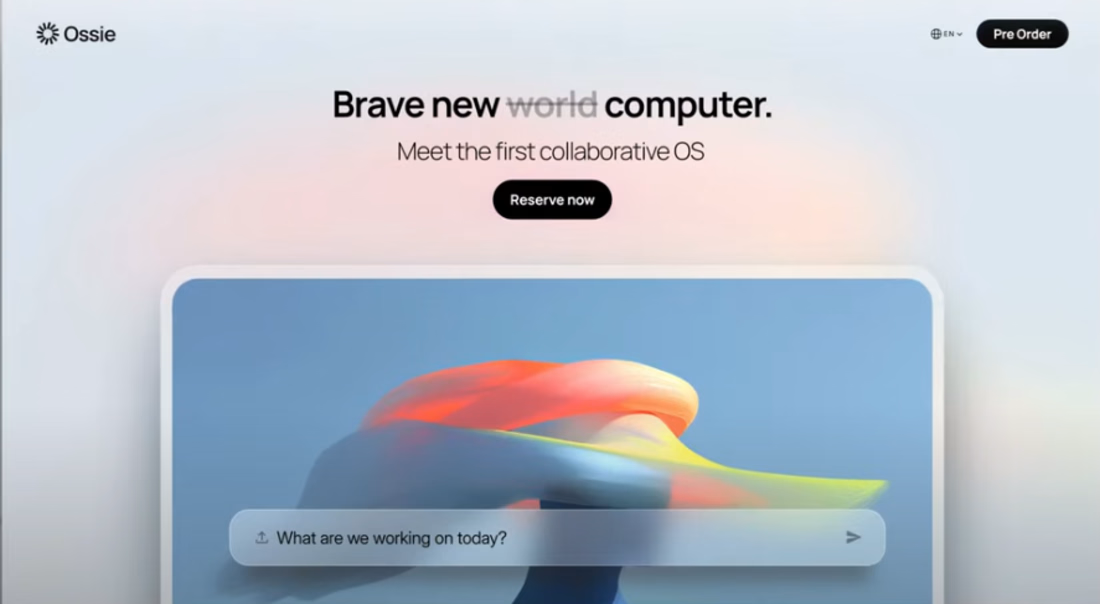
What if your operating system didn’t just run your apps, but actually worked with you?
Meet Ossie.
An AI-native OS concept designed from the ground up.
I explored what computing could feel like when AI isn't another app you open, but part of the system itself.
Designed in Figma. Built in Framer.
Would you use a computer like this? 👀


The hero deserve praise only

In 90 days, AI stopped being a tool I use and became a teammate I manage.
Here's what actually changed, from where I sit as a software engineer:
→ Agents went mainstream. JetBrains found 90% of professional developers use coding agents weekly and 68% daily. Claude Code usage doubled since January (18% → 39%). Codex went 3% → 16%.
→ Models learned to drive computers. GPT-6 Astra (Sep 3) was pitched on computer use and software engineering, and shipped with gated access over its cyber capabilities.
→ Output limits blew open. Gemini 4 Argon (Sep 30) can write up to 1M tokens in one response, up from 64K. Also gated at launch.
→ Agents did real, checkable work. Dozens of Claude agents formalized Fermat's Last Theorem in Lean in 11 days: 13M lines, machine-verified. (Formalization, not a new proof. The verification is the point.)
→ The plumbing grew up. MCP's July spec went stateless, so agent tooling now deploys like ordinary web infrastructure.
→ Open weights kept pace. Alibaba released Qwen3.8-Max as a 2.4T-parameter open-weights model.
My take: code generation is getting cheap. Judgment isn't.
Anthropic's agentic coding report says engineers use AI in roughly 60% of their work but can fully delegate only 0–20% of tasks. The bottleneck has moved to architecture, review, testing, security, and keeping things alive in production.
That's where I spend my time: shipping AI features (agents, RAG, LLM integrations) into real products, with the guardrails that make them survive contact with users.
What's one task you'd hand to an agent tomorrow, and one you never would?
#AI #SoftwareEngineering #AIAgents #LLM #FullStack


managing agents instead of just using them is exactly the shift I've felt too ngl

Now you can launch everything with creative idea and design. let me know what do you think about it??