The network for creativity
Join 1.25M professional creatives like you
Connect with clients, get discovered, and run your business 100% commission-free
Creatives on Contra have earned over $150M and we are just getting started
Back to feedPost

Sample 3: How-To Piece (Practical/Instructional)
Title: How to Build a Household System That Survives a Bad Week
Most organizational systems are designed for your best days — when you're rested, motivated, and have an hour to spare. They fall apart the moment life gets hard, which is exactly when you need them most. Here's how to build one that holds up anyway.
Design for your worst day, not your best one. Ask: "Will this still work if I only have 10 minutes and I'm exhausted?" If the answer is no, simplify it until it is.
Reduce decisions, not just tasks. A schedule that tells you what to do removes more mental load than a checklist you have to interpret. "Monday: kitchen" beats "wash dishes, wipe counters, sweep, take out trash" — same result, fewer decisions.
Make the system visible, not memorized. If a system only lives in your head, it dies the moment you're too tired to think. Post it. Write it down. Put it somewhere you'll see it without having to remember to look.
Build in a "good enough" version. Every task should have a stripped-down version for hard days — the 20% that matters most. A quick wipe-down still counts. Partial progress still counts.
Review and adjust monthly, not daily. Don't try to perfect the system in real time. Let it run, notice what keeps breaking, and adjust once a month. Systems that get redesigned every day never get the chance to actually work.
A system built for your best day will always fail you on your worst one. Build for the worst day, and the good days take care of themselves.


The network for creativity
Join 1.25M professional creatives like you
Connect with clients, get discovered, and run your business 100% commission-free
Creatives on Contra have earned over $150M and we are just getting started


Related posts


The movement flow so naturally, it feels effortless to watch.

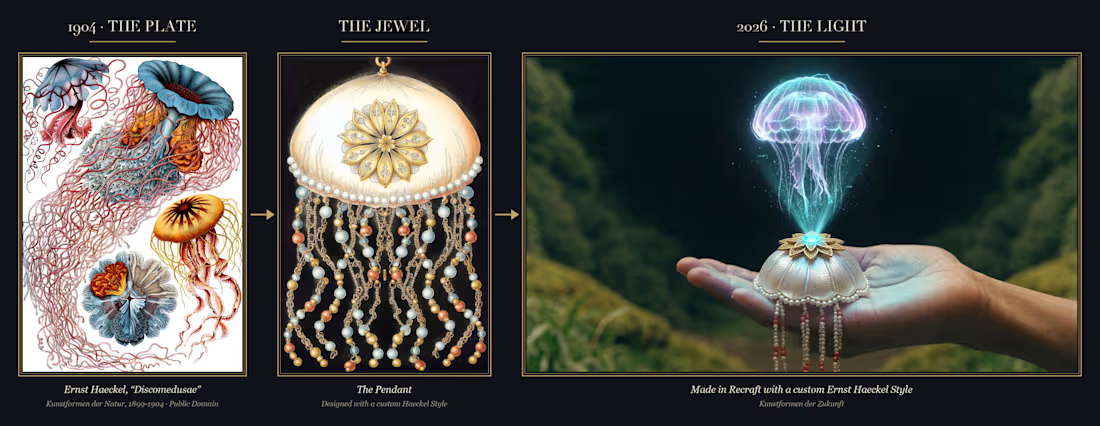
I've always been a little obsessed with jellyfish. They look like they were designed, not born. 🪼
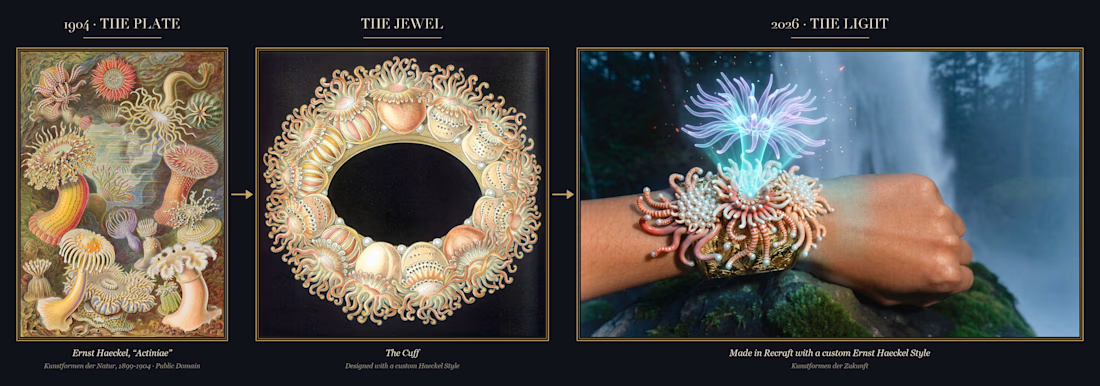
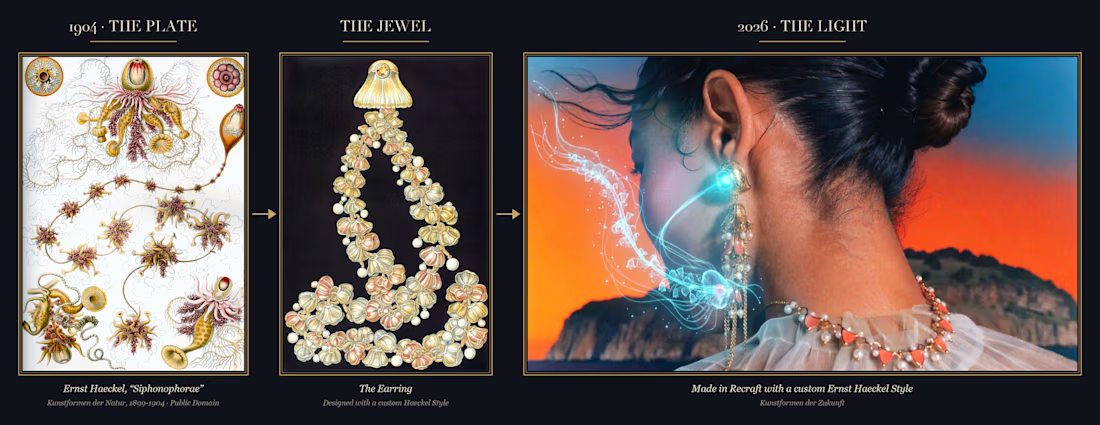
Turns out someone agreed with me in 1904. The biologist Ernst Haeckel spent years drawing sea creatures under a
microscope for Kunstformen der Natur (Art Forms in Nature), and every plate looks like a page from a jeweler's
sketchbook.
So I trained a custom Recraft Style on ten of his plates and designed a 2026 high-jewelry collection: a pendant, a ring,
a brooch, a cuff, an earring, a necklace and a watch.
And each piece has a secret. It projects the creature it was born from, as a glowing hologram. ✨
From microscope, to jewel, to light.



The little green dot moving through the grid is so satisfying