The network for creativity
Join 1.25M professional creatives like you
Connect with clients, get discovered, and run your business 100% commission-free
Creatives on Contra have earned over $150M and we are just getting started
Back to feedPost
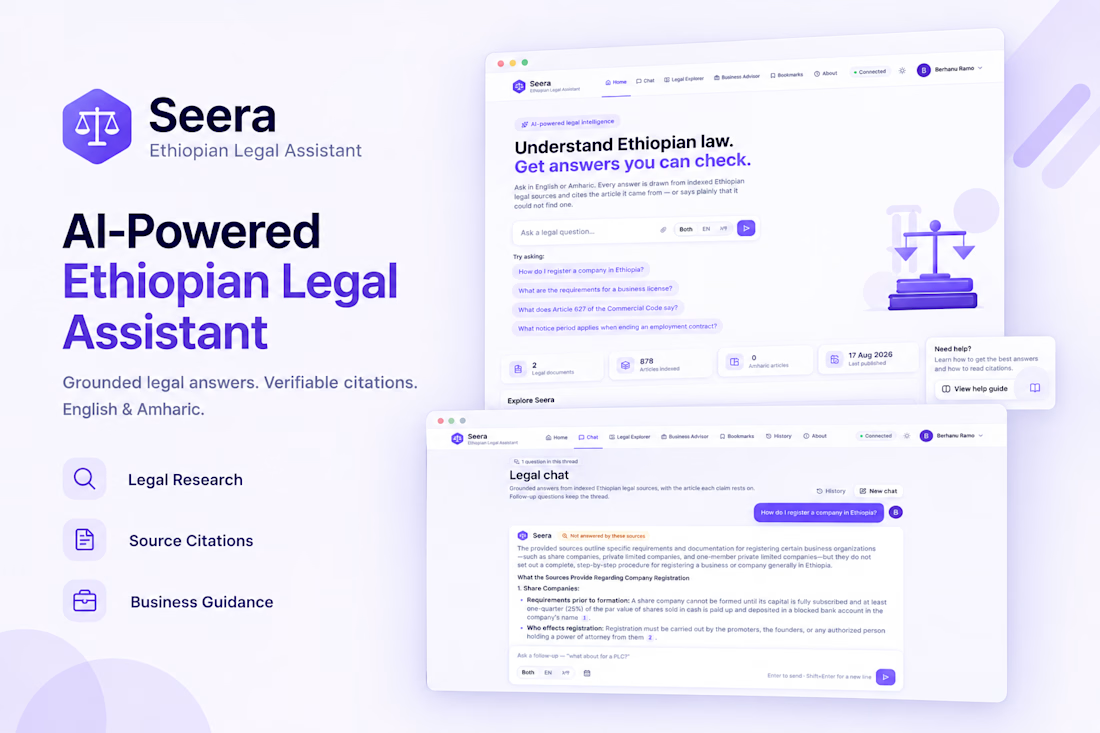
What if an AI assistant could tell you exactly which law supports its answer?
That's the idea behind Seera, an AI-powered legal research platform I'm building to make Ethiopian legal information easier to explore.
Instead of relying only on an LLM's general knowledge, I built a retrieval-based approach that searches indexed legal documents and grounds answers in relevant sources.
The stack includes:
Go for the backend and streaming responses
React + TypeScript for the frontend
PostgreSQL + pgvector for legal document retrieval
RAG to connect AI-generated answers with source material
One design principle matters to me: when the available sources don't support an answer, the system should make that clear rather than pretend to know.
Seera is still a work in progress, but building it has taught me a lot about combining backend engineering, AI, and a real-world problem.
Building useful things, one challenge at a time.
Feel free to check it here https://www.seera.site/

I'd test Seera with a question that retrieves a closely related law but asks for a conclusion the passage doesn't support. Does it still abstain when retrieval similarity is high?

Thanks for checking on it. Currently there only two law legal documents with 878 articles are cited and Seera only answers Grounded data.
The network for creativity
Join 1.25M professional creatives like you
Connect with clients, get discovered, and run your business 100% commission-free
Creatives on Contra have earned over $150M and we are just getting started






Related posts

Most AI automations fail at the inbox, not in the demo.
Problem: a founder I work with used to answer every lead by hand. Replies took hours, sometimes a day. By the time the answer arrived, the buyer had already picked a faster vendor.
Build: I shipped an agent that replies in minutes, not hours. Every reply cites its source, every action is logged, and nothing ships until it passes an eval set first.
Result: 3 AI agents now run in production for that client, with 1 paying subscriber live. The same eval-first pattern powers my other builds, including a PDF reader that returns 1 cited answer in seconds.
Offer: if replies are your bottleneck — support, sales, or ops — DM me and tell me your slowest reply. I will tell you honestly whether an agent can fix it, and what the eval would look like.


Very nice


Curative Intelligence is the best!
Running it to get some mobile app UI screens designed for an ongoing project with Ruri.
Complete Case study drops very soon!