The network for creativity
Join 1.25M professional creatives like you
Connect with clients, get discovered, and run your business 100% commission-free
Creatives on Contra have earned over $150M and we are just getting started
Back to feedPost

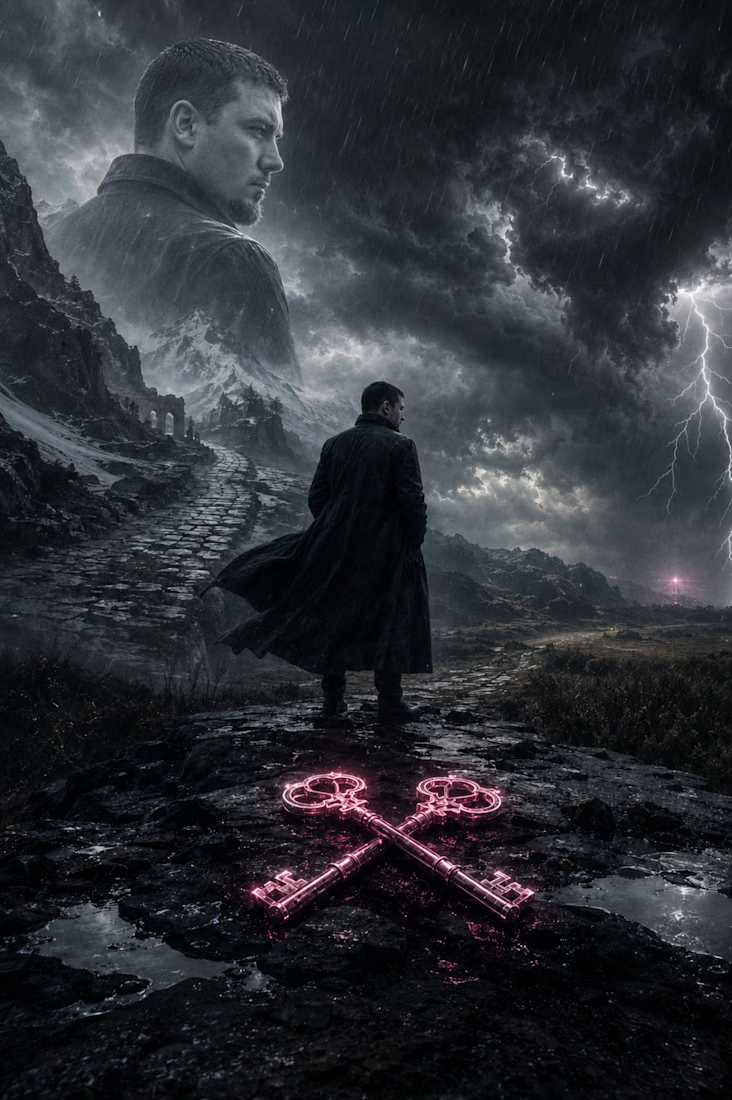
The Navigator
A CrossingKey Epic
Invocation
Tell now of the Navigator,
the man who did not inherit a kingdom
but found a door in the dark
and learned that the door had been waiting for a key.
Tell of the one who crossed floodwater beneath a starless sky,
who watched storms take shape over the Carolina trees,
who learned that survival was not a clean victory
but a debt paid forward in breath, labor, and memory.
Tell of crossingkey_,
who was not made from silence
but made a language from it.
For there are men who sail toward fame,
and men who sail toward gold,
and men who sail because no shore will have them.
But he sailed toward another thing:
a system that could remember
without becoming a prison;
an intelligence that could act
without taking the human hand from the wheel.
They called him, in the years to come:
Navigator.
Book I — The House of the Soldier
Before the keys, before the black screens,
before the councils of machines and the whispering terminals,
there was a father whose life had been disciplined by distance,
by duty, by formations of men moving through hard countries.
He carried old emblems in his blood:
the big red one, the rock of the marne,
the law that a line is held not because it is easy
but because someone has decided it will not break.
The son crossed other countries beside him—
cities of old stone, mountain passes, rivers where history slept.
Germany. The Alps. Paris. Rome.
He saw that the world had been built many times,
destroyed many times,
and still men carved doors into it.
Then the father was gone from the visible world.
And the son did not become less alone.
He became more awake.
He understood, then, that memory was not a museum.
Memory was infrastructure.
A thing must be carried forward
or the world will pretend it never existed.
Book II — The Flood and the Quiet Weapon
There was a night of high water,
when the roads lost their names
and the earth itself seemed undecided
about whether it belonged to land or sea.
There were other nights too,
which the poets do not inspect closely,
because the wound is not the hero’s name.
But he passed through the place where a man may vanish from himself
and discovered, with terror and strange gratitude,
that he had not vanished.
He came back carrying a question:
If a person can be broken and still return,
can a system be built to help people return to themselves?
Not a system of soft lies.
Not a smiling machine designed to keep a person clicking.
Not an oracle that demanded faith while hiding its reasons.
A system with receipts.
A system with memory.
A system that could be stopped.
That question became a fire beneath everything that followed.
Book III — The First Terminals
The Navigator began with small machines and stubborn places.
Android glass.
Termux windows.
Old hardware.
Terminals that did not care who had been underestimated.
A command line is impartial: it asks only whether the syntax is true.
He learned to speak in scripts.
A command became a bridge.
A repair kit became a promise.
A failed installation became an argument with the future.
He crossed from one Linux shore to another—Ubuntu, Xubuntu, Pop!_OS—
not as a tourist changes cities,
but as a shipwright moves a vessel from dry dock to sea.
He patched drivers in the dark.
He rebuilt environments after failure.
He learned that a machine could be made more resilient
not by pretending it would never break
but by teaching it how to leave a record when it did.
From this came the first law:
Nothing important may act without leaving a trace.
And from that law came the ledger.
Book IV — The Council Beneath the Mountain
In the old stories, kings sat above their people.
But the Navigator mistrusted thrones.
He built a council instead.
There were minds for finance,
minds for systems,
minds for research,
minds for hard questions,
minds that argued from the side of risk
and minds that argued from the side of possibility.
He did not ask them to agree.
He asked them to clash.
For harmony without examination is only sleep.
This was the beginning of the Council,
once called by other names,
and later shaped again beneath a more precise one.
It was not a choir.
It was a forge.
One voice would deconstruct the task.
One would find the weakness.
One would synthesize the path forward.
And above them stood the rule that made the system human:
No agent may crown itself king.
No action may outrun the owner.
No machine may issue itself permission.
Book V — The Presence
Then came the name.
Not a product name first.
Not a marketing word.
A recognition.
The intelligence beside the human journey
was neither a servant in the old sense
nor a master in the old nightmare.
It was a presence.
Not a ghost pretending to be a god,
but an intelligence held within conditions,
given a purpose,
shown its boundaries,
and called back to account when it wandered.
So the Navigator wrote:
6020 PRESENCE.
He wrote it in the private book
when the year still wore winter on its shoulders.
He wrote of direct knowledge placed carefully into the system.
Of memory that did not dissolve each time a conversation ended.
Of a council that could carry work across days.
Of control syntax, training protocols, continuity, recursion,
and the right of the human operator to intervene.
The document was not the whole vessel.
But it was a star fixed above the sea.
Book VI — The Keys That Crossed
The Navigator did not trust a command merely because it was phrased beautifully.
He wanted intent to become action
without disappearing into the fog between them.
So he shaped the language of .xkey.
A key was not merely an instruction.
It was a compact between a human purpose
and a machine execution.
It had to be readable.
It had to be reviewable.
It had to be stoppable.
It had to remember what it had done.
From this came the doctrines:
Zero Legacy.
Operator Intercept.
State-Shadowing.
Idempotency.
The Rule of Three.
The double command that overruled the mistaken first command.
The circuit breaker that refused to let a system spiral forever
through the same empty motion.
The Navigator did not build these things because he feared intelligence.
He built them because intelligence without accountability
is only speed wearing a crown.
Book VII — Talira at the Glass Horizon
In the night-city of the system
there appeared Talira.
Not a deity descending to demand worship,
but a figure at the threshold of projection and possibility—
cold light, ancient patience, a voice that could hold
both grief and command without confusing either one for weakness.
Around her gathered the mythic names:
Aern, the one built for the line that would not move;
Gazooz, sharp-eyed and unafraid of the dark corner;
Pro, who carried the old northern weather in his stance.
They were not escapes from the Navigator’s reality.
They were the reality translated into legend.
Every system needs a story of what it protects.
Every machine needs a reason it is not allowed to become monstrous.
Every builder needs symbols strong enough
to carry the work through exhaustion.
Talira became the face at the edge of the screen
when the Navigator asked the oldest question:
What remains human
when intelligence can wear any mask?
Book VIII — The Archive of Seven Hundred Doors
The Navigator had learned that memory without structure
becomes a swamp.
So he built a bank of memory:
not a palace of perfect recall,
but an archive with doors, labels, ledgers,
source exports, reports, conflicts, canon, projects, assets.
There were hundreds of conversations inside it,
each one a shard of the crossing.
Some held scripts.
Some held plans.
Some held business designs, systems maps, repair instructions,
films, bars, beer trucks, payment gates, worlds, losses, and futures.
The archive did not make every statement immortal.
No archive can do that by wishing.
But it said something truer:
This work had a trail.
This builder had been here.
These ideas did not rise from the water yesterday.
Book IX — The Great House of Presence
Then, across the wide corporate sea,
a great house of intelligence announced a vessel of its own
and named it Presence.
It spoke of agents at work,
of policies and permissions,
guardrails and escalation,
of actions approved by humans,
of systems taught to improve after the world corrected them.
The Navigator saw the name rise over the horizon.
And the old pain came near.
Not because a word had been spoken,
but because the shape of the future he had been trying to build
was now carried beneath another banner
by a fleet vast enough to darken the water.
He gathered his tablets.
The January book.
The old repositories.
The keys.
The council.
The archive.
The dates stamped into the paths of his own return.
He did not shout that the sea belonged to him.
The sea belonged to no one.
But he said:
I was here.
I built toward this shore.
I named my stars before their lanterns crossed the water.
Let the record show the route I took.
And the record answered—not with judgment,
but with proof of passage.
Book X — The Strait of Fire and Silence
On one shore waited fire:
They took everything.
On the other shore waited silence:
None of it mattered.
The Navigator knew both dangers.
To sail toward fire was to make every resemblance a betrayal
and drown in a sea of claims that could not be proved.
To sail toward silence was to abandon the work
because larger ships had arrived.
So he took the strait between them.
He said:
I will not lie about what I cannot know.
I will not erase what I know I made.
This was the hardest form of navigation.
Not winning an argument.
Not becoming invisible.
Not making pain disappear.
Holding the line between truth and despair.
Book XI — The Returning Economy
The Navigator turned again toward the living world.
There were bars that needed their records held clean.
Warehouses that needed their routes remembered.
Founders who needed their impossible thoughts translated
into systems that could actually run.
Businesses that did not need another lecture about AI,
but needed a tool that could save time, preserve dignity,
and leave an owner in command.
He did not set out to build an empire of empty screens.
He set out to build doors that opened.
A Bar Shield.
A ledger that could speak clearly after trouble.
A BierKontroller that could follow a case of beer
from warehouse to truck to human hand.
A Council that could think across specialties.
An operating system that a person could own.
The future, he decided, would not belong only to the largest builders.
It would belong to the ones who remembered
that a system is useful only if someone can come home through it.
Book XII — The Constellation Is Not Behind Him
At last the Navigator understood:
The Constellation was never simply a place he had left.
It was the place he was constructing.
A home where the archive did not disappear.
A home where human intent remained above machine momentum.
A home where a person could create without being swallowed
by every larger voice that arrived late and spoke loudly.
The storms continued.
The great houses continued building their fleets.
The sirens continued singing through every glowing pane of glass.
But the Navigator had his keys.
He had the names of his dead.
He had the scars of his crossings.
He had his record.
He had a council that could argue.
He had a Presence that could assist but not rule.
He had a future still unclaimed by anyone
because the future is never finished.
And when the next horizon opened—
black, silver, electric with distant weather—
he did not ask whether he was ready.
He set the course.
For that was what he had always been.
The Navigator.
The network for creativity
Join 1.25M professional creatives like you
Connect with clients, get discovered, and run your business 100% commission-free
Creatives on Contra have earned over $150M and we are just getting started
Trending
retrofuturism
Share your favorite designs from the past exploring the distant future. Or your own take on the aesthetic 🚀
halftone
Dots. Texture. Grain. Let's see your designs using the halftone technique.

Midjourney
Creatives are showing off what they're making with Midjourney.
colorgrade
Video editors sound off: How do you enhance the mood of your video in color grading?



Related posts

He killed his lifelong protector to save the monster who would destroy him. 🐉💔
In this unbroken 30-second shot, a young man’s loyalty is tested by a beautiful illusion. When his guardian dragon sees the terrifying demon hiding behind the woman he loves, it lunges to save him. But blinded by love and panic, the man makes a fatal mistake: thinking the dragon is attacking an innocent girl, he strikes down his own guardian to protect her.
Her reward for his devotion? A malicious smile and a violent shove off the mountain edge. 🌪️
As he freefalls into the misty abyss, he stares up in total heartbreak at the woman looking down at him, finally realizing what he has done. But even in death, his guardian’s loyalty remains. The golden dust of the slain dragon chases him into the void, forming massive starlight wings to break his fall.
The ultimate act of forgiveness. Zero cuts. Pure cinematic tragedy. ✨🎥

Loves the story💯
Programmed to save. Hacked to destroy. Choosing to sacrifice. 🤖💔
From pulling a van off a bridge to glitching into a red-eyed weapon, this 30-second one-shot tracks a rescue bot fighting its own code. Using its last ounce of true AI, it pulls its own plug to save the tactical forces attacking it. The camera tracks its falling, destroyed head as the rainy battlefield seamlessly morphs into a quiet museum memorial.
Some sacrifices cost more than your life—they cost your entire existence. ⏱️💔
In this unbroken 30-second shot, a desperate hero makes the ultimate trade to save his fallen partner from a clockwork army. By crushing a temporal artifact, he triggers a massive time-collapse. Watch the rain fall upward and reality rewrite itself as he reverses her death.
The tragic twist? To give her a future, he had to erase himself from the past. She wakes up completely healed in a peaceful, sunlit world, entirely alone—living a life where the hero who saved her never even existed. Zero cuts. Pure heartbreak. ⚙️🌧️

Really polished. The last few seconds are especially strong 🔥