The network for creativity
Join 1.25M professional creatives like you
Connect with clients, get discovered, and run your business 100% commission-free
Creatives on Contra have earned over $150M and we are just getting started
Back to feedPost

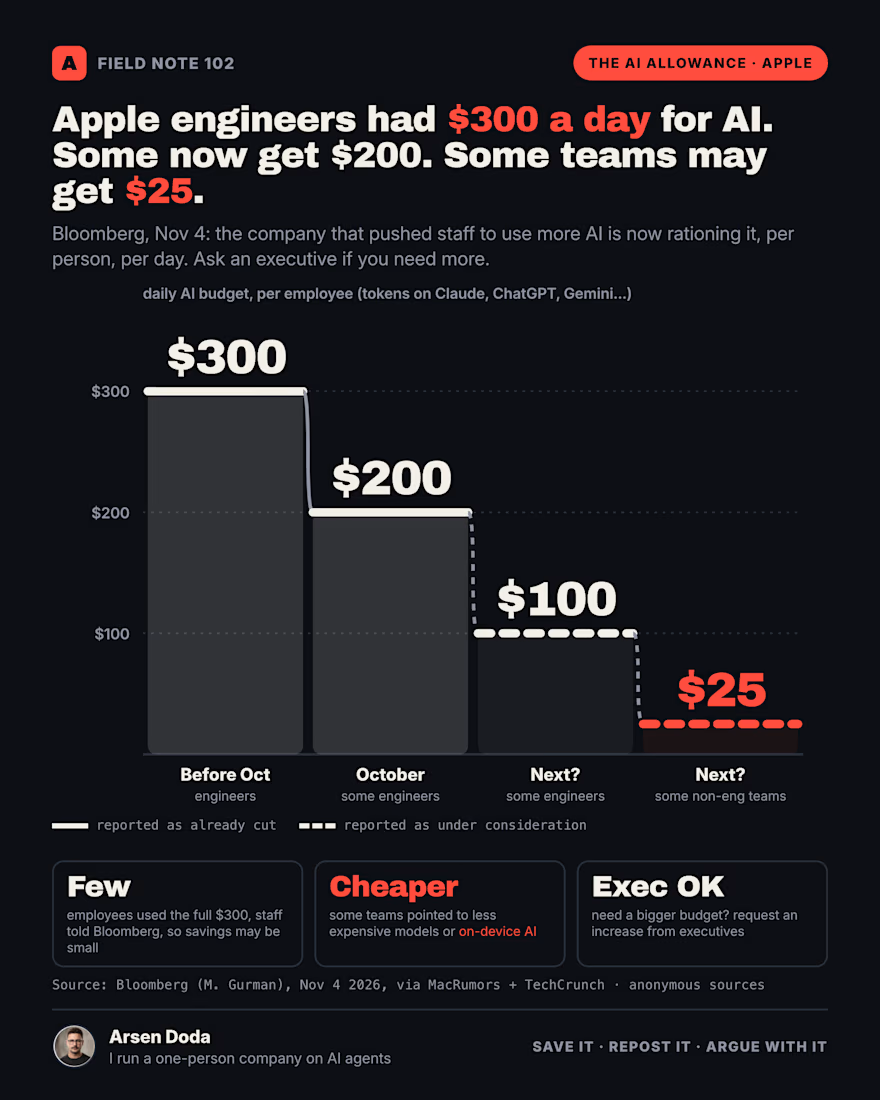
Apple engineers had $300 a day to spend on AI.
In October some of them dropped to $200.
Bloomberg says $100 is being considered next, and some non-engineering teams could go as low as $25.
This is the same company that spent this year pushing staff to use more AI.
Now it's per person, per day, and if you need more you ask an executive.
Here's what most people will miss:
The cut isn't the story.
The meter is.
What Bloomberg reported (anonymous sources, Nov 4):
→ Some engineers: $300 → $200 a day, cut in October
→ Some engineers: $100 a day under consideration
→ Many teams outside engineering: already at $100, some could get $25
→ Some teams pointed to cheaper models or on-device AI
→ Staff said few people ever used the full $300, so the savings may be small
Read that last line again.
If almost nobody hit $300, cutting to $200 doesn't save much money.
What it does is make every employee look at the meter.
That's the real change. AI stops being a free tap and becomes a budget line with your name on it.
I've lived inside that meter for months.
I run a one-person company on AI agents. Every task has a price, and this week my top model ran out of credits in the middle of my morning runs. Nothing broke. It stopped, and the work waited for me.
That's what a cap feels like from the inside. You don't get a warning that you're doing too much. You get a wall at 7:35 a.m.
So here's how I'd run a team under a daily AI budget:
Rule 1: Put the expensive model on judgment, not reading.
Bulk reads, searches and first drafts go to cheaper models. The top model writes the brief and signs off on what ships.
Rule 2: Track cost per finished task, not per seat.
"$200 a day" means nothing. "$4 per merged fix" means something you can defend in a budget review.
Rule 3: Plan for the wall before you hit it.
Decide today what happens when the budget runs out at 11 a.m.: which jobs wait, which drop to a cheaper model, and who gets told.
The companies that spent this year telling staff to "use AI more" are learning what every finance team already knew.
Usage without a unit cost is not a strategy. It's a bill.
Apple's numbers will leak into every other company's planning deck by January.
The question is whether your team finds its cost per task before finance picks a number for you.
Screenshot this for your next budget meeting.
One word: is a daily AI cap SMART or SHORTSIGHTED?
The network for creativity
Join 1.25M professional creatives like you
Connect with clients, get discovered, and run your business 100% commission-free
Creatives on Contra have earned over $150M and we are just getting started
Related posts

Your Business Doesn't Need More Tools. It Needs Better Systems.
Most businesses don't have a software problem. They have an integration problem.
Their CRM is disconnected from their database. Their spreadsheets require manual updates. Their reports take hours to prepare. Their teams waste valuable time moving information between platforms.
That's where I come in.
I'm a Full-Stack AI Engineer specializing in building connected, intelligent business systems.
What I can build for your business:
CRM & ERP Integrations — Connect business platforms, databases, and third-party services through APIs.
Workflow Automation — Eliminate repetitive processes with intelligent automation.
Custom Dashboards — Turn scattered business data into actionable insights.
Data Pipelines — Build reliable systems for collecting, processing, validating, and synchronizing data.
AI-Powered Solutions — Integrate LLMs, intelligent agents, and automation into existing workflows.
Custom Software — Build complete web applications and business platforms from architecture to deployment.
I've independently developed complex digital platforms, including government-level systems, international applications, and AI-powered products.
My approach is simple:
Understand the business problem. Design the right architecture. Build the complete solution. Make it reliable.
I'm interested in working with founders, agencies, and businesses looking to modernize their operations and build software that actually solves problems.
Have a complex workflow or an integration challenge? Let's build something that works.
#FullStackDevelopment #AIAutomation #CRMIntegration #WorkflowAutomation #SoftwareEngineering #AIEngineering #Contra
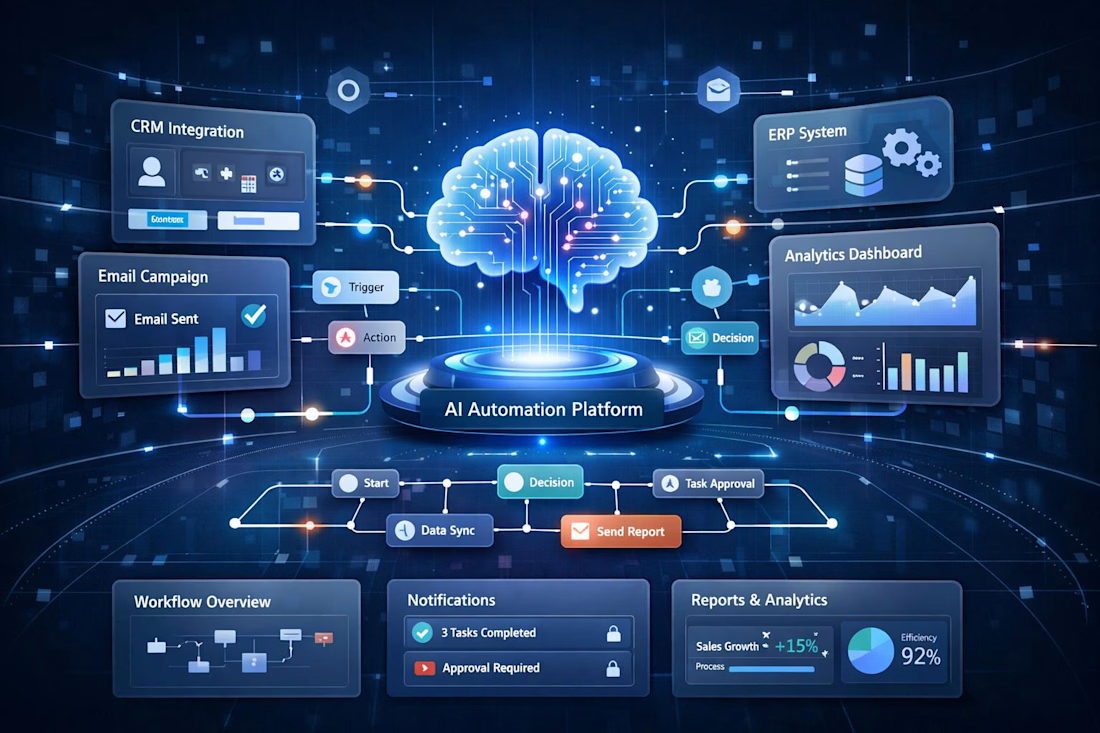

When a CRM-to-database sync fails halfway, how do you handle it: idempotent retries, or a reconciliation pass afterward? That's usually where integrations start to drift.

Did a motion for the Cockpit concept ⁕ 🔈 ON
Design & Creative Direction: Me
Motion & Sound: Claude Code
Cockpit is an AI agent management platform concept that helps teams:
- Set boundaries
- Monitor activity
- Manage approvals
- Track knowledge sources
- Measure performance and costs
It brings together five key AI UX challenges:
👉 Autonomy
👉 Observability
👉 Human Approvals
👉 Context
👉 Analytics
The idea is simple:
As AI agents become more capable, the experiences we design around them need to make their actions more transparent, predictable, and manageable.
Thanks!


Human approvals is the part most agent UIs skip. Good call making it one of the five challenges.

For an AI scribe, I'd test what happens when someone switches encounters while a draft is still generating.
In my Arogya / Aurora EHR work, typed or dictated rounds become editable drafts. AI content stays advisory, and a clinician explicitly approves anything added to the chart.
The first response should stay attached to its original encounter. Before saving, I'd check that the encounter being reviewed still matches the draft, as well as requiring clinician approval.
That context check belongs in the save workflow, even when the draft reads well.

kapilchauhan.netlify.app
Arogya / Aurora EHR: AI for inpatient care | Kapil Chauhan
Production hospital and EHR platform that accelerates rounds, documentation, records, and care operations with clinician-reviewed AI.