The network for creativity
Join 1.25M professional creatives like you
Connect with clients, get discovered, and run your business 100% commission-free
Creatives on Contra have earned over $150M and we are just getting started
Back to feedPost

🚀 Practical improvement: moving data fetching from client-side useEffect calls to server components + targeted caching
The problem it solves: A common Next.js pattern (especially in dashboards like the admin panels you built at DevStarX) is fetching data in a useEffect after the page mounts. This causes a loading flash, waterfalls when multiple components each fetch their own data, and hurts both perceived performance and SEO for anything server-renderable.
What I'd do concretely:
Move fetches into Server Components (App Router) so data is fetched during render on the server, not after hydration. This eliminates the client-side loading spinner for initial page data and cuts a full round-trip.
Parallelize instead of waterfall. If a dashboard page needs data from 3 different endpoints, fire them concurrently with Promise.all rather than sequential await calls — this alone can cut load time significantly on data-heavy admin panels.
Add caching at the right layer. For data that doesn't change every second (e.g., subscription plans, ad campaign settings in the Best Agent Today SaaS), use Next.js's fetch caching with revalidate tags instead of hitting Postgres on every request. Pair this with your existing Redis caching layer on the backend for a two-tier cache — Next.js edge cache for near-static data, Redis for computed/aggregated data.
Stream in the slow parts. Use <Suspense> boundaries so fast data (page shell, nav) renders immediately while slower queries (e.g., analytics aggregations) stream in separately — this keeps the app feeling responsive even when one query is heavy.
Maintainability side-benefit: Centralizing fetch logic in server components (vs. scattered useEffect/useState fetch boilerplate across client components) also cuts down on duplicated loading/error state handling — which pays off across a monorepo like the one you built at Onsense AI, since shared data-fetching utilities can live in a common package.
For a portfolio/blog post, this pairs well with a before/after: show a useEffect-based client fetch with a loading spinner, then the server-component + Suspense version, and note the measurable change (e.g., Time to Interactive or Largest Contentful Paint improvement via Lighthouse).

The network for creativity
Join 1.25M professional creatives like you
Connect with clients, get discovered, and run your business 100% commission-free
Creatives on Contra have earned over $150M and we are just getting started

Challenges
View all


Related posts

Working on the homepage for Still Blooming, a wedding and floral studio, I explored two different layout directions for the hero section. Same brand, same copy, just a different structure and visual rhythm.
Option 1 : Left Aligned. Text sits on the left with supporting content beside it, giving an editorial, asymmetrical feel.
Option 2 : Centered. Everything is stacked and centered, giving a clean, balanced, more classic hero layout.
Would love your honest UX/UI take which direction feels more elegant, functional, and true to a wedding/floral brand, and why?
22 voted
41%
32 voted
59%
54 votes
Closed

Great Design :)

New Framer website is live now!!
Feel it here: https://realestatebeta.framer.ai/


It grabs my attention....Specially I love the header most!

Which of these two website designs do you prefer for Chess club "Dubica"?
I’ve finished the new website and designed two options for review:
Editorial (first image)
Futuristic (second image)
Vote in the comments below and share what you’d change.
Site: http://sahdubica.com/
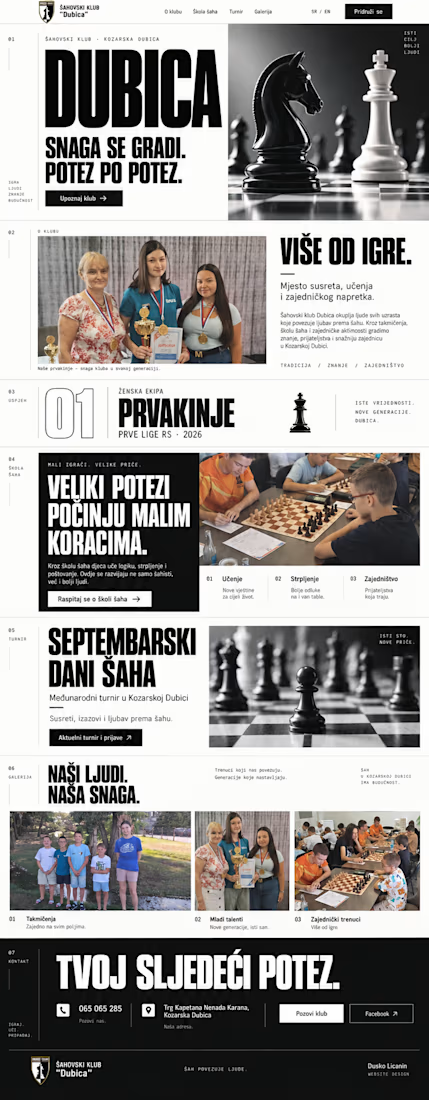
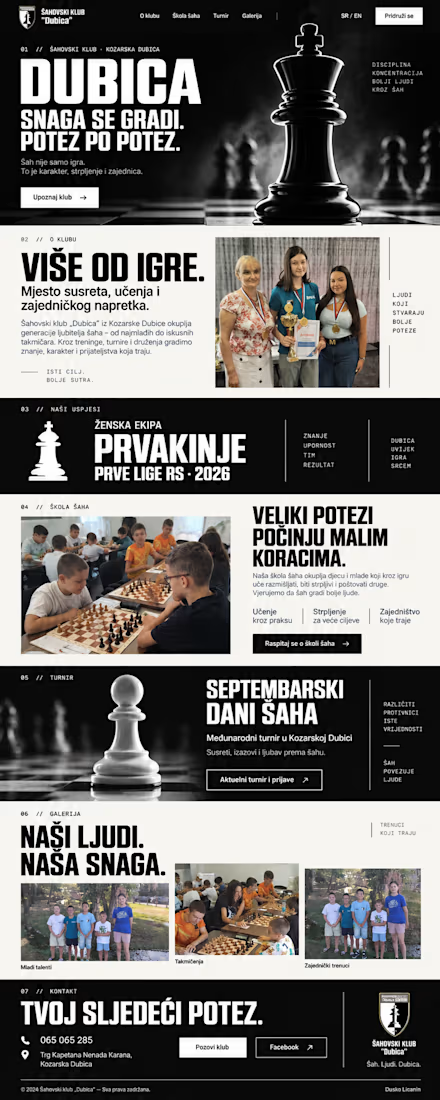

"Šahovski klub Dubica", chess club website
A bilingual static site for a chess club in Bosnia and Herzegovina. Built once, handed over, not maintained.
...

The two directions make the comparison easy to understand, and the editorial option feels especially aligned with a chess club’s sense of heritage and focus.