The network for creativity
Join 1.25M professional creatives like you
Connect with clients, get discovered, and run your business 100% commission-free
Creatives on Contra have earned over $150M and we are just getting started
Back to feedPost
[Problem]
While working retail to fund my CS degree, I saw a persistent failure: shift changes, seasonal turnover, and manual scheduling create bottlenecks that waste labor hours and management time.
[Solution]
ShiftPlate is an enterprise scheduling and shift-management platform for large retailers. It digitizes paper and email workflows, giving admins real-time staffing visibility, instant shift approvals, and better team coordination.
[Business Model]
ShiftPlate uses a value-based enterprise SaaS model tied to labor savings. Pricing starts at $99.99 per year per enterprise admin account, covering up to 50, with incremental pricing for added seats. Revenue scales through multi-location contracts, premium analytics, compliance reporting, and payroll/HR integrations.


Love this! Super efficient

I forgot to leave a copy of the link in here. I'm going to leave it in the comments. I did computer science engineering at Google before and this kind of software sure helps people program much faster and deliver MVPs much sooner than programming line by line and typing out...

johnhuatech-30890.bubbleapps.io
Check out my Bubble app
Bubble is the only platform that lets you switch between AI prompting and visual editing to go beyond prototypes and launch real apps — no code required.
The network for creativity
Join 1.25M professional creatives like you
Connect with clients, get discovered, and run your business 100% commission-free
Creatives on Contra have earned over $150M and we are just getting started





Related posts

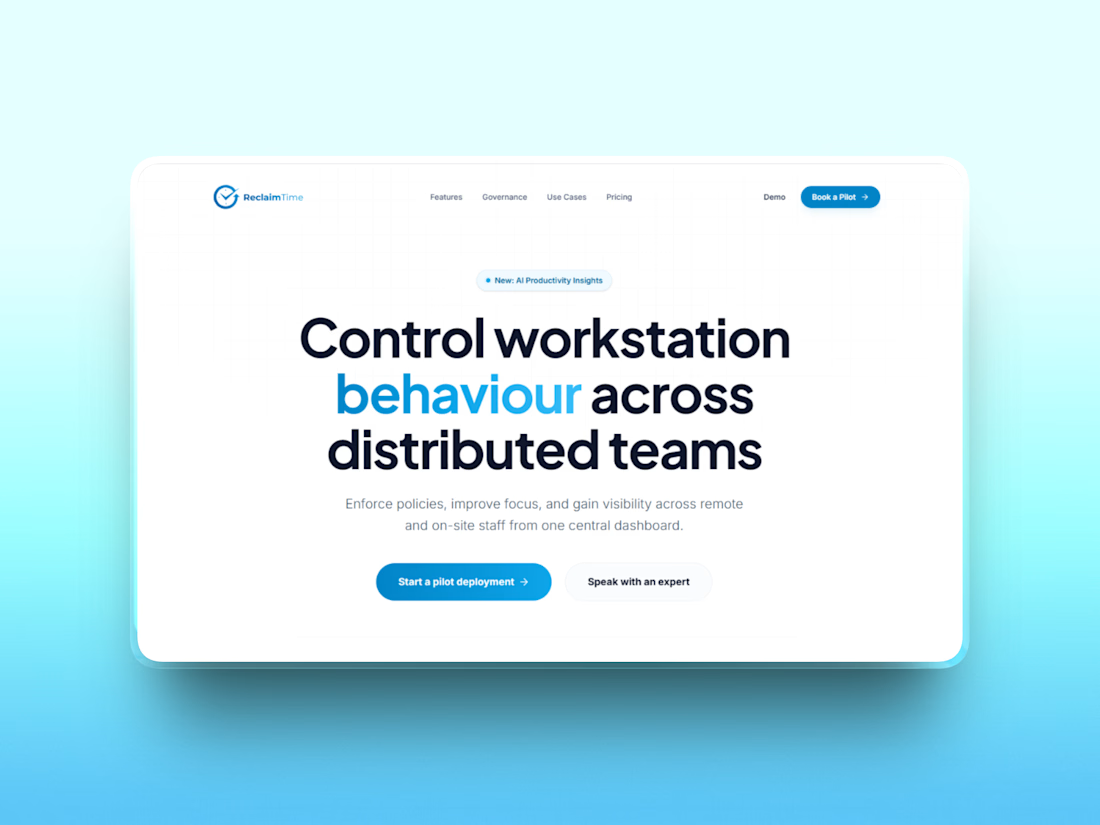
Product and web design for Reclaim Time, a B2B SaaS platform for managing workstation activity across distributed teams.

Looks amazing 🤩

Quick question for small business owners.
Which job eats more of your week?
A) Fixing messy spreadsheets
B) Copying data from one app to another
Both can be automated. I'm curious which one hurts more.

0 votes
Ends in 1d

The workflow I refuse to automate — and why that makes my AI builds better.
Problem: Every founder I meet wants to automate everything. But automating a judgment call doesn't save time — it scales bad decisions. The worst agents I've seen weren't underbuilt. They were trusted too far, too fast.
Build: Before I build, I run every workflow through three questions: Is it reversible? Does it look the same every time? What does a mistake cost? If a step fails any of them, it stays human — and the agent is built around it, with a clear handoff and an escalation rule.
Result: The automations I ship in my 5-day n8n x OpenAI sprints survive the first month, because the boundaries were decided on Day 1, not discovered in week 3. The runbook lists what the agent never touches, so the founder keeps control where it matters.
Offer: Tell me the one workflow you're unsure about automating. I'll tell you honestly whether it belongs in a sprint — and what should stay human.