The network for creativity
Join 1.25M professional creatives like you
Connect with clients, get discovered, and run your business 100% commission-free
Creatives on Contra have earned over $150M and we are just getting started
Back to feedPost

I gave an LLM 2,000 Excel rows to analyze. Every second or third sentiment label was wrong.
The problem wasn’t necessarily the model.
The problem was the workflow.
LLMs are designed to take instructions and context, recognize patterns, and generate the most useful response they can. But the quality of that response depends heavily on the quality and clarity of the input.
A clear prompt helps.
A structured workflow helps even more.
When I first tested sentiment analysis on approximately 2,000 Excel rows in a single task, the output looked convincing. But during manual validation, I noticed that every second or third classification was inaccurate.
The model had too much data, too many decisions, and too little room for proper validation.
That is where LLM chaining becomes useful.
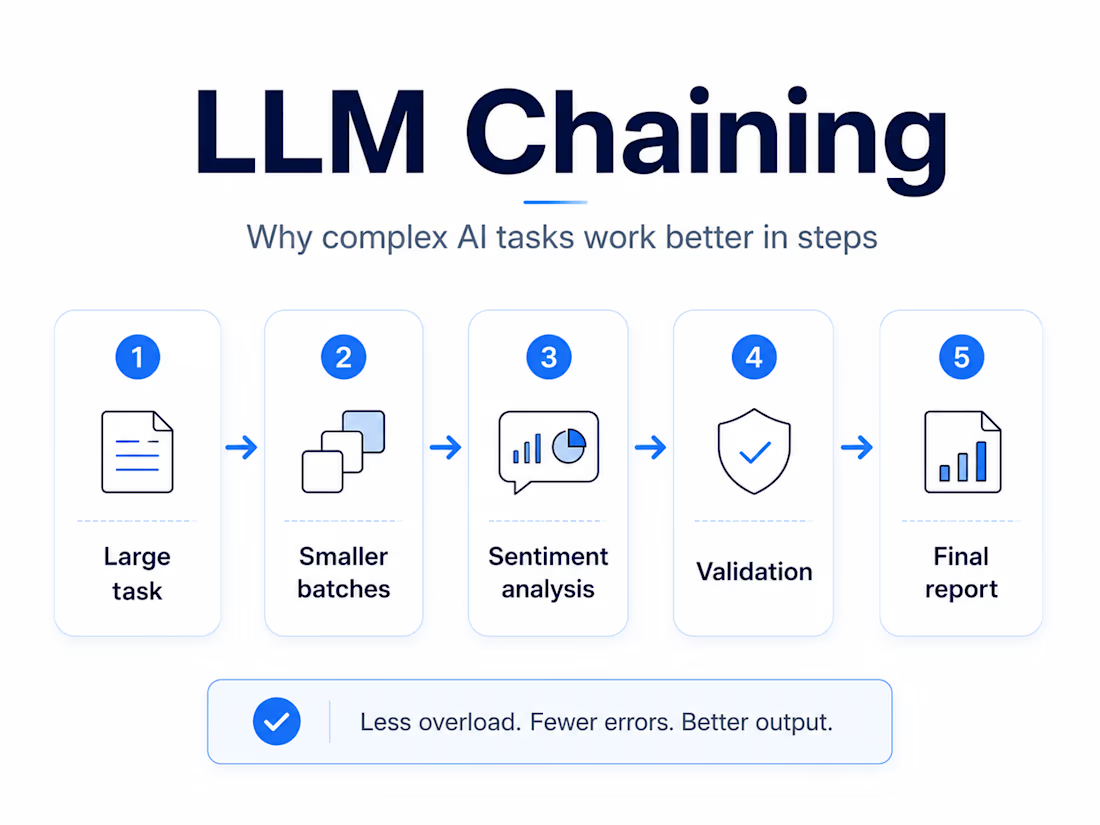
Instead of asking the model to complete one large task at once, the process is divided into smaller connected steps:
1. Clean and prepare the data
2. Analyze smaller batches
3. Classify sentiment
4. Identify recurring themes
5. Validate uncertain results
6. Combine the outputs into a final report
Each output becomes the input for the next step.
This reduces task complexity, makes errors easier to detect, and allows every stage to be checked before moving forward.
It can also prevent unnecessary context overload. Larger inputs consume more tokens, increase costs, and may push important instructions or data out of the model’s effective context. Official model documentation confirms that inputs and outputs consume tokens and that exceeding a model’s context window can cause requests to fail or older context to be truncated.
The lesson was simple:
Don’t give AI one enormous task and hope for a perfect answer. Build a process in which every step improves the next one.
That is the difference between using an LLM as a chatbot and using it as part of a reliable workflow.
The network for creativity
Join 1.25M professional creatives like you
Connect with clients, get discovered, and run your business 100% commission-free
Creatives on Contra have earned over $150M and we are just getting started
Trending
retrofuturism
Share your favorite designs from the past exploring the distant future. Or your own take on the aesthetic 🚀
halftone
Dots. Texture. Grain. Let's see your designs using the halftone technique.

Midjourney
Creatives are showing off what they're making with Midjourney.
colorgrade
Video editors sound off: How do you enhance the mood of your video in color grading?





Related posts


Wow..... I create a single 30-second, 16:9 cinematic transformation shot in 720p, using Seedance 2.5 setup for a room transformation video, designed for that satisfying before → process → after glow-up.


Amazing

AI Study Assistant & E-Learning Mobile App UI Design
Personalized, adaptive learning is transforming education. Students no longer want passive video lectures—they need instant homework help, interactive practice, and AI-generated study materials tailored to their specific curriculum.
We designed this vibrant AI Study Assistant & E-Learning Mobile App UI to bridge conversational AI with structured learning workflows. Built for EdTech startups, AI SaaS platforms, online academy founders, and study tool developers, this interface combines conversational tutor bots with automated exercise scanning and instant study sheet generation.
The Problem We Solved
Most study tools suffer from fragmented user experiences—forcing students to jump between separate apps for AI chat, flashcards, problem scanning, and study notes. This disjointed flow interrupts deep focus and reduces long-term study consistency.
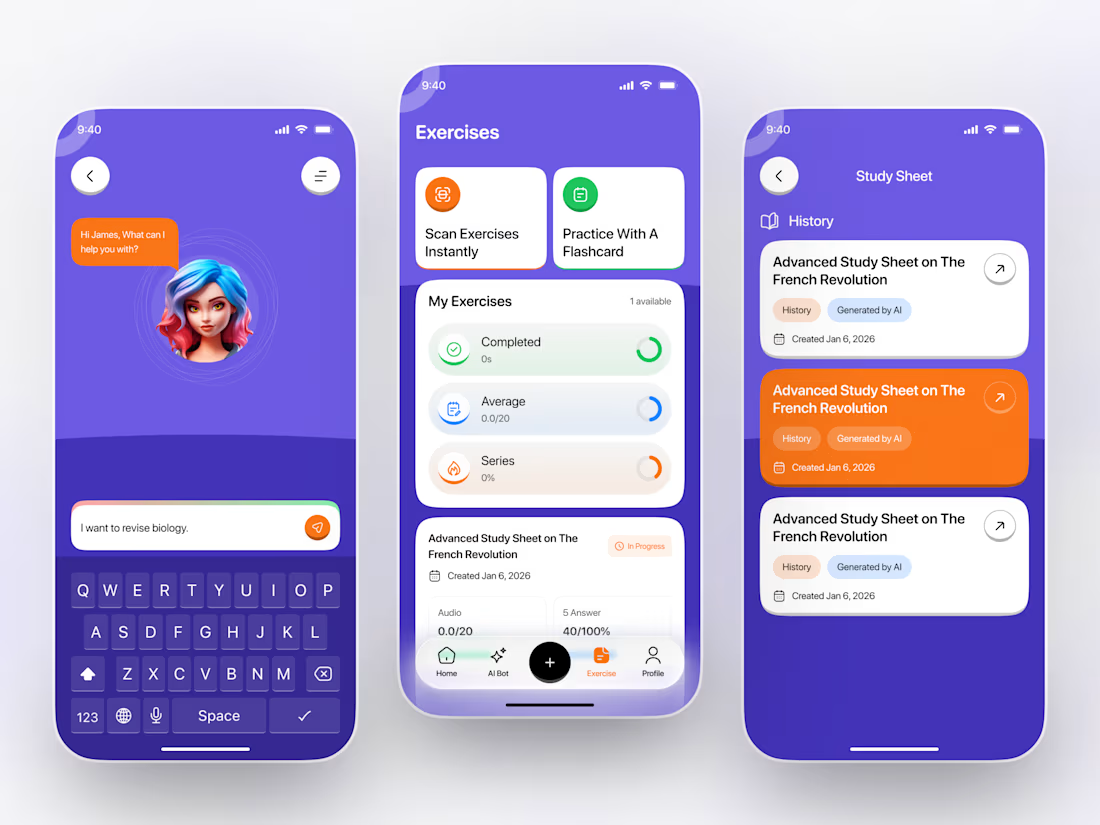
This concept creates a unified AI learning hub, allowing students to seamlessly transition from asking an AI avatar questions ("I want to revise biology") to scanning physical exercise worksheets and generating structured study sheets in seconds.
Key Features & UX Highlights
Interactive AI Tutor Chat: Conversational avatar screen with natural language prompt inputs, enabling instant step-by-step homework help and topic revision.
Instant Exercise Scanner & Flashcard Practice: One-tap camera scanning feature (Scan Exercises Instantly) that converts physical assignment sheets into digital practice modules and interactive flashcard decks.
AI-Generated Study Sheet Engine: Dynamic content hub automatically organizing AI-summarized notes and historical breakdowns (Advanced Study Sheet on The French Revolution).
Gamified Progress Tracking: Clean analytics dashboard displaying completed tasks, score averages ($0.0/20$), and revision streaks to maintain student engagement.
Building an AI EdTech Startup or E-Learning Platform?
Whether you're an ambitious founder launching a next-gen AI homework helper, building a personalized tutoring app, or scaling an e-learning SaaS platform, we design intuitive, conversion-focused UI/UX that drives student retention and daily active usage (DAU).



Web3 Isn’t Lambos & Dubai - Contra / CapCut Seedance 2.5 Challenge
Workflows:
- Created two clips with CapCut Video Studio (giving prompts to an AI agent).
- Added voiceovers and personalised texts to the video with CapCut Editor.
It was a bullish experience creating this one! Thank you, @Contra HQ and @CapCut !
#CapCutCPP #Web3
