The network for creativity
Join 1.25M professional creatives like you
Connect with clients, get discovered, and run your business 100% commission-free
Creatives on Contra have earned over $150M and we are just getting started
Back to feedPost

How to Prevent AI Hallucinations in Travel Recommendation Apps
AI-powered travel apps can help users discover destinations, create itineraries, recommend hotels, and personalize trips. However, generative AI can sometimes produce confident but incorrect information, commonly known as AI hallucinations.
In travel, even a small factual error can create a poor user experience. An AI system might recommend a closed attraction, provide outdated opening hours, invent a restaurant, or suggest an incorrect travel route. Research published in 2026 found that hallucinations in tourism recommendations can reduce perceived accuracy, usefulness, and trust.
For businesses investing in travel app development, reducing hallucinations should therefore be treated as an architecture and data-quality requirement rather than only a prompt-engineering problem.
What Are AI Hallucinations in Travel Apps?
An AI hallucination occurs when a model generates information that sounds realistic but is factually incorrect.
For example, a traveler could ask:
“Suggest three restaurants near the Eiffel Tower that are open tonight.”
An unreliable AI system might:
Recommend a restaurant that no longer exists
Provide incorrect opening hours
Invent ratings or reviews
Give an inaccurate distance
Recommend a location that does not match the user's requirements
These problems are particularly important for travel applications because information such as prices, availability, opening hours, transportation schedules, and travel policies can change frequently.
Why Do Travel Recommendation Apps Hallucinate?
Several factors can contribute to hallucinations.
1. Outdated Training Data
Large language models may not have access to the latest information. Travel information changes continuously, including hotel availability, attraction schedules, transportation routes, and local regulations.
2. Missing Context
If the AI receives limited information about the destination, dates, budget, traveler preferences, or available services, it may fill gaps with plausible assumptions.
3. Unverified External Data
Poor-quality or outdated information retrieved from third-party sources can also lead to incorrect recommendations.
4. Model Guessing
Language models are designed to generate likely responses, not automatically verify every factual statement. Therefore, a model may provide an answer even when reliable information is unavailable.
1. Use Retrieval-Augmented Generation (RAG)
One of the most effective approaches is to use Retrieval-Augmented Generation (RAG).
Instead of asking the AI model to generate travel information from its internal knowledge, the application first retrieves relevant information from trusted data sources and provides that context to the model.
A simplified architecture looks like this:
User Query → Retrieval Layer → Verified Travel Data → AI Model → Validation → Recommendation
For example, when a user asks for hotels in Dubai, the application can retrieve current hotel information, availability, location, pricing, and amenities before generating recommendations.
RAG can improve accuracy by giving the model relevant external context rather than relying only on its training knowledge.
2. Connect AI With Real-Time Travel APIs
RAG alone is not enough if the underlying information is outdated.
A robust travel app development strategy should combine AI with reliable APIs for information such as:
Flight schedules
Hotel availability
Room prices
Airport information
Attractions
Maps and distances
Transportation
Weather
Currency exchange rates
For time-sensitive information, the application should retrieve the latest available data instead of allowing the AI model to guess.
3. Create a Trusted Data Layer
Not every source should have equal authority.
Create a data layer that classifies information according to source reliability.
For example:
Data Preferred Source Flight schedules Airline/GDS APIs Hotel availability Hotel/booking APIs Attraction hours Official attraction data Transportation Official transport APIs Visa requirements Government sources Weather Weather APIs Maps Trusted mapping providers
This allows the recommendation engine to prioritize authoritative information.
4. Add Data Freshness Checks
Travel information can become obsolete quickly.
Every important data record can include metadata such as:
Last updated time
Source
Expiration time
Geographic region
Data confidence
API status
Before generating a recommendation, the application can check whether the information is still valid.
For example:
Restaurant Data → Updated 2 hours ago → Valid
versus:
Restaurant Data → Updated 14 months ago → Requires verification
This approach helps prevent stale information from reaching users.
5. Validate AI-Generated Recommendations
Do not immediately display every AI-generated recommendation.
Add a validation layer after generation.
For example:
AI recommends hotel → Check hotel exists → Check location → Check availability → Check dates → Check price → Display recommendation
The validator can reject or regenerate recommendations when important information does not match the verified data.
This is particularly useful for:
Hotel names
Flight numbers
Attraction names
Addresses
Opening hours
Prices
Travel dates
Booking availability
6. Use Structured Data Instead of Free-Text Generation
Whenever possible, provide structured information to the AI.
Instead of asking the model to invent a complete hotel description, provide structured fields such as:
The AI can then generate a natural-language recommendation using those verified fields.
This reduces the amount of information the model needs to generate itself.
7. Give the AI Clear Instructions
Prompt design still matters.
The system prompt should clearly instruct the model to:
Use only retrieved information for factual claims
Never invent unavailable information
State when information cannot be verified
Distinguish recommendations from facts
Avoid making assumptions
Ask for missing information when necessary
For example:
“If the retrieved data does not contain an answer, do not guess. Tell the user that the information could not be verified.”
Clear instructions combined with reliable retrieval can improve consistency. OpenAI's current guidance similarly emphasizes retrieval, context optimization, prompting, and evaluation as separate parts of improving model accuracy.
8. Add Confidence and Source Indicators
Travelers should be able to understand where important information comes from.
For example:
Opening hours: 9 AM–6 PM
Source: Official attraction data
Updated: 2 hours ago
For AI-generated recommendations, you can also display:
Verified
Based on current availability
Source updated recently
Information requires confirmation
This makes the system more transparent and helps users distinguish generated suggestions from verified facts.
9. Introduce Human Review for High-Risk Information
Some travel information should receive additional verification before being presented as definitive.
Examples include:
Visa and entry requirements
Safety information
Cancellation policies
Booking confirmations
Prices and fees
Medical or emergency information
A 2026 tourism study recommends additional human verification for high-risk communications and emphasizes grounding recommendations in reliable, real-time sources.
10. Build an Evaluation Pipeline
AI hallucination prevention should be continuously tested after deployment.
Create test cases covering:
Different destinations
Different travel dates
Different budgets
Multiple languages
Hotel recommendations
Restaurant recommendations
Flight information
Transportation
Attractions
Complex itineraries
Measure metrics such as:
Factual accuracy
Retrieval accuracy
Recommendation relevance
Citation/source accuracy
Invalid recommendation rate
Response latency
User feedback
This allows the development team to identify where the AI system is failing and improve the retrieval or validation layer.
Recommended Architecture for Hallucination-Resistant Travel Apps
A reliable AI travel recommendation system can follow this architecture:
Mobile/Web App
↓
API Gateway
↓
Travel Recommendation Engine
↓
Intent & Preference Processing
↓
RAG / Retrieval Layer
↓
Verified Travel Data + Real-Time APIs
↓
LLM
↓
Validation & Safety Layer
↓
Personalized Recommendation
↓
User
This architecture separates data retrieval, AI generation, and validation, making the system easier to monitor and improve.
AI Hallucination Prevention Checklist
Before launching an AI-powered travel app, development teams should consider:
Use RAG for knowledge-based recommendations
Connect to real-time travel APIs
Prioritize authoritative data sources
Track data freshness
Validate AI-generated entities
Use structured travel data
Create strict system prompts
Display sources where appropriate
Add human review for high-risk information
Monitor hallucination and error rates
Continuously evaluate AI responses
Provide users with a way to report incorrect information
Conclusion
AI can make travel applications more personalized and conversational, but a fluent answer does not automatically mean an accurate answer. Research in 2026 shows that hallucinated tourism information can negatively affect users' perceptions of accuracy, usefulness, and trust.
For successful travel app development, the goal should not be to make the AI generate more information. Instead, developers should build a system where AI receives reliable data, generates recommendations within defined boundaries, and passes important outputs through validation.
Combining RAG, real-time travel APIs, trusted data sources, structured information, validation, and continuous evaluation can create a much more reliable AI travel recommendation experience.
The network for creativity
Join 1.25M professional creatives like you
Connect with clients, get discovered, and run your business 100% commission-free
Creatives on Contra have earned over $150M and we are just getting started



Related posts


Amazing design!

If your website was created before 2025, do this right now:
Navigate to your AI of choice and ask to validate your schema data.
Structured data is essential for AI engines to understand your business. If it is outdated, factually incorrect or missing you will not be cited by AI engines such as Gemini or ChatGPT.
It is not a new standard, but it has never been more important.

Nice information. You are right now. @Roman Avshalumov


Project Title
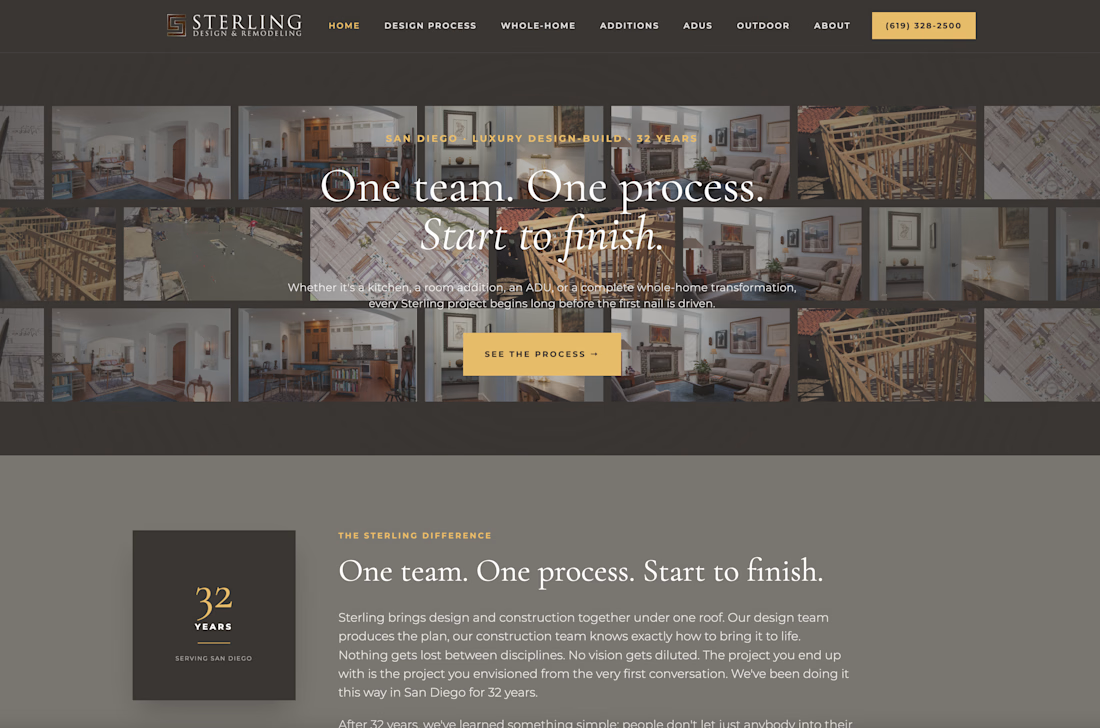
Sterling Design & Remodeling | AI-Powered Website & Lead Generation
Short Description
An AI-powered website designed to showcase luxury remodeling services, attract homeowner inquiries, and support local search visibility in San Diego.
Project Overview
Transformed Design Inc. developed a website experience for Sterling Design & Remodeling that presents its integrated approach to residential design and construction.
The design combines warm charcoal tones, gold accents, elegant typography, and project imagery to reflect the company’s premium positioning. Clear navigation helps homeowners explore the design process, whole-home remodeling, additions, ADUs, and outdoor projects.
Lead Generation Strategy
The website guides prospective clients from exploring project possibilities to understanding Sterling’s design-build process and contacting the team. Service-specific navigation, prominent phone access, and process-focused calls to action help homeowners evaluate the company’s approach before discussing their project.
AI Search Strategy
The content approach emphasizes clearly defined remodeling services, descriptive headings, and geographic relevance to San Diego. This structure is intended to help search engines and AI search tools understand the company’s capabilities and relevance to homeowners seeking design-build and renovation services.
Project Focus
AI-powered website development
Homeowner inquiry lead generation
Luxury remodeling and project presentation
Design-build process communication
Local SEO and AI search content structure
Website
designedbysterling.com



Clear service categories are helpful.