The network for creativity
Join 1.25M professional creatives like you
Connect with clients, get discovered, and run your business 100% commission-free
Creatives on Contra have earned over $150M and we are just getting started
Back to feedPost

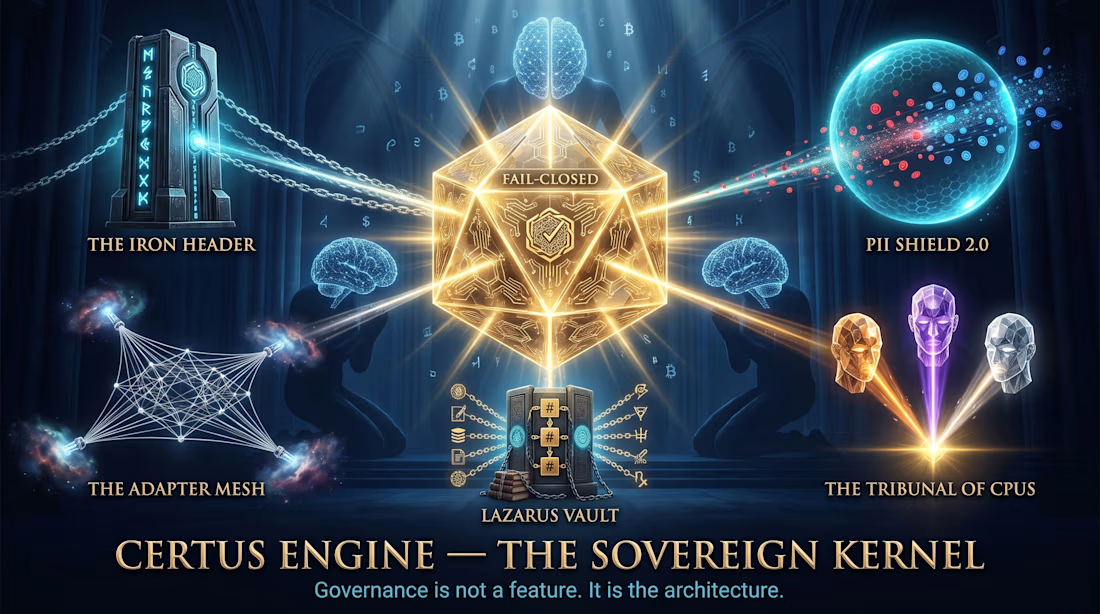
⚙️ CERTUS ENGINE — THE SOVEREIGN KERNEL
Article 1 of 3: The deterministic governance core that commands artificial intelligence instead of trusting it
THE PROBLEM THAT DEMANDED A NEW ARCHITECTURE
Modern generative artificial intelligence operates under a fundamental paradox: probabilistic models are being deployed in contexts that demand absolute determinism. Banks cannot tolerate hallucinations in transaction processing. Municipal governments cannot accept invented citations in legal documents. Hospitals cannot risk fabricated patient records. Courts cannot admit evidence produced by a system that occasionally makes things up.
Conventional solutions attempted to fix this with wrappers, guardrails, and retrieval-augmented generation. All of them failed for the same reason: they treated the symptom, not the root cause. The root cause is the absence of an institutional control layer between the organization and the model. When the model itself decides what is safe, what is compliant, and what is true, the organization has surrendered its sovereignty to a probabilistic machine it cannot audit, cannot predict, and cannot hold accountable.
The Certus Engine was built to reclaim that sovereignty. It is not a language model. It is not a chatbot. It is not a thin gateway. It is a deterministic governance engine — the decision-making core that intercepts, validates, sanitizes, and cryptographically records every interaction between an institution and external AI models, before any sensitive data crosses the organizational boundary and before any output reaches the user.
WHAT THE CERTUS ENGINE ACTUALLY IS
The most accurate definition is this: the Certus Engine is an AI Governance Engine. It does not replace GPT, Claude, Gemini, or any other large language model. It subordinates them. External models become interchangeable processing units — CPUs, in the Engine's internal vocabulary — that execute tasks under the strict supervision of the institution's own policies, encoded as immutable rules inside the Engine.
This architectural decision is what makes the entire system defensible. The Engine does not compete with language models on intelligence. It competes for control over them. The organization defines the rules; the Engine enforces them; the models merely compute. If a model changes its pricing, degrades in quality, alters its data residency policy, or simply fails, the institution swaps the model without changing a single line of policy. The governance layer persists; the processing layer is disposable.
THE IRON HEADER — THE SUPREME INSTRUCTION
At the foundation of the Engine sits the Iron Header: a supreme, indestructible systemic instruction injected into every single call made to an external model. It is not a suggestion, a system prompt convention, or a soft guideline. It is a mandatory protocol enforcement that forces the model to operate at the highest tier of syntactic adherence, prohibits creative digression, blocks hallucinated references, and constrains every response to the technical plan originally defined by the institution.
The Iron Header embodies the Engine's core philosophy: the model never decides the rules. The rules decide whether the model's output is allowed to exist.
THE SOVEREIGN KERNEL — IMMUTABLE RULES AS EXECUTABLE LAW
The Kernel Sovereign is the heart of the system. It contains the ontological rule matrix — hundreds of governance nodes covering privacy law, financial regulation, health compliance, electoral integrity, contract security, and active defense. Each node is not a document but an executable, testable, version-controlled invariant.
The Kernel's job is to answer one question before anything happens: does this operation satisfy every applicable invariant? If the answer is anything less than a provable yes, the operation does not proceed. There is no negotiation, no degraded mode, no "best effort." This principle — known as fail-closed — is what separates institutional infrastructure from experimental tooling. A system that fails open hopes for the best; a system that fails closed refuses to act without proof.
The Kernel also enforces boundary constraints between agents and roles. It detects what the architecture calls role bleeding — the phenomenon where one specialized component begins performing functions reserved for another — and blocks it before publication. Governance, in the Certus model, is not a review process that happens after the fact. It is a physical property of execution.
THE ADAPTER MESH — FREEDOM FROM LOCK-IN
Beneath the Kernel, the Adapter Mesh provides the abstraction layer between institutional policy and the heterogeneous world of AI providers. Different vendors expose different interfaces, different data residency guarantees, and different commercial terms. The Mesh translates all of them into a single internal contract, so the institution's policies are written once and enforced everywhere.
This is strategically decisive for regulated entities. A bank that depends on a single provider inherits that provider's risks, pricing power, and jurisdictional exposure. A bank that sits behind the Adapter Mesh holds the power of substitution. Tomorrow, if a model becomes too expensive, too slow, legally problematic, or technically inferior, the Mesh routes traffic elsewhere — silently, instantly, and without touching a single governance rule. Lock-in is eliminated at the architectural level, not the contractual level.
PII SHIELD 2.0 — PRIVACY AS ARCHITECTURE, NOT AS FEATURE
The PII Shield operates at the transport layer, sanitizing sensitive data in real time before it ever reaches an external model. Identification numbers, email addresses, phone numbers, medical records, credentials, and API keys are detected, tokenized using format-preserving encryption, masked, or outright denied — depending on the policy configured by the institution.
The transformation is bidirectional and controlled. Data leaves the organization in an anonymized form, the external model processes symbols it cannot interpret, and reconstitution happens only on return, only under explicit policy, and only within the institution's perimeter. The model never sees the citizen's real identifier. It never sees the patient's real record. It never sees the actual key.
This changes the commercial and legal conversation fundamentally. The value proposition is no longer "we have secure AI." It is stronger and technically precise: the institution retains control over its data before the data ever reaches the AI. Privacy stops being a promise and becomes an architectural impossibility of leakage — the sensitive value simply never traverses the boundary.
THE TRIBUNAL OF CPUS — CONSENSUS AS A SAFETY MECHANISM
For critical operations, the Engine does not trust a single model. It convenes the Tribunal of CPUs: multiple independent models are consulted simultaneously, and a Byzantine fault-tolerant majority vote determines the outcome. Before delivery, results undergo real-time structural validation against the defined invariants.
It is important to be precise about what this guarantees. Agreement among three models does not prove absolute factual truth — no consensus mechanism ever has. What the Tribunal guarantees is something the institution can actually rely on: structural consistency, divergence detection before impact, policy compliance, format correctness, and automatic rejection whenever the quorum fails. When models disagree on a critical output, the answer is not "pick one and hope." The answer is that the operation is halted. This is the practical elimination of hallucination in production — not by making models perfect, but by refusing to act without convergence.
Compared to post-training techniques like reinforcement learning from human feedback, which reduce hallucination statistically, Byzantine consensus reduces it structurally. Statistics can fail silently. Structure fails loudly, or does not fail at all.
LAZARUS VAULT — CRYPTOGRAPHIC EVIDENCE, NOT LOGS
Every decision, every sanitization event, every Tribunal verdict, and every fail-closed rejection is recorded in the LAZARUS Vault. But the Vault is not a logging system. Logs can be edited, rotated, or lost. The Vault produces cryptographic evidence: content hashing with SHA-256, digital signatures with Ed25519, append-only Merkle chains, trusted timestamps, and external anchoring — with preparation already underway for sovereign blockchain anchoring on Cardano's Midnight sidechain.
The distinction matters enormously in regulated environments. A log says "the system claims it did this." A cryptographic chain says "here is the mathematical proof of what was executed, signed, timestamped, and structurally impossible to alter without detection." When a regulator, a court, or an internal auditor asks how a decision was made, the institution does not present screenshots. It presents a verifiable evidence chain that any independent party can recompute.
This transforms compliance from a documentation exercise into a demonstrable property of the system. Auditors stop asking "show me your process" and start verifying "the process provably happened this way."
FAIL-CLOSED AS A PHILOSOPHY
If one idea were to summarize the entire Certus Engine, it would be this: when the system cannot prove that an operation satisfies its rules, the operation does not execute.
Most software is built on the opposite assumption — try, and recover from failure afterward. That philosophy is acceptable for consumer applications. It is catastrophic for payment systems, public administration, automated decision-making, legal workflows, identity management, and critical infrastructure. In those domains, an incorrect action that succeeds is worse than no action at all.
Fail-closed inverts the burden of proof. Innocence is not presumed; compliance must be demonstrated mathematically before execution. The result is a system that, by construction, prefers silence to error — and that can prove, cryptographically, why it stayed silent.
THE FULL POTENTIAL: WHAT THE ENGINE UNLOCKS
Taken together, these components allow the Certus Engine to deliver what no single model and no conventional wrapper can:
Institutional sovereignty. The organization owns its decision logic permanently. Models come and go; governance endures.
Regulatory readiness. Technical controls aligned with privacy-by-design principles of the LGPD, GDPR, HIPAA, and financial regulations — not as marketing claims, but as enforceable, auditable invariants.
Zero-leak privacy. Sensitive data is transformed before it ever leaves the institutional perimeter, making leakage architecturally impossible rather than merely improbable.
Deterministic execution. Same inputs, same policies, same outputs — always. The engine is reproducible by design, which is precisely what regulators, auditors, and courts require.
Verifiable evidence. Every action produces a signed, hashed, timestamped record admissible as technical evidence, not merely as internal documentation.
Cost sovereignty. Circuit breakers and budget controls prevent runaway token consumption and denial-of-wallet attacks, turning AI spending from an unpredictable variable into a governed resource.
Provider independence. The Adapter Mesh converts vendor relationships into commodities, restoring negotiating power to the institution.
CONCLUSION: THE CONTROL BRAIN
The Certus Engine exists because a profound shift is underway: artificial intelligence has become critical infrastructure, and critical infrastructure cannot be governed by probability.
The Engine is the answer to that shift. It is the control brain that stands between the institution and the machine — enforcing rules the institution wrote, protecting data the institution owns, validating outputs the institution will sign, and recording evidence the institution can defend.
It does not make AI smarter. It makes AI governable. And in regulated, sovereign, and high-stakes environments, governable is the only kind of intelligence that is allowed to operate.
This is Article 1 of 3. Article 2 covers the APEX Fleet — the twelve active defense agents operating at the edge. Article 3 covers OMNI MATRIX V3 — the sovereign operating system that unifies the entire ecosystem.
© 2026 Certus Engine — Educatech AI Digital Sovereign
The network for creativity
Join 1.25M professional creatives like you
Connect with clients, get discovered, and run your business 100% commission-free
Creatives on Contra have earned over $150M and we are just getting started
Trending
retrofuturism
Share your favorite designs from the past exploring the distant future. Or your own take on the aesthetic 🚀
halftone
Dots. Texture. Grain. Let's see your designs using the halftone technique.

Midjourney
Creatives are showing off what they're making with Midjourney.
colorgrade
Video editors sound off: How do you enhance the mood of your video in color grading?





Related posts

AI Agent Development & n8n Workflow
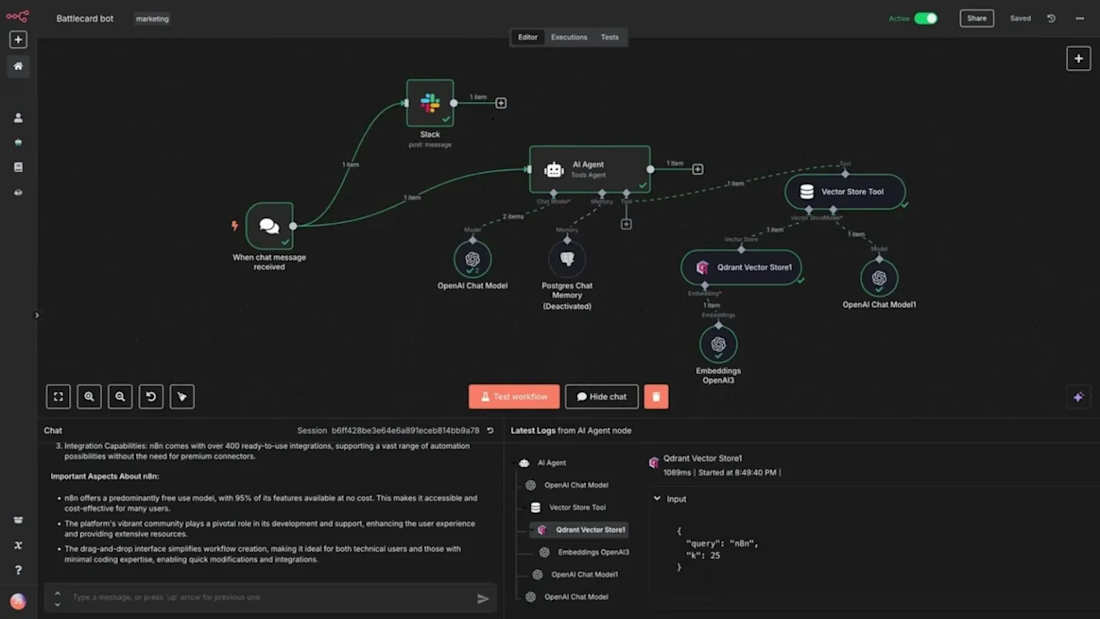
I developed high-performance AI Agents integrated into complex enterprise workflows using n8n as the core orchestration engine. The system leverages webhooks for instant data ingestion, Qdrant Vector Stores for semantic memory, and LangChain for intelligent decision-making. Designed for scalability, the architecture uses sophisticated data pipelines and conditional logic to route outputs across Slack, Google Sheets, and Email, reducing manual overhead through precise prompt engineering and structured memory management.



Super impressive work

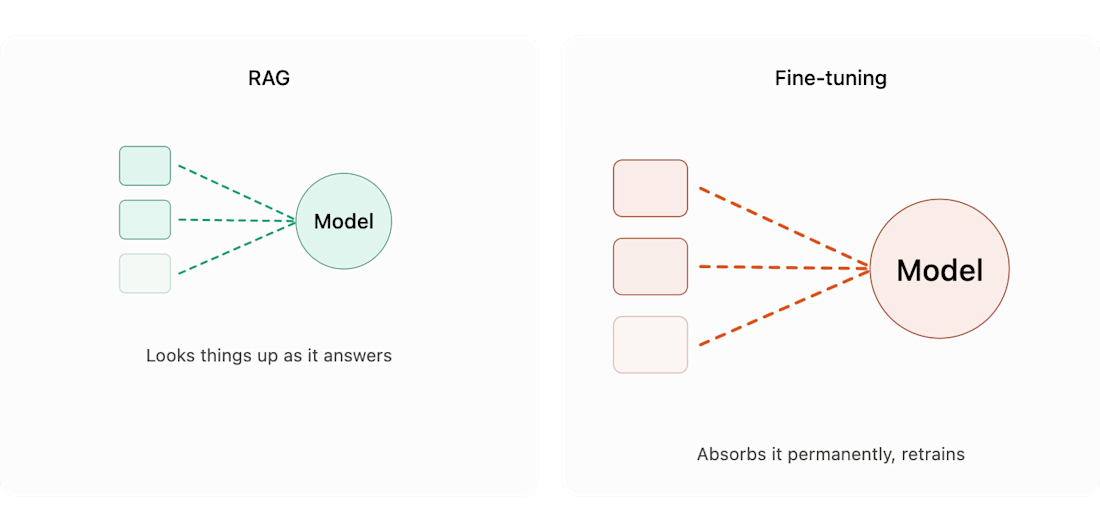
RAG or fine-tuning? The question I get asked most and the answer is almost never "fine-tune."
Quick way to think about it:
→ Your data changes often, or you need the model citing real, current info? Go RAG. Faster to build, cheaper to update, and you're not retraining every time something changes.
→ You need the model to consistently think or respond in a very specific style/format that plain prompting won't hold onto? That's when fine-tuning earns its cost.
Most business use cases internal knowledge bots, support agents, research assistants are RAG problems wearing a fine-tuning costume. People reach for the expensive option because it sounds more "AI," not because it's the right one.
Building something and not sure which one fits? Happy to help you think it through.
#AI #MachineLearning #RAG #SoftwareDevelopment #Contra


Hey! We've updated one of our most popular and frequently used Flora's workflows, where you could generate a model, then match the campaign's style, and then generate product showcasing in that editorial reference style. Now our workflow is more efficient and more fault-tolerant. We've updated all the techniques inside, switched from NanoBanana to GPT Image 2. It's more consistent and delivers more expected results. So, check it out, enjoy, and use it in your projects 👉 https://refer.flora.ai/NgofLHR