The network for creativity
Join 1.25M professional creatives like you
Connect with clients, get discovered, and run your business 100% commission-free
Creatives on Contra have earned over $150M and we are just getting started
Back to feedPost

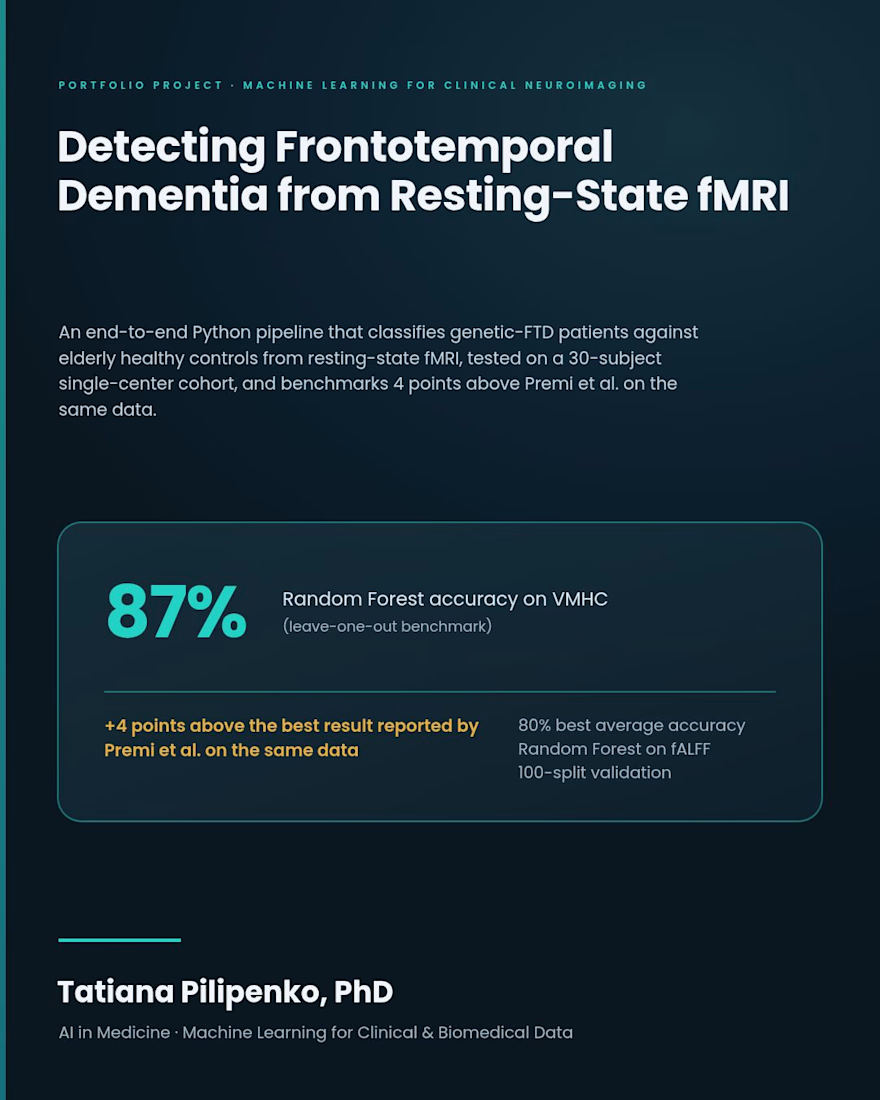
In this study, I worked on classifying genetic frontotemporal dementia from resting-state fMRI using Python and scikit-learn. We tested the approach in a small, single-center cohort of 14 patients and 16 healthy controls.
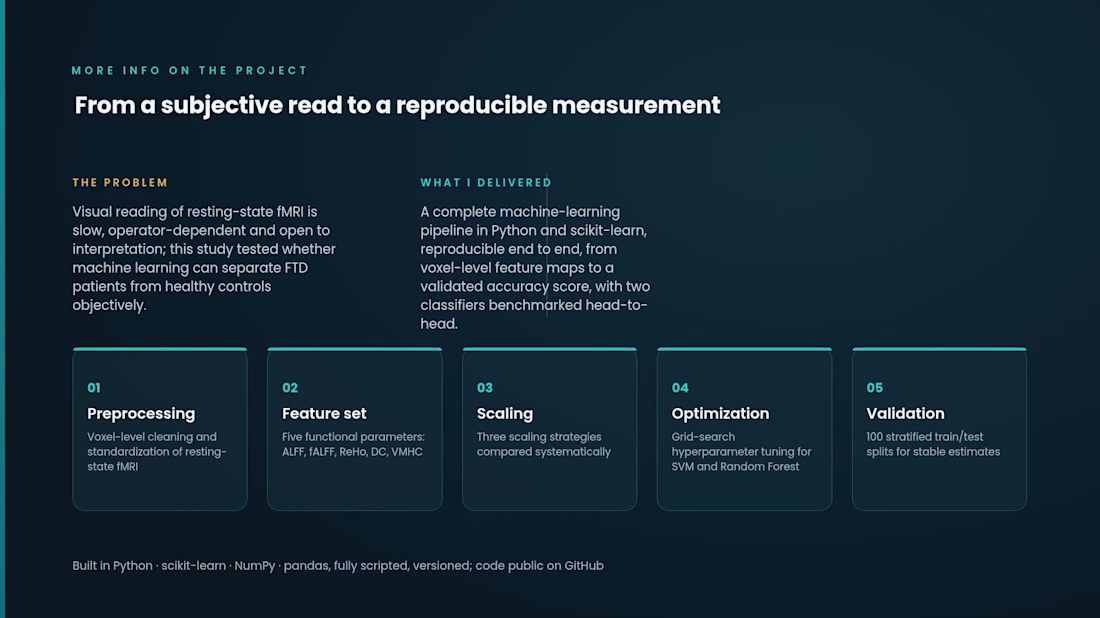
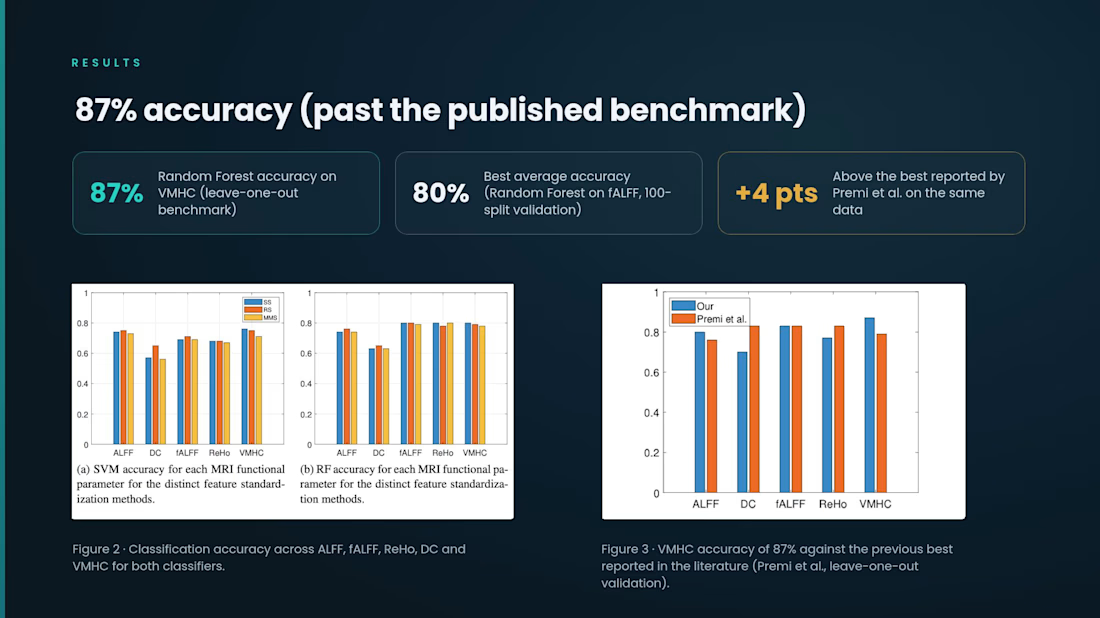
I compared SVM and Random Forest across five functional parameters and three scaling methods, with grid-search tuning and 100 stratified train/test splits.
Random Forest reached an average accuracy of 80% on fALFF under the 100-split validation. In a separate leave-one-out comparison, it reached 87% on VMHC, compared with 83% reported by Premi et al. on the same data.
The study was published in Procedia Computer Science at KES 2022, and the code is available on GitHub.

The network for creativity
Join 1.25M professional creatives like you
Connect with clients, get discovered, and run your business 100% commission-free
Creatives on Contra have earned over $150M and we are just getting started



Related posts

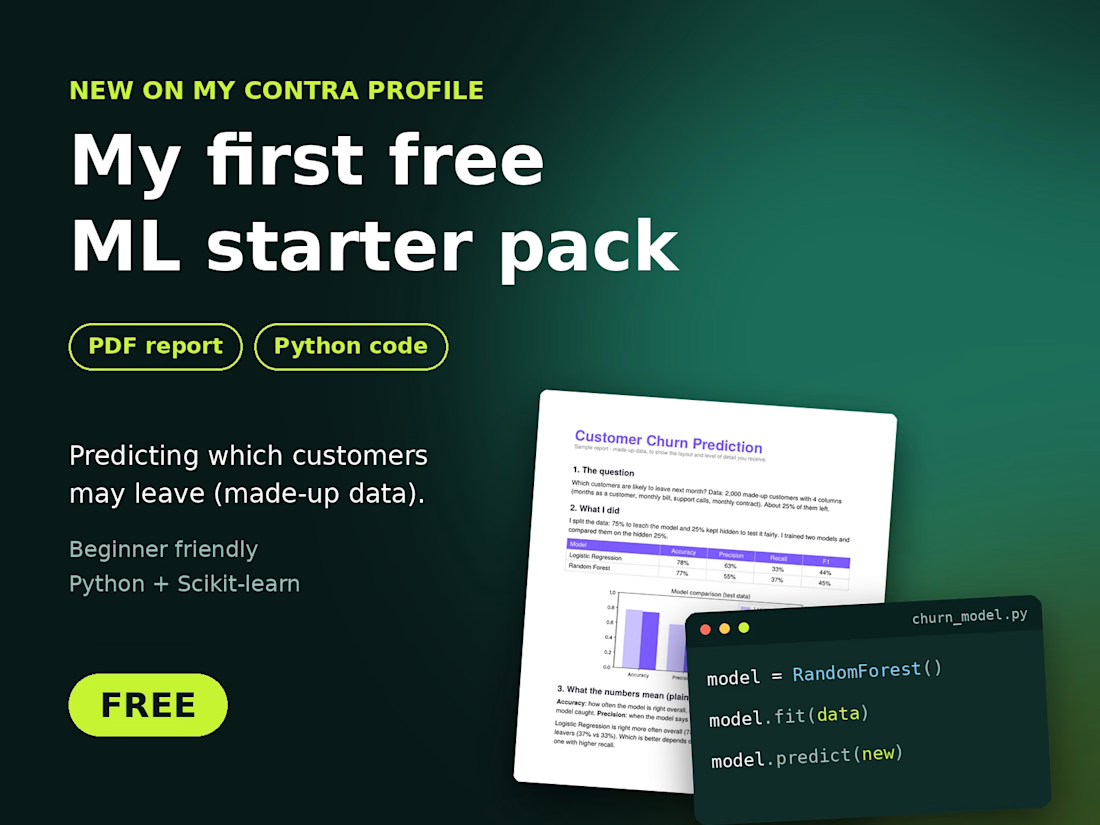
I just published a free starter pack that shows how machine learning can predict which customers will leave.
It has a 2-page plain-language report and the Python code (Pandas + scikit-learn). The data is made up, for learning only.
Feedback is welcome!