The network for creativity
Join 1.25M professional creatives like you
Connect with clients, get discovered, and run your business 100% commission-free
Creatives on Contra have earned over $150M and we are just getting started
Back to feedPost

Project Title:
Inventory Management Automation System (n8n + AI Agents + PostgreSQL)
Manual inventory management breaks down for a predictable reason: nothing keeps the stock count, the spreadsheet, and reality in sync once things start moving fast. Businesses end up overselling, missing reorder points, or making decisions on outdated numbers.
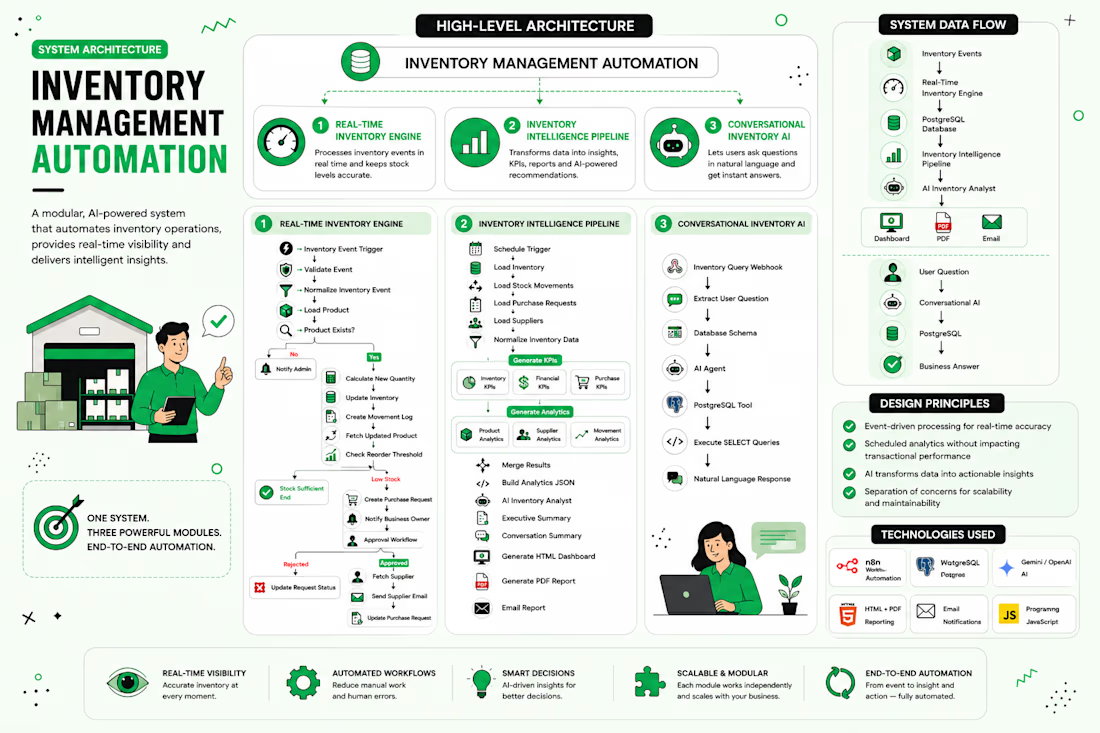
I designed and built an end-to-end inventory automation system to solve this, structured as three independent modules rather than one large workflow:
1. Real-Time Inventory Engine
Processes every inventory event sales, returns, damage, manual adjustments as it happens. Validates the event, updates stock, logs the movement for auditability, and checks reorder thresholds. When stock drops below the reorder point, it automatically creates a purchase request, routes it through an approval step, and notifies the supplier once approved.
2. Inventory Intelligence Pipeline
Runs on a schedule, fully decoupled from live operations. Pulls inventory, movement, and purchase data, calculates KPIs, generates AI-driven insights, and delivers an HTML dashboard and PDF report automatically.
3. Conversational Inventory AI
An AI agent that answers natural-language questions about inventory by querying PostgreSQL directly with read-only queries answers come from real data, not estimation.
Each module has different triggers, failure tolerances, and scaling needs, which is why they're built to run independently rather than as one workflow. PostgreSQL sits underneath all three as the single source of truth, so the dashboard, the AI answers, and the actual stock count never drift apart.
My Role:
End-to-end design and development architecture, workflow logic, database schema, AI agent integration, and reporting pipeline.
Tools & Technologies:
n8n · PostgreSQL · Gemini / OpenAI · JavaScript · Webhooks · HTML/PDF Reporting · Email Notifications
Links:
GitHub repository: https://github.com/anshudainsights3/inventory-automation.N8N/tree/main — full n8n workflow JSON, database schema, SQL scripts, architecture diagrams, and README.
The network for creativity
Join 1.25M professional creatives like you
Connect with clients, get discovered, and run your business 100% commission-free
Creatives on Contra have earned over $150M and we are just getting started





Related posts

👋 I'm new to Contra and I did my first post without realizing I hadn't even introduced myself!
Hey I'm Katya, I'm an AI Systems Architect, marketer and yoga teacher.
I build AI systems that bring in business and handle the work behind it. A voice agent that calls new leads back within seconds and books the appointment. A pipeline that traced 16,900+ leads to the ads that brought them. Listing videos made from the photos a real estate agent already has.
The marketing side came first. I built the multi-channel campaign for Jay Shetty's launch (22 million followers). After that I discovered the tech world and when AI came along, I realized I'm a builder at heart and never looked back! Building is so much fun 🤍
Here's what I've shared:
My first post: on building a fully AI-made YouTube video, end to end, because I'm camera shy 🙈 https://contra.com/community/MP9mFRuT-im-building-my-first-fully-ai-made
Last thing, if you're building with AI video or automation, I'd like to see what you're working on
And if you're hiring: I may be new to Contra but definitely not new to this work. Reach out for AI agent builds, apps, websites or anything in between.
P.s The video below is my AI avatar. My profile video is the real me :)


Nice Portrait....Has everything from a great pose, great composition and lighting and perfect environment setting.

Then: 1 month, 1 template.
Now: 1 week, 15 templates.
Same designer, different workflow.
I wrote up how I built no-code.supply: fifteen website templates, each with its own brand, in HTML and React, and some in Framer too. Claude Code did most of the typing. I did the directing.

no-code.supply
How I built 15 website templates with an AI coding agent in a week
How I built 15 AI-ready website templates with Claude Code in a week: the workflow, the quality bar, and why a template is only the starting point.

Going from one template a month to fifteen a week is wild. How much of the design direction did you still do by hand?

Local developer tool that executes atomic commit plans through a dual-agent AI pipeline (Generator & Reviewer) with real-time SSE streaming, quality gates, and automated rollbacks.




The dual agent pipeline creating atomic commit plans and the live SSE stream makes the review loop feel almost instant.