The network for creativity
Join 1.25M professional creatives like you
Connect with clients, get discovered, and run your business 100% commission-free
Creatives on Contra have earned over $150M and we are just getting started
Back to feedPost

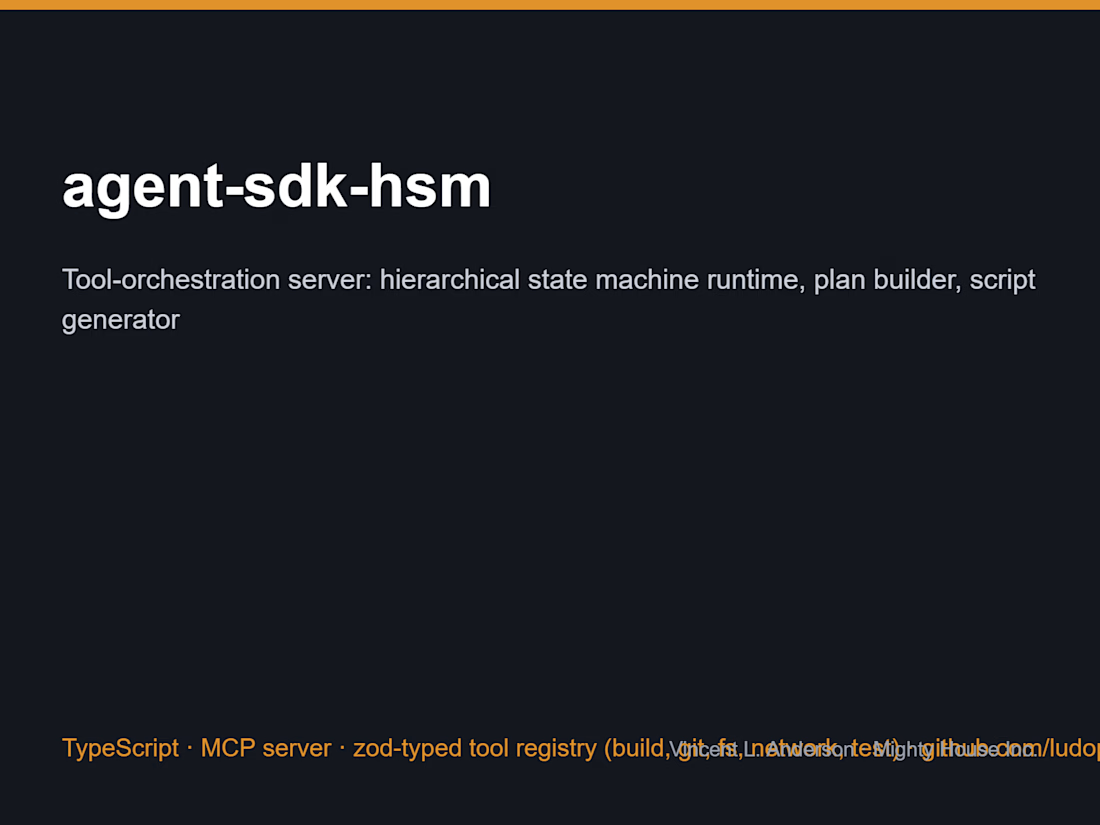
agent-sdk-hsm — a TypeScript tool-orchestration server built on the Agent SDK and the Model Context Protocol. A hierarchical state machine (HSM) runtime governs which tools an LLM agent may call and in what order; a plan builder turns a goal into an ordered, typed tool plan; a script generator emits the resulting shell script for review before anything runs. Tool registry is zod-typed and grouped by domain: build, git, filesystem, network, test. Source: https://github.com/ludoplex/agent-sdk-hsm


The network for creativity
Join 1.25M professional creatives like you
Connect with clients, get discovered, and run your business 100% commission-free
Creatives on Contra have earned over $150M and we are just getting started

Challenges
View all


Related posts


Code is a map of the problem it solves.
Good software is not defined by how much code exists, how complex the stack looks, or how many technologies were involved.
It is defined by whether the system solves the right problem clearly, reliably and with as little unnecessary complexity as possible.
At HERODOT, software engineering is where strategy becomes infrastructure.
Architecture, automation, interfaces, integrations, security, maintainability and performance all have to work together. The goal is not simply to ship code. The goal is to build systems that remain understandable, adaptable and useful after launch.
Because code is temporary.
The problem it solves is what matters.




The framing turns a fairly abstract engineering message into something visually legible—the red-on-black system and oversized type create a strong technical voice. The line about solving the right problem also gives the composition a clear point of view.

Just wrapped up my Autonomous Resume Verifier for the Micro1 Challenge! I built this AI agent to automate candidate screening by parsing and evaluating resumes instantly.
Tech Stack: Python, Streamlit, Llama 3 & Groq API.
Check out the video to see it in action! Let me know what you think.
#ArtificialIntelligence #Python #Streamlit #Llama3 #Groq #Micro1Challenge #WebDevelopment #AIAgent #FreelanceDeveloper


Perfect

Most people don’t avoid automation because they lack ideas.
They avoid it because turning “when this happens, do that” into a working system can swallow an afternoon.
n8n has just introduced an assistant that can take a plain-English request, build the workflow, run it, and help fix what breaks.
That makes the first step easier. But there’s still one thing the tool can’t decide for you: what should happen when reality doesn’t follow the happy path.
Before automating a task, write down:
What starts it?
What should happen?
When should a person step in?
If you could automate one annoying task this week, what would it be?
