The network for creativity
Join 1.25M professional creatives like you
Connect with clients, get discovered, and run your business 100% commission-free
Creatives on Contra have earned over $150M and we are just getting started
Back to feedPost


🚀 Project Launch: Vectra Governance – Autonomous Level-4 SRE Engine on Google Cloud
Human SRE response times to live production incidents average 42 minutes, costing enterprises thousands in SLA penalties and cloud egress burn.
I engineered Vectra Governance to eliminate that lag: an autonomous Level-4 reliability control room built for the Google Cloud All Things Agentic Hackathon.
Powered by Gemini on Vertex AI, Vectra Governance executes closed-loop incident remediation in real time using the O.D.E.R. Loop (Observe, Diagnose, Evaluate, Remediate), transforming raw log spikes into cryptographically signed, zero-trust infrastructure patches in seconds.
⚡ Key Features & Technical Architecture:
* Closed-Loop Remediation: Automatically ingests live telemetry logs, runs multi-agent reasoning, and deploys gcloud patches without human delay.
* FinOps SLA Protection: Calculates financial exposure instantly to slash excess egress burn and avert severe downtime liabilities.
* Enterprise Stack: Python, FastAPI, Docker multi-stage containerization, deployed natively to Google Cloud Run.
🔗 Try the Live System:
* Control Room: https://vectra-governance-630243518379.us-central1.run.app/
Looking to build autonomous AI
infrastructure, zero-trust agentic gateways, or production Cloud Run backends?
Explore my active Contra services or reach out directly to collaborate.
The network for creativity
Join 1.25M professional creatives like you
Connect with clients, get discovered, and run your business 100% commission-free
Creatives on Contra have earned over $150M and we are just getting started



Related posts

I tried to create the cleanest AI/SaaS startup template.
Please check and share your thoughts!
https://www.framer.com/marketplace/templates/novasai/


Every interaction remembered, context never lost is a genuinely good hero line for an AI product, it sells the benefit not the tech. That soft blue gradient keeps it calm instead of the usual dark techy template look. Clean build.

Cybersecurity tools can feel overwhelming for small teams.
Shielda explores a cleaner dashboard experience that helps businesses monitor their digital footprint across domains, email, and social channels.
The interface surfaces password leaks, phishing clones, suspicious mentions, and brand abuse through a clear Security Score, compact threat cards, severity tags, and AI-powered summaries.
Instead of forcing users to interpret complex security data, Shielda helps them understand what happened, how serious it is, and what to do next.


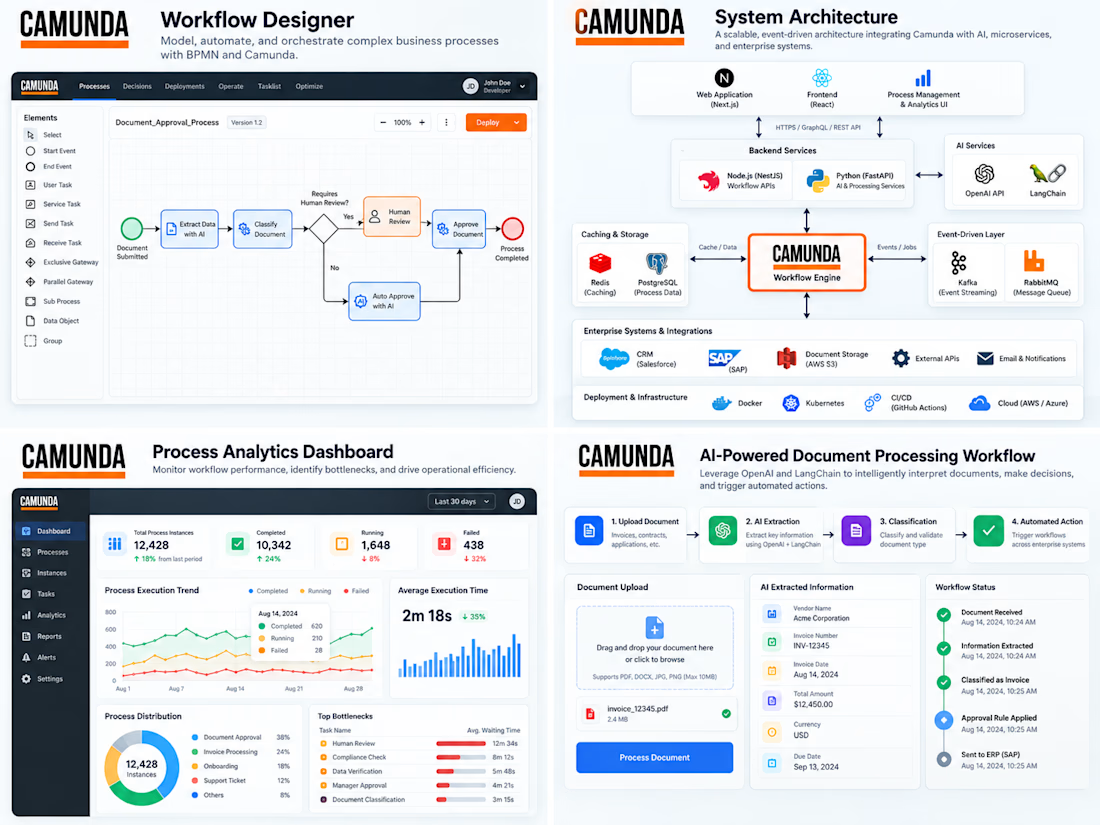
Camunda enterprise workflow automation platform
I led the architecture and development of an enterprise workflow orchestration platform built around Camunda and BPMN, designed to automate complex, mission-critical business processes.
I developed scalable backend services using Node.js/NestJS and Python/FastAPI, with React and Next.js powering process management and analytics experiences. I also integrated OpenAI and LangChain to introduce AI-driven decision capabilities, enabling workflows to interpret documents, classify incoming data, make contextual decisions, and automatically trigger actions across connected services.
To support high-volume workflow execution, I designed a distributed, event-driven processing architecture using queue-based systems, reducing workflow latency by 35%. I optimized GraphQL and REST APIs with Redis caching and asynchronous processing, improving API response times by 30%.
I also built interactive process analytics dashboards that gave teams visibility into workflow status, execution metrics, failures, and bottlenecks, contributing to a 40% improvement in operational efficiency.
The platform was containerized with Docker and deployed through Kubernetes-based CI/CD pipelines, reducing release cycle time by 25%.
Technologies: Camunda, BPMN, Node.js, NestJS, Python, FastAPI, React, Next.js, TypeScript, OpenAI API, LangChain, GraphQL, REST APIs, Redis, Docker, Kubernetes, CI/CD