The network for creativity
Join 1.25M professional creatives like you
Connect with clients, get discovered, and run your business 100% commission-free
Creatives on Contra have earned over $150M and we are just getting started
Back to feedPost

Copybook is a Video.js v10 skin for lesson videos. It treats the player as a page in a school exercise book: the video is taped onto squared paper beside a red margin, the seek bar is a wooden ruler, and captions are written on a highlighter strip under the picture instead of over it.
Every control sits on the paper below the video, so text and icons keep the same contrast over any footage. The ruler is divided by the video's chapters, numbered like centimetres, and finished parts turn green, so the seek bar doubles as lesson progress; hovering it shows a polaroid of that moment. The same chapters build a checklist outline next to the player.
Small details carry the idea through: a ruled title card before the lesson starts, hand-drawn icons, sticky notes that confirm shortcuts and double-taps, and a gold star when the lesson is finished. Buttons are at least 44px, every icon has a tooltip with its shortcut, focus is a thick pen-blue outline, and all motion switches off under reduced motion. Four colour themes (Classic, Kraft, Night and Chalkboard) are switched with one attribute, and each is checked for contrast.
I built it for the video tour of my own browser extension, AI Bookmarks and Notes, where it now runs live.
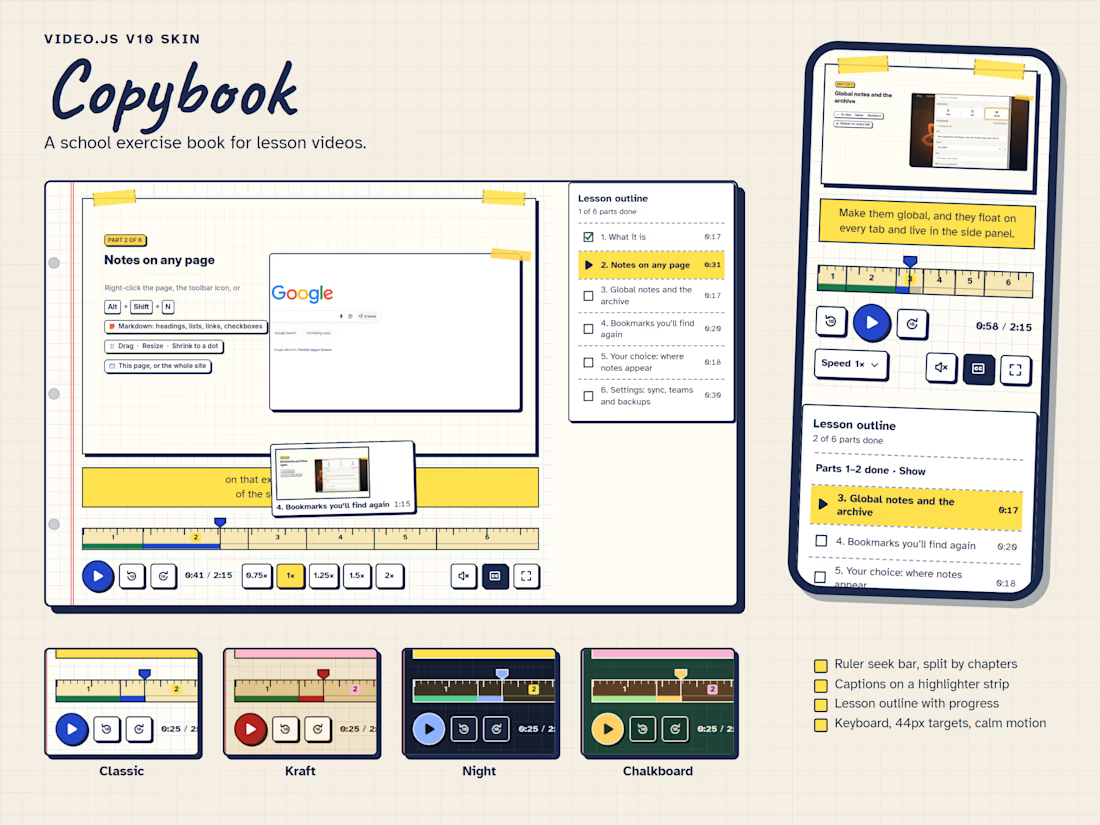

A wooden ruler as the seek bar and captions on a highlighter strip, so charming.
The network for creativity
Join 1.25M professional creatives like you
Connect with clients, get discovered, and run your business 100% commission-free
Creatives on Contra have earned over $150M and we are just getting started



Related posts

I Designed a custom skin for the Video.js v10 player.
In Video.js v10, a skin is the player’s interface: the UI components plus the styles that present them. Video.js is open source and community-driven, and the player can end up on almost any website, so every skin makes a choice: how much personality it has, how well it fits into someone else’s design, and how far it pushes the controls. This was all incorporated into the design from scratch. The built-in v10 skins show this range. Creativity and mastery are incorporated to produce something nice and pleasant.
videojs.org
Video.js | Open Source Video Player
The open-source video player for React and HTML. Lightweight, accessible components built for performance and streaming.


Please make sure you've shared a public link for us to view your project!

Plate is an HTML skin for Video.js 10. It draws the player the way quickflow.dev draws everything else: a numbered head with a status word, the picture framed by corner marks, a chapter index beside it, a ruler for a timeline and text keys underneath. A player is a diagram of a video's time, so I drew it like one.
What it does
Every chapter cue gets a button in the index, with its own frame from Mux's storyboard. Video.js has no chapter navigation control yet, so a small custom element reads the cues from the player store. Below 760px the index turns into a strip that scrolls with the video.
The time slider is a ruler, with a numbered mark where each chapter starts.
The keys are words you can read. Speed, Quality, Captions and Audio open Video.js menus. Space, K, M, the arrows, J and L, 0 to 9, < and >, F, C and I all work from the keyboard, and every control shows a focus ring.
In fullscreen the picture goes edge to edge, the controls fade while it plays, and an Index key opens the chapters as a side panel.
It comes in three themes (Night, Blueprint, Signal), takes your colours, fonts and corners through public custom properties, and speaks seven languages: English, German, French, Spanish, Romanian, Russian and Arabic, right to left included. It follows reduced motion, higher contrast, reduced transparency and forced colors.
The workbench at plate.quickflow.dev lets you try it on your own video, change every property, watch contrast and control names in a live accessibility readout, and download the CSS for your theme.
Plate plays the showreel on quickflow.dev. The code is open source under Apache 2.0.


does the chapter index stay visible in fullscreen or does it tuck away?

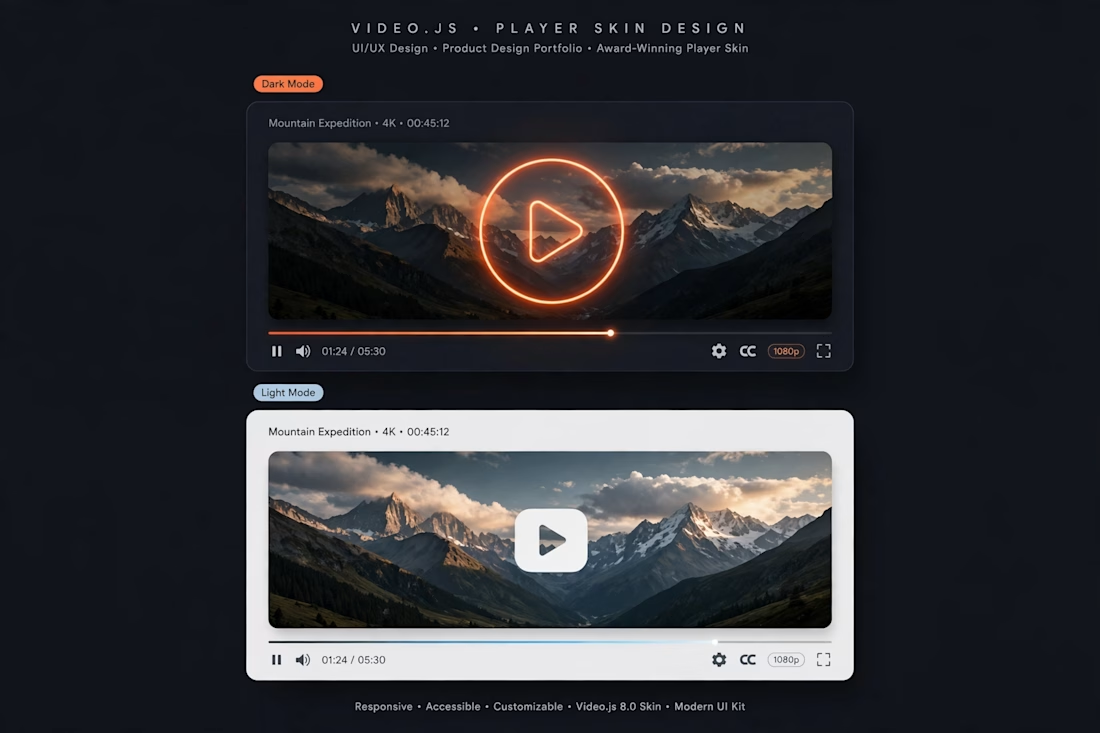
GlowFlow - Premium http://Video.js Skin. I designed a modern player with both Dark Mode and Light Mode. It has a glowing play button, clean progress bar, and easy controls for volume, captions, quality, and fullscreen. It is responsive, accessible, and easy to use on phone and computer.