The network for creativity
Join 1.25M professional creatives like you
Connect with clients, get discovered, and run your business 100% commission-free
Creatives on Contra have earned over $150M and we are just getting started
Back to feedPost

AuraLens - a desktop-class photo editor that runs entirely in the browser
No server. No upload. No account. On-device AI reads the photo (80+ object
classes, faces, exposure), auto-fixes it, and hands the user 25+ pro tools
curves, levels, frequency separation, dodge & burn, mesh warp, histogram and waveform scopes - all on Canvas/WebGL pipelines running locally. A real Lightroom workflow where the original image never leaves the customer's laptop.
Stack: WebGL + Canvas pixel pipelines, on-device ML models (loaded once,
run offline after), optional opt-in cloud vision via Cloudflare Workers AI
that only ever sends a downscaled copy - privacy as architecture, not a
policy page. Open-sourced (AGPL with commercial license available)


The network for creativity
Join 1.25M professional creatives like you
Connect with clients, get discovered, and run your business 100% commission-free
Creatives on Contra have earned over $150M and we are just getting started











Related posts

This is wild to me!
I have worked so hard to build this profile and it just goes to show that you really do get out what you put in. Work has really picked up since I worked on my discovery score and the right clients seem to be finding their way to me. Couldn't be happier.

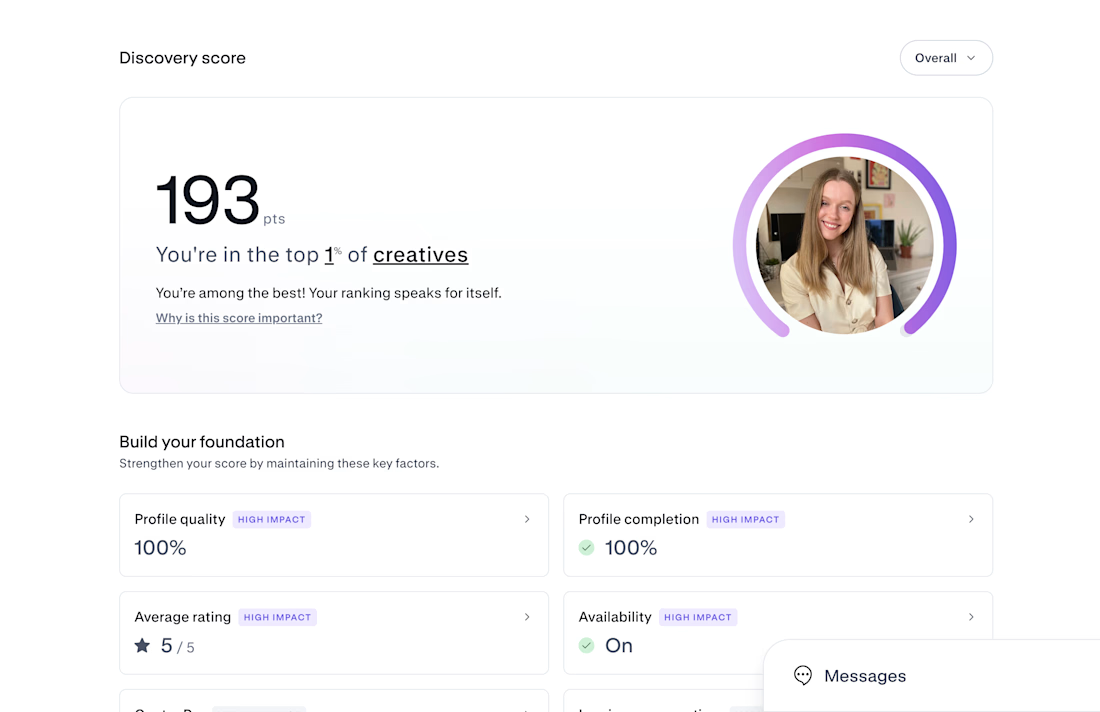

Congrats on Top 1% — that's huge! 193 is wild. If you don't mind sharing, what moved the needle most for your discovery score? Was it profile completion, case studies, or just consistent posting? Trying to build mine from scratch right now.


This UI was really great nice job Piotr🔥🔥🔥

An interaction study for Mare’s collection feed, exploring how to make groups legible within a dense, mixed-format archive.
The layout preserves image proportions and integrates collection labels into the packing system. On hover, image-derived gradients establish the collection boundary, while subtle displacement creates space around the active group without changing its position or scale.
The motion studies isolate assembly, packing, colour and proximity, using real collection content to examine timing, spatial continuity and hover behaviour.

Love how you preserved image proportions while keeping the labels integrated into the packing system. The image-derived gradients on hover is a smart way to establish grouping without adding extra UI. Really thoughtful interaction study!