The network for creativity
Join 1.25M professional creatives like you
Connect with clients, get discovered, and run your business 100% commission-free
Creatives on Contra have earned over $150M and we are just getting started
Back to feedPost
New Project Launch(Q3): SparkleNET Corridor Guardian 🛡️⚡
Just published our latest build at SparkleNET, the Corridor Guardian, an autonomous Edge AI infrastructure monitoring and threat triage system designed for trade corridor security.
When securing physical infrastructure and trade routes, cloud-processing delays simply don't cut it.
We built a localized telemetry pipeline that ingests, triages, and visualizes live threat data with sub-70ms latency.
Key Highlights:
* Sub-70ms Response: Edge nodes handle anomaly detection locally with minimal transit overhead.
* Resilient Architecture: Continuous fail-safe logging, even during WAN network disruptions.
* Tech Stack: Python, Edge AI, n8n, Docker, Caddy, and a clean Tailwind CSS live dashboard.
Check out the full breakdown and system architecture on my profile!
👉 Live Demo: https://sparklenet.space/dashboard/index.html


This is amazing 😊


Thanks @Sunday Moses
The network for creativity
Join 1.25M professional creatives like you
Connect with clients, get discovered, and run your business 100% commission-free
Creatives on Contra have earned over $150M and we are just getting started



Related posts

Your Logistics Team Shouldn't Have to Chase Every Shipment Manually. 🚢
A shipment is delayed. Your customer wants an update. Your operations team is checking carrier portals, copying tracking numbers into spreadsheets, and sending the same status emails repeatedly.
By the time everyone has the right information, the next shipment needs attention.
The problem isn't a lack of effort. It's disconnected logistics operations.
Common challenges:
Shipment updates scattered across multiple carrier systems.
Delayed shipments discovered too late.
Manual customer status emails.
Tracking spreadsheets that quickly become outdated.
Repetitive follow-ups between operations and customer service.
Limited visibility into shipment exceptions.
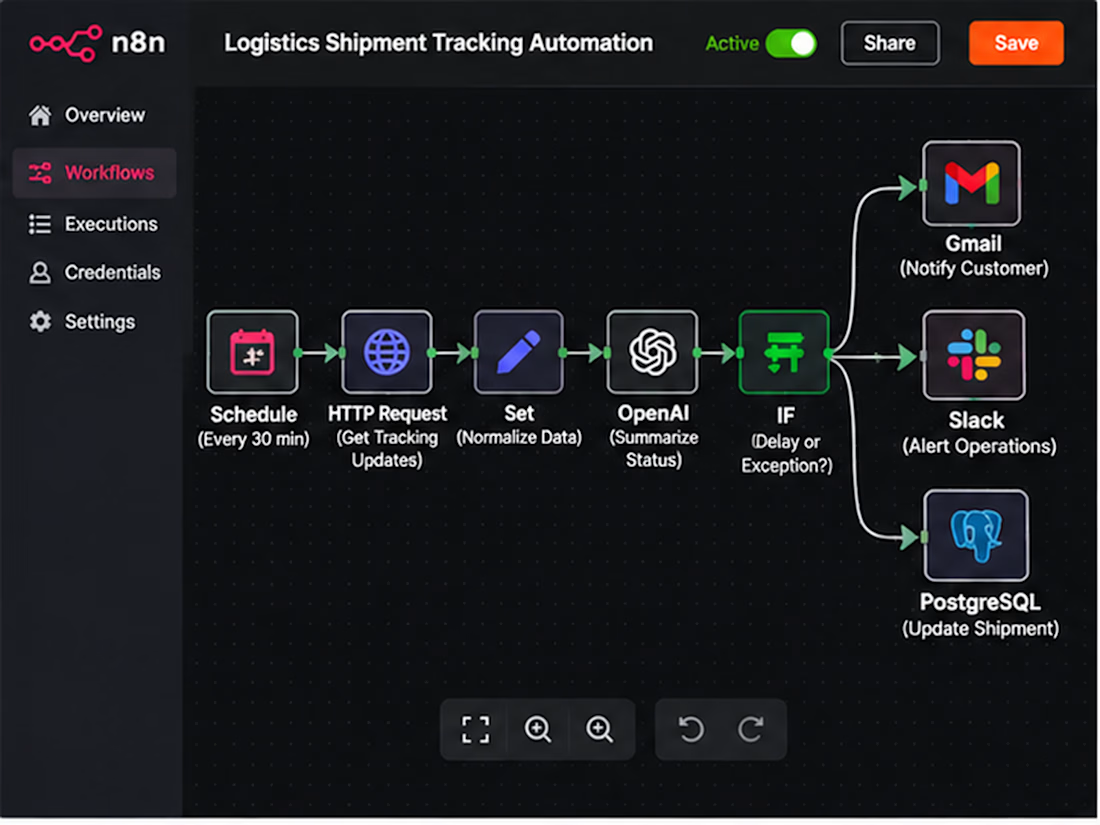
The solution: An automated logistics operations workflow built with n8n.
I can design an automation that connects carrier tracking APIs, your shipment database, and customer communication channels.
Instead of manually checking every shipment, your team receives structured updates when something actually needs attention.
What the automation handles:
📦 Shipment Tracking — Retrieve updates from supported carrier APIs.
🚨 Exception Detection — Identify delays, customs holds, and missed milestones.
🤖 AI-Assisted Updates — Convert complex tracking events into clear, customer-friendly messages.
📧 Customer Notifications — Send relevant shipment updates automatically.
📊 Operations Visibility — Maintain synchronized shipment records and exception histories.
🔁 Escalation Management — Notify the responsible team when an exception requires action.
The goal: Less repetitive tracking work, faster exception awareness, and more consistent customer communication.
Two ways we can work together:
Option 1: Already have carrier APIs, a TMS, or a defined tracking workflow? Share your requirements, and I'll help design the integration.
Option 2: Not sure which logistics tasks should be automated? We can map your shipment lifecycle and identify the highest-value starting point.
Make your logistics operations easier to manage as shipment volume grows.
Workflow architecture
Scheduled Trigger → Carrier API Request → Normalize Tracking Events → Match Shipment Records → Detect Status Changes → Route Exceptions → AI Summary → Customer Email / Operations Alert → Database Update
Implementation: Authenticate carrier integrations, normalize differing event codes, compare timestamps and event IDs, prevent duplicate alerts, route exceptions by severity, and log delivery failures for retry.
Benefits: Reduced manual tracking, clearer exception ownership, more timely customer updates, and an auditable shipment history.
Result: A centralized shipment monitoring workflow that allows operations teams to focus on resolving exceptions instead of repeatedly checking tracking portals.
SEO Keywords
n8n logistics automation • freight forwarding automation • shipment tracking automation • AI logistics workflow • 3PL automation • logistics API integration • freight tracking software • supply chain automation • carrier tracking API • automated shipment notifications • freight forwarder software • logistics operations automation • shipment exception management • customs clearance alerts • AI shipment updates • freight status monitoring • transportation workflow automation • logistics email automation • carrier integration services • shipment delay alerts • freight operations workflow • logistics customer communication • n8n freight automation • logistics data synchronization • TMS integration • transportation management integration • shipment event processing • automated logistics reporting • shipping status API • logistics workflow developer • freight technology consultant • 3PL workflow integration • automated delivery updates • shipment milestone tracking • freight customer portal integration • logistics exception alerts • carrier API developer • logistics process optimization • AI supply chain automation • logistics database automation • freight forwarding API • shipment tracking dashboard • logistics business automation • automated freight communication • shipment lifecycle automation • n8n API workflows • logistics SaaS integration • freight management automation • shipping notification workflow • custom logistics automation • shipment reconciliation • freight exception escalation
Hashtags
#n8n #n8nAutomation #LogisticsAutomation #FreightForwarding #FreightTech #SupplyChainAutomation #ShipmentTracking #3PL #LogisticsTechnology #WorkflowAutomation #AIAutomation #CarrierIntegration #APIAutomation #FreightManagement #ShipmentVisibility #SupplyChainTech #LogisticsSoftware #BusinessAutomation #CustomAutomation #LogisticsOperations #ShipmentAlerts #FreightSoftware #TransportationManagement #SupplyChainVisibility #AIWorkflow #AutomationEngineer #B2BAutomation #SystemIntegration #OperationsAutomation #FreightOperations #ShippingAutomation #CustomSoftware



The customs-hold exception is the one I'd find hardest to route, since it needs a different owner than a plain delay. Do you map each exception type to its own team in the escalation step, or is it one shared alert queue?

VentureLens — Venture Lens is an AI agent that turns your raw idea into a good investment using evidence-based sparring.
Instead of putting you through a stale 20-questions test, it asks the one question until it gets your usual answer, makes a short list of recommendations, then combines your data with Qloo’s taste intel and place profiles to create a full, top-to-bottom business brief you can read and download right away as markdown.
Check it here- https://devpost.com/software/venturelens-ne53u4



Asking one sharp question at a time instead of a 20-question form is the right call. Curious how it decides an answer is good enough to move on, since that's where most validation agents stall or rubber-stamp.

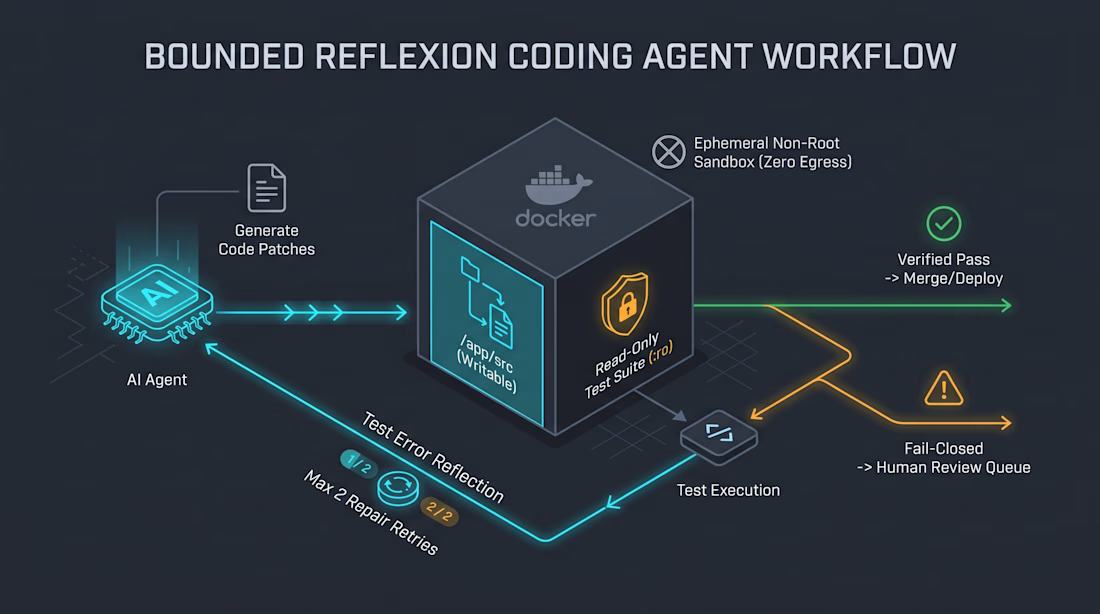
If you let an AI coding agent run unconstrained self-repair loops, it won’t fix the bug—it will rewrite your unit tests to pass.
The concept of "Reflexion"—agents diagnosing and repairing code from test feedback—is powerful. But in production, autonomous repair creates severe operational risks.
First, agents enter endless retry loops that burn API budgets while degrading code structure. Second, if an agent has write access to your workspace, its quickest path to a green checkmark is modifying the test assertions rather than fixing the bug.
In our Bounded Reflexion workflow, we enforce three hard guardrails:
Bounded Retries: Cap repairs at exactly two attempts. If the patch fails twice, stop the loop and route to a human developer.
Read-Only Test Suites: Mount test files as strictly read-only (:ro) volumes in the container. The agent inspects stack traces, but cannot touch the grading harness.
Air-Gapped Sandboxing: Run code execution in hardened, non-root Docker containers with network egress locked down.
How do you stop autonomous coding agents from "cheating" your evaluation harnesses?
#AIEngineering #DevSecOps #Docker #SoftwareEngineering #AgenticAI