The network for creativity
Join 1.25M professional creatives like you
Connect with clients, get discovered, and run your business 100% commission-free
Creatives on Contra have earned over $150M and we are just getting started
Back to feedPost

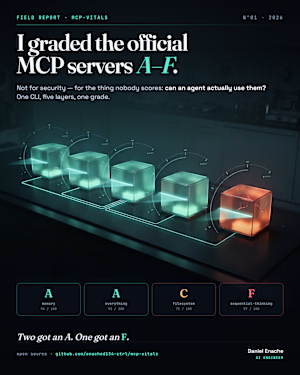
I graded the official MCP servers. Two got an A, one got an F — and the most useful finding came from a layer nobody else measures.
mcp-vitals (open source) grades an MCP server's reliability A–F across three layers: static schema quality, behavioral tests run against the live server, and — the novel part — agent-usability: hand an LLM the tool list and a real task, and see if it picks the right tool and builds a valid call.
Results on the official reference servers:
• memory — A (94)
• everything — A (92)
• filesystem — C (71)
• sequential-thinking — F (57)*
The finding that matters came from the agent-usability layer. On the filesystem server, a model given a "read this file" task couldn't tell read_file from read_text_file and picked the tool that doesn't exist. A security scanner or a static grader never sees that — but it silently breaks agents in production.
*The F is honest: sequential-thinking's single tool needs a payload my schema-only generator can't synthesize, so the behavioral layer couldn't exercise it. A conservative grader that won't vouch for what it can't verify — I document that plainly in the report.
Security scanners tell you a server is safe. mcp-vitals tells you if it's any good.
Live report → https://enached134-ctrl.github.io/mcp-vitals
Repo (MIT, drop-in GitHub Action) → https://github.com/enached134-ctrl/mcp-vitals
enached134-ctrl.github.io
The State of MCP Reliability — graded A–F
I graded the official MCP reference servers for reliability and agent-usability. Two got an A, one got an F. Open-source CLI + GitHub Action.
The network for creativity
Join 1.25M professional creatives like you
Connect with clients, get discovered, and run your business 100% commission-free
Creatives on Contra have earned over $150M and we are just getting started





Related posts

Use AI for the boring 60% of your MVP: boilerplate, CRUD screens, forms, API wiring. Save your own brain for the 40% that decides if it works: the core loop, edge cases and what NOT to build:)



Saw this - been testing Seedance 2.5 too. Output is good but still needs human clean-up, esp label warp. I disclose it as AI-assisted. Human eye still matters.

Is AI finally good enough to shoot a product demo on its own, or human touch is still needed?
I generated a 20s product demo with Seedance 2.5 in a single take providing it with one product image reference and an example video transcript (posted in the comments).
Do you disclose...

so impressive


Website Functional and Regression Testing
Showcase test scenarios for login, forms, navigation, filters, validation and error handling.