The network for creativity
Join 1.25M professional creatives like you
Connect with clients, get discovered, and run your business 100% commission-free
Creatives on Contra have earned over $150M and we are just getting started
Back to feedPost

I Spent Years Shaving Milliseconds. Then We Added an LLM.
Most of the wait isn't the model. It's everything you built around it.
For a long stretch of my career, latency was the job.
On the VoIP platform, a few hundred milliseconds of delay in the signalling path
was the difference between a call that felt natural and one where people talked
over each other. We measured everything. We argued about connection pools. A
regression of 80ms was a conversation.
Then we started putting language models into products, and suddenly a nine-second
response was considered normal. Nobody flinched. The demo worked, the answers were
good, and the wait was just accepted as the cost of doing AI.
It isn't. And the thing I found most interesting when I actually measured one of
these end to end is that the model was not the main problem.
Where the time actually goes
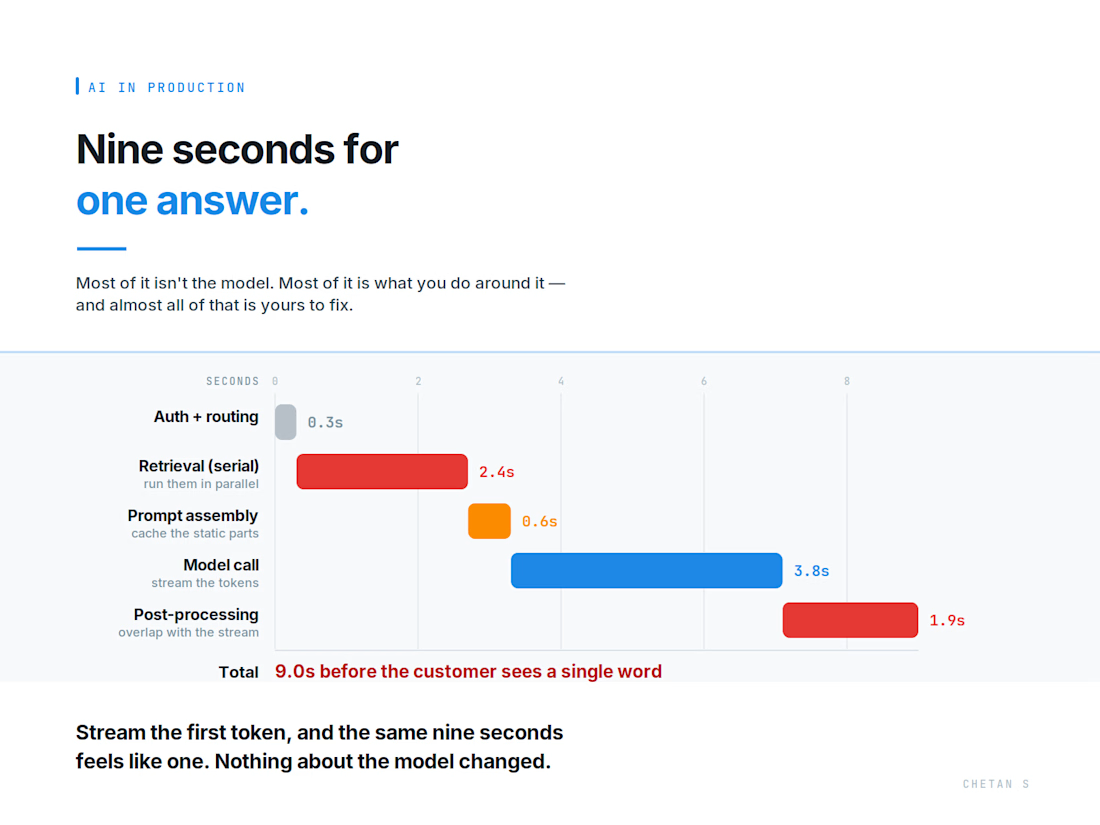
If you profile a typical AI assistant request, you get something like this.
A small amount at the front for auth and routing. Then retrieval — and this is
usually where the first surprise is, because most implementations run their
lookups one after another. Search the vector index, then fetch the conversation
history, then pull the customer record. Each is fast. In sequence they're not.
Then prompt assembly, which sounds instant and often isn't, because someone is
rebuilding the same system prompt and the same set of examples on every single
request.
Then the model call itself.
Then post-processing — parsing, validating, formatting, maybe a second model call
to check the first one — which happens after the model has already finished, while
the customer continues to wait.
In the one I measured, the model was under half the total. Everything else was
mine.
The fixes are unglamorous
Run retrieval in parallel. Your vector search, your conversation history and
your user lookup don't depend on each other. Fire them together. This is
first-year concurrency and it routinely saves seconds.
Cache the parts of the prompt that never change. Your system instructions and
your few-shot examples are the same on every request. Assemble them once. Several
providers will also cache a common prefix on their side and charge you less for
it, which is a rare case of faster and cheaper being the same change.
Overlap post-processing with generation. If you're streaming, you can start
validating and formatting the beginning of the answer while the end is still being
produced. Most implementations wait for the whole thing first, out of habit rather
than necessity.
Don't use your biggest model for everything. Intent classification doesn't
need the same model that writes the final answer. A smaller model on the routing
step is faster and cheaper, and the quality difference on a classification task
is usually nothing.
The one that matters more than all of them
Stream the response.
Nine seconds where nothing happens is unbearable. Nine seconds where words start
appearing after 800 milliseconds is completely fine — and people will read along
as it generates, which means the perceived wait is closer to one second than nine.
The total time is identical. The experience is not remotely the same.
This is the single highest-leverage change available in most AI features, and it's
often skipped because the first version was built as a request/response call and
nobody went back to it.
Why this is worth caring about
There's a comfortable assumption that this problem solves itself — models keep
getting faster, so wait it out.
Partly true. But inference speed improving doesn't fix serial retrieval, and it
doesn't fix rebuilding your prompt from scratch every time, and it doesn't fix
blocking post-processing. Those are architecture problems and they'll still be
there on a faster model. You'll just have a shorter blue bar in the middle of the
same chart.
And the cost of slowness is real. People abandon. On a support assistant, a slow
answer pushes customers to ask for a human, which is precisely the outcome the
system was built to avoid — and it looks in your metrics like the bot failed to
answer, when actually it just answered too late to be wanted.
The bit I keep coming back to
The habits that made me useful on telephony systems turned out to transfer almost
completely. Measure the whole path, not the part everyone's looking at. Parallelise
what doesn't depend on anything. Cache what doesn't change. Show the user something
as soon as you possibly can.
None of that is AI knowledge. It's just performance work, applied to a new place
where — for reasons I don't fully understand — we all agreed to stop doing it.
Have you actually profiled one of your AI features end to end? I'd be curious what
fraction turned out to be the model versus everything around it. Mine was under
half, and I was genuinely surprised.
The network for creativity
Join 1.25M professional creatives like you
Connect with clients, get discovered, and run your business 100% commission-free
Creatives on Contra have earned over $150M and we are just getting started



Related posts

Exploring the listening state for an AI voice interface.
Which direction would you ship, A or B?
10 voted
29%
25 voted
71%
35 votes
Closed

The particle field looks more polished and beautiful🔥

Building a robotics startup? Meet Torq Robot, a new template on shadcnspace ⚡


Cool template for robotics.

An AI customer support chatbot for a fictional Nigerian food delivery business, Lagos Fresh Kitchen. It runs on n8n Cloud and uses Claude Haiku 5.5 as the AI model. The workflow is three nodes: a chat trigger receives the customer’s message, an AI Agent processes it, and the Anthropic Chat Model writes the answer.
How it behaves
The AI Agent has a system message that sets the rules. It must answer only from the business information, never invent prices, areas, hours or policies, and use a fixed fallback line when the answer isn’t there: “I don’t have enough information to answer that accurately. Please contact our support team.”
The business information it knows
Open Monday to Saturday, 9 AM to 8 PM, closed Sundays
Delivers to Lagos Mainland (Ikeja, Yaba, Surulere, Maryland, Ojota, Gbagada) and Island areas (Victoria Island, Ikoyi, Lekki), not outside Lagos
Delivery takes 30 to 60 minutes, with fees from ₦1,000
Menu of jollof rice, fried rice, rice and stew, pounded yam with egusi, grilled chicken, suya and soft drinks
Payments by card, transfer and cash on delivery
Cancellation allowed before cooking starts
No Sunday orders or Sunday delivery, and no event catering
Refunds, complaints and order status go to support


good work