The network for creativity
Join 1.25M professional creatives like you
Connect with clients, get discovered, and run your business 100% commission-free
Creatives on Contra have earned over $150M and we are just getting started
Back to feedPost


Tools don’t create leverage. Clear thinking does.
This is something I keep noticing in web projects as new tools and frameworks keep showing up.
Productivity rarely slows down because we’re missing a tool. More often, it slows down because our understanding of the system gets blurry. Adding another tool at that point usually increases mental load instead of reducing it.
Clear thinking isn’t about avoiding tools. It’s about pausing to ask what really needs to be solved and what can be simplified first.
Why this matters: clearer thinking makes projects easier to maintain, easier to collaborate on, and less exhausting over time.
Leverage doesn’t come from the toolbox.
It comes from how clearly we think about the system we’re building.

The network for creativity
Join 1.25M professional creatives like you
Connect with clients, get discovered, and run your business 100% commission-free
Creatives on Contra have earned over $150M and we are just getting started











Related posts

Making software faster is not always about doing more work. Sometimes, it is about eliminating work the system does not need to do.
Imagine an application processing thousands of records. If it repeatedly copies information it already has, it can consume additional memory and processing time, especially as the workload grows.
One way to improve efficiency is to work with existing data instead of creating unnecessary copies.
But there is a trade-off.
Keeping references to existing data can make the system more efficient, but it also introduces constraints around how long that data remains available and when it can safely be used.
Creating a separate copy may consume more resources, but it can make the data easier to manage independently.
This is where engineering judgment matters.
The goal is not to eliminate every copy or optimize every operation. It is to understand where the overhead comes from, determine whether it meaningfully affects performance, and choose an approach that balances efficiency with maintainability.
Good engineering is not about using fewer resources at all costs. It is about removing unnecessary costs without creating unnecessary complexity.


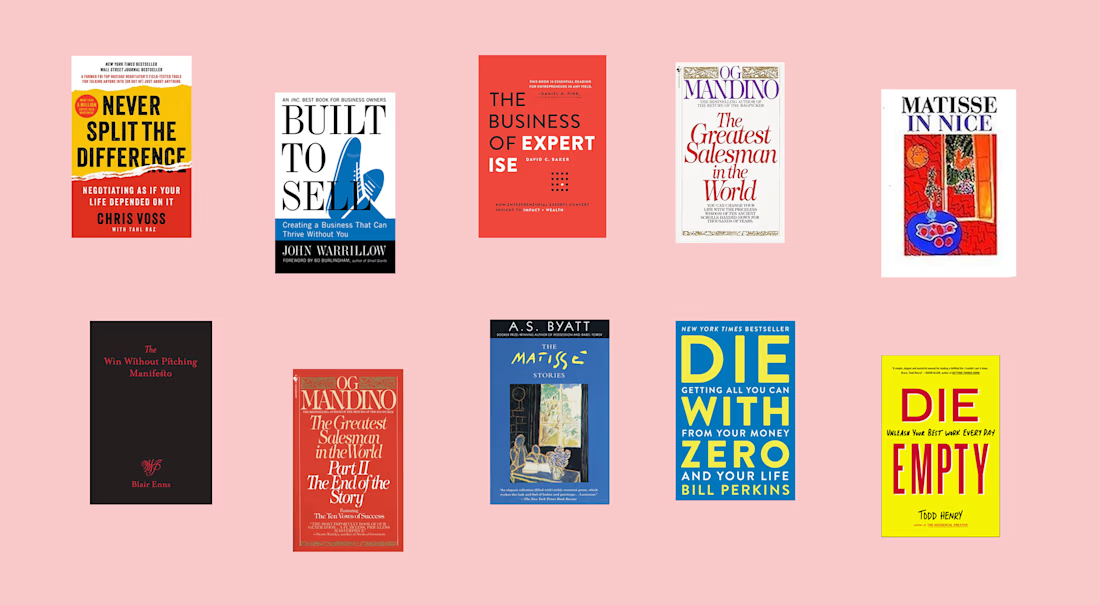
This past summer, I read 10 books on thinking like a business and becoming more intentional with time and resources. Here are a few takeaways:
Built to Sell and The Business of Expertise challenged me to focus on specialization instead of trying to be everything to everyone.
Win Without Pitching's main point is we shouldn’t have to convince everyone to work with us. The goal is to become valuable enough to attract the right clients on the right terms.
Never Split the Difference drove home that the skill of negotiation is understanding what someone actually needs to get what you want in return.
The Greatest Salesman in the World Parts 1 & 2 both explore the mindset and personal responsibility behind lasting success.
Matisse in Nice and The Matisse Stories were personal reads because I love his art.
Die With Zero asks how we can use our money and time to create meaningful experiences while we're alive. Die Empty challenges us to stop sitting on our ideas and put our potential into the world.
If you're a reader, what books have improved the way you approach your work?

Thanks for sharing Arron. It's nice to read shuch info coz it initiates me to read further

Design and development are getting easier with AI.
But the real difference is how you guide it.
Give AI the right direction, references, and clear instructions, and you can turn your ideas into reality much faster.
AI does the heavy lifting. Your vision makes it special.
What do you think? 👇
#AI #WebDesign #WebDevelopment #ClaudeAI


