The network for creativity
Join 1.25M professional creatives like you
Connect with clients, get discovered, and run your business 100% commission-free
Creatives on Contra have earned over $150M and we are just getting started
Back to feedPost

I recently completed a security hardening pass on an AI-enabled mobile product.
The most important issues weren’t exotic vulnerabilities.
They were practical deployment risks:
password reset race conditions
missing abuse controls
weak retention guarantees
mobile backup exposure
logging and CI gaps
Each confirmed finding was fixed and backed by regression tests before the security baseline was marked PASS.
One lesson stood out: security reviews are most useful when they produce evidence and actionable fixes, not just scanner output.
I’m now offering focused 24-hour AI Agent Security Mini-Audits for founders and small teams.



contra.com
AI Agent Security Mini-Audit by Guillaume Strohecker
Read more about AI Agent Security Mini-Audit by Guillaume Strohecker on Contra.
The network for creativity
Join 1.25M professional creatives like you
Connect with clients, get discovered, and run your business 100% commission-free
Creatives on Contra have earned over $150M and we are just getting started
Related posts

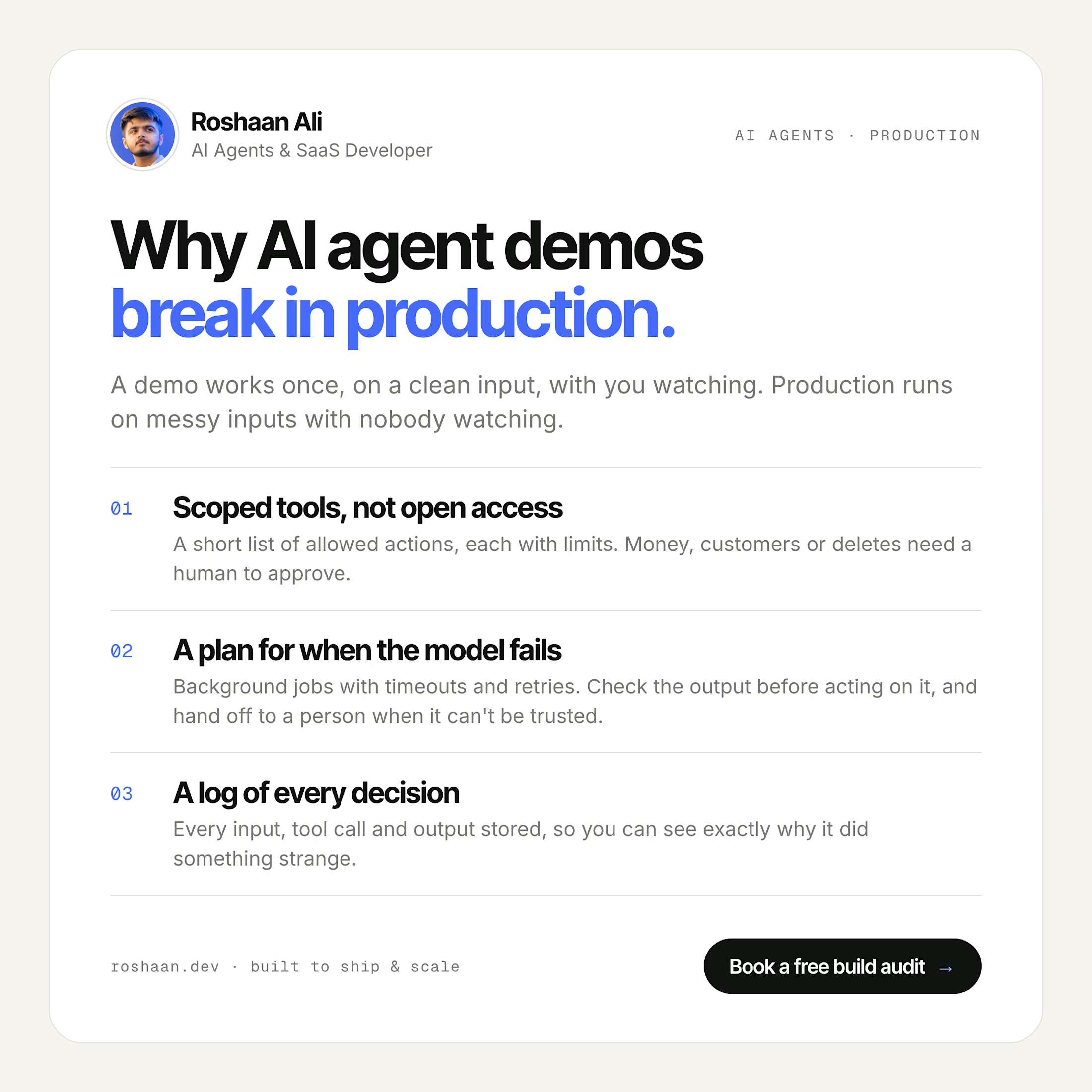
Why AI Agent Demos Break in Production
An AI agent demo only has to work once, on a clean input, with you watching. In production it runs again and again on messy real inputs, and nobody's watching.
I've built AI into real products, from a repricing engine that runs 24/7 for a US Amazon seller to a voice automation platform for a company in Germany. These are the three things I put in place before any agent goes live:
1. Scoped tools, not open access
Give the agent a short list of actions it's allowed to take, each with its own limits, instead of raw access to your database or APIs. Anything that touches money, customers or deleting data needs a human to approve it.
2. A plan for when the model fails
Model calls are slow, they time out, and sometimes they return something that makes no sense. Run agent work in background jobs with timeouts and retries, check the output before acting on it, and hand the task to a person when it still can't be trusted.
3. A log of every decision
Store every input, tool call and output. When the agent does something strange (and at some point it will), you can see exactly why and fix it instead of guessing.
None of this shows up in a demo. All of it decides whether the agent is still running a month later.
Planning an AI agent for your product? I offer a free build audit: calendly.com/roshaanali-business


Is this really happening?
After 17 years as a graphic designer and illustrator, I find myself, at 43 years old, feeling forced to pursue a degree in Artificial Intelligence Engineering.
And honestly, I'm torn.
On one hand, the thought of going back to university, with everything it demands, feels overwhelming. I'm afraid of losing my livelihood, despite having spent years proving myself, consistently pushing beyond expectations, standing out, and becoming exceptionally good at what I do.
Yet somehow, fear is eating away at me.
The realization that everything I've built over nearly two decades could be hanging by a thread is terrifying.
But on the other hand, I'm genuinely excited.
The idea of understanding how to build AI, how it thinks, how it learns, and potentially making a living from that knowledge fascinates me.
Applied mathematics. Programming. Computer science fundamentals. Algorithms. Machine learning.
An endless journey of studying, practicing, failing, learning, and starting again.
At 43.
As a man, I feel a responsibility to protect and provide for my family.
But as a human being, I feel an even deeper responsibility to contribute, however small my contribution might be, to preventing the darker consequences of the technology we're creating.
Mass unemployment. Surveillance and control. Suicide. Hunger. The loss of human identity. New threats. Wars. Conflicts we can barely imagine today.
We are building something that could fundamentally reshape what it means to be human.
And while the possibilities are extraordinary, so are the risks.
I don't want to spend the rest of my life watching from the sidelines, afraid of what comes next.
I want to understand it.
I want to be part of it.
And above all, I want to help make sure this technology serves humanity rather than destroys what makes us human.
The future isn't written yet.
It's in our hands.
Let's do something about it.


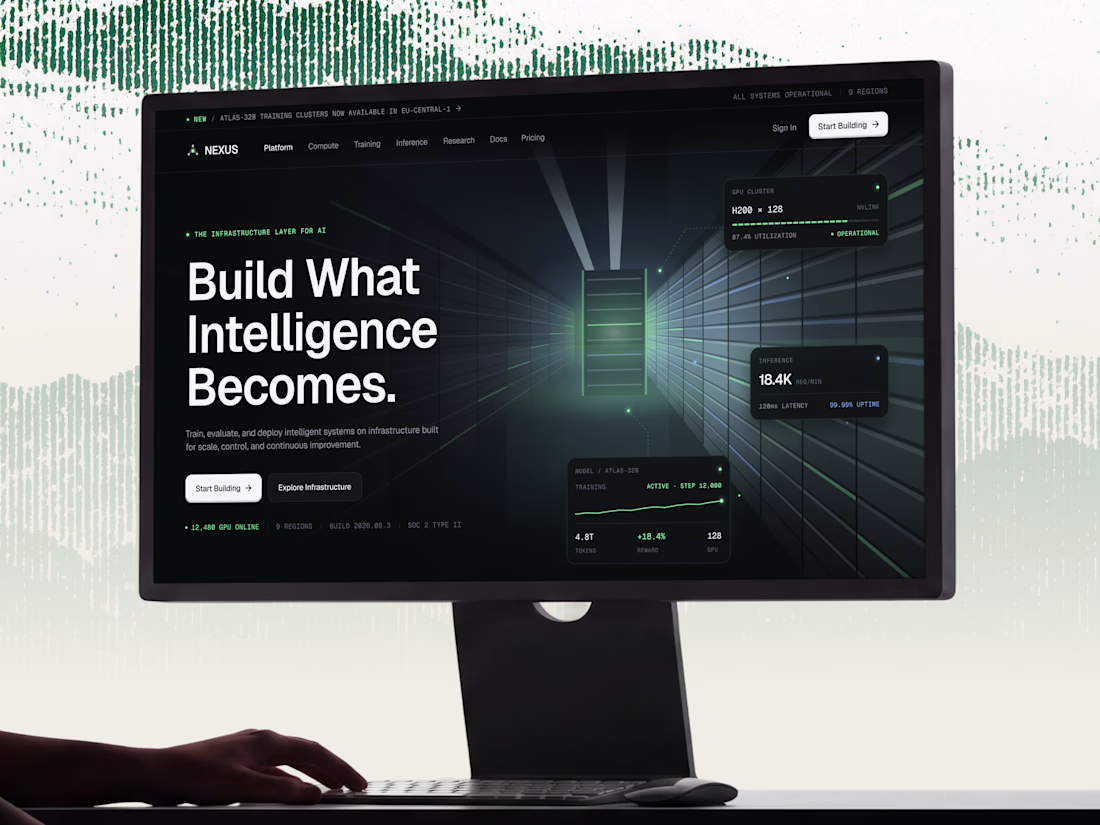
Nexus — AI Infrastructure & Compute Platform Landing Page
An enterprise-grade web dashboard ecosystem engineered for machine learning developers and AI engineering teams. The workspace provides complete observability over GPU compute allocations, training telemetry, serverless inference routing, and real-time model benchmarks.
Project Goal
The objective was to eliminate the friction of chaotic terminal logs and disconnected telemetry tools by building a unified, closed-loop AI infrastructure system. Every interface card was crafted to maximize visual scannability, streamline cluster-scale workflows, and deliver instant operational clarity without cognitive overload.
The full preview landing page is available to check directly inside the case study link! 👉🏻 Check it out