The network for creativity
Join 1.25M professional creatives like you
Connect with clients, get discovered, and run your business 100% commission-free
Creatives on Contra have earned over $150M and we are just getting started
Back to feedPost

Playhouse: the curtain rises when you press play
Playhouse is a Video.js 10 skin in the manner of a 1950s television playhouse, when television sold itself as a theatre in the living room. The player waits in your page as a slim ticket; press play and the show begins.
How it works
• The ticket: until someone presses play, the player is a theatre ticket in the page. One stub is a little set showing the poster, the middle carries the title, the scenes and the running time over a strip of film negative with the reel's frames rolling past, and the other stub is a brass play plate. After a close it reads "Continue · 0:33" and the strip shows how much you have seen.
• The warm-up: press the plate and the ticket blooms into the stage the way an old set warmed up, a bright line opening into the picture.
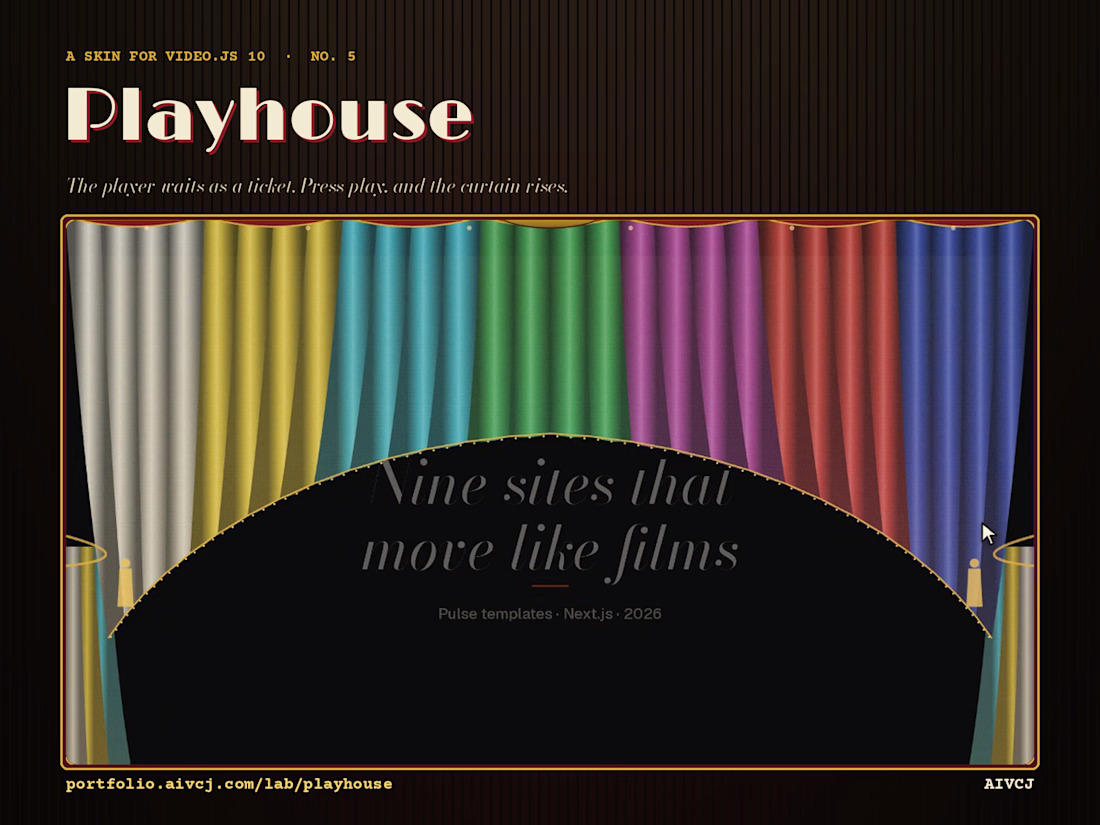
• The curtain is the test card: it is woven from the colour bars, each bar a run of velvet pleats with folds, sheen and a gold fringe, drawn on a canvas (no images, no 3D). For a moment the downlights and the coloured spots of an old picture palace play on it.
• The rise: the film starts and the curtain rises like an opera curtain, gathering up and out to gold tie-backs, while the downlights dim and the picture comes up out of the dark. The first show takes about three seconds; later ones are quicker.
• Playing: the controls sit on the stage apron in house velvet and gold. The timeline is a strip of colour bars, one per scene; point at it and a playbill card shows the frame, the scene numeral and the time.
• Two ways to open, set with one attribute: in place, where the page makes room, or over the page, where the house lights go down (the page dims and blurs, focus stays on the stage, Esc or ⊗ closes). A case study page shows both in the middle of an article.
• Close it and the house lights come back as the curtain falls, the picture collapses into a line, and the ticket is where you left it.
• One property, --media-accent-color, re-dyes the velvet: crimson, emerald, royal blue or plum.
Usability
• The show never stands in the way: any key or click skips it and the film starts at once; pause keeps the stage open.
• The stock Video.js time slider stays the control; the seven custom elements only act through the player store (play, pause, seek).
• Full keyboard map: Space/K, ←/→ 5 s, J/L 10 s, [ and ] for scenes (announced), M, F, C, I, 0–9, < and >, Esc to close.
• On a phone the ticket fits the column, the stage takes the width, and every control is a 44 px target.
Accessibility
• The slider names the scene for screen readers ("Scene 3 of 9: Lunetta"); focus moves onto the stage when it opens and back to the ticket's play plate when it closes.
• Every word sits on velvet or paper, never on the picture: cream on the apron velvet 12:1, ink on paper 16:1, the smallest label 8:1.
• Reduced motion: no show at all, the film starts on the press. Forced colours: no curtain, system colours throughout. Captions with sound descriptions.
Real site: running live on AIVCJ's portfolio domain with our studio reel, nine live templates, one scene each, streamed from Mux. Built on @videojs/html 10.4, started from the Scaffold skin. Type: Limelight, Bodoni Moda, Courier Prime. Licensed under Apache-2.0. Music: "Another August" by The Cynic Project in the reel and "Vaporware (Calm Piano 1)" from OpenGameArt in the demo film (both CC0).

The player waiting as a slim ticket until you press play, lovely 1950s playhouse idea.
The network for creativity
Join 1.25M professional creatives like you
Connect with clients, get discovered, and run your business 100% commission-free
Creatives on Contra have earned over $150M and we are just getting started


Related posts

Tint: a Video.js skin that takes its colors from the film playing. The poster shows the film's color fingerprint, the timeline is a slice of every frame, and the scene you're watching tints the controls. Built with jelly physics, custom subtitles, and scene-aware UI. Open source.

Pulling the palette from the film itself is such a smart move, the controls can never clash with the footage. Does the tint ease between scenes or switch right on the cut?

Mahlin is a video player that watches with you. Its only face is a single golden eye — the play button. The eye opens as the video plays, closes when it rests, and fills with gold while it loads, so you can tell what the player is doing at a glance, without reading a single icon. Hold the eye and drag to move through the video at up to 7x speed; drag down to return to where you were. Slide the right side for volume, the left for brightness — in fullscreen and in normal view alike. Chapters, live hover previews, a three-video playlist, subtitles and quality controls sit quietly inside a deep navy-and-gold design: everything there when you need it, invisible when you don't. A gold Share button gives a video link and embed code, so the player can be shared and embedded anywhere.

A single golden eye is such a memorable identity for Mahlin. The deep navy and gold make the idea feel wonderfully cohesive.

I designed a custom Video.js skin to improve the video playback experience through a modern, clean, and intuitive interface. The design focuses on usability, visual consistency, and accessible playback controls, while maintaining the flexibility of Video.js.
My goal was to create a player interface that feels polished, responsive, and suitable for modern web applications.
The simple 'Drop in and play' start makes AFTERFRAME feel welcoming. Nice work keeping that first step so clear.