The network for creativity
Join 1.25M professional creatives like you
Connect with clients, get discovered, and run your business 100% commission-free
Creatives on Contra have earned over $150M and we are just getting started
Back to feedPost



The network for creativity
Join 1.25M professional creatives like you
Connect with clients, get discovered, and run your business 100% commission-free
Creatives on Contra have earned over $150M and we are just getting started





Related posts

Business: Glasshouse Padel Club
Location: Bryanston, Johannesburg, South Africa
Problem solved (one line):
A solo owner stops chasing court payments: players pay their own quarter, unpaid holds release themselves, and bookings confirm without a message.
Client brief:
Glasshouse is an independent padel club with four glass courts (three indoor, one outdoor panoramic), open 06:00-22:30. The owner runs it alone and fields around [90] booking messages a day. Weekday evenings are packed and mid-mornings sit empty. About [1 in 5] bookings collapse when one friend never pays their share, leaving the court held and unsold.
What I built:
Front door: live availability across all four courts, honest peak, standard and quiet-hour prices, and booking with no account needed.
Follow-through: the court is held for 15 minutes while each friend pays their own quarter from their own link. At 4 of 4 paid, the booking confirms itself. If the squad doesn't fill, the court releases itself and goes back on sale.
Payments run in demo mode (approved and declined flows, receipts). No real money moves, and PayFast or Paystack would plug in for live use.
Owner view shows paid bookings and released holds without the owner sending a message.
Live app (public, no login needed): https://glasshouse-court-connect.lovable.app/
https://lovable.dev/projects/8abd13d8-7d17-4b61-9e9e-8cd9cb80abff?magic_link=mc_e65531e2-e36c-4808-8c5a-181c366db468
@Lovable


The 15 minute hold that releases itself is a smart fix for no-shows.

I’ve always liked products that solve a very specific problem instead of trying to do everything.
So for the Lovable Challenge, I picked a simple question that event-tent rental businesses hear all the time:
“Can I book a tent for my wedding?”
The problem is… a tent can’t really be booked until you know if the whole event will work.
How many guests?
How much usable space?
Tables? Dance floor? Bar? Stage?
Will the layout actually fit?
Can the crew set it up and pick it up on time?
Usually, the owner has to figure all of that out manually through messages, calls and calendar checking.
So I built TentFit — a spatial booking experience for event tent rentals.
The customer starts by planning the event, then maps out the space and everything they want inside it. TentFit checks the layout and highlights conflicts.
And instead of just saying “doesn’t fit,” it helps solve the problem:
Switch the tent. Move the layout. Remove an element.
Once everything works, TentFit checks the logistics and turns the final setup into a booking.
The goal was simple:
Make the customer’s decision easier, and make the owner’s job easier.
The flow is basically:
FIT → FEASIBLE → BOOKED
I had a lot of fun building the spatial planning part of this one.
X/Twitter post: https://x.com/brjanov/status/2105630218492731501?s=20
Built with @Lovable
#LovableChallenge #ProductDesign #UXDesign #NoCode #SaaS #WebDesign


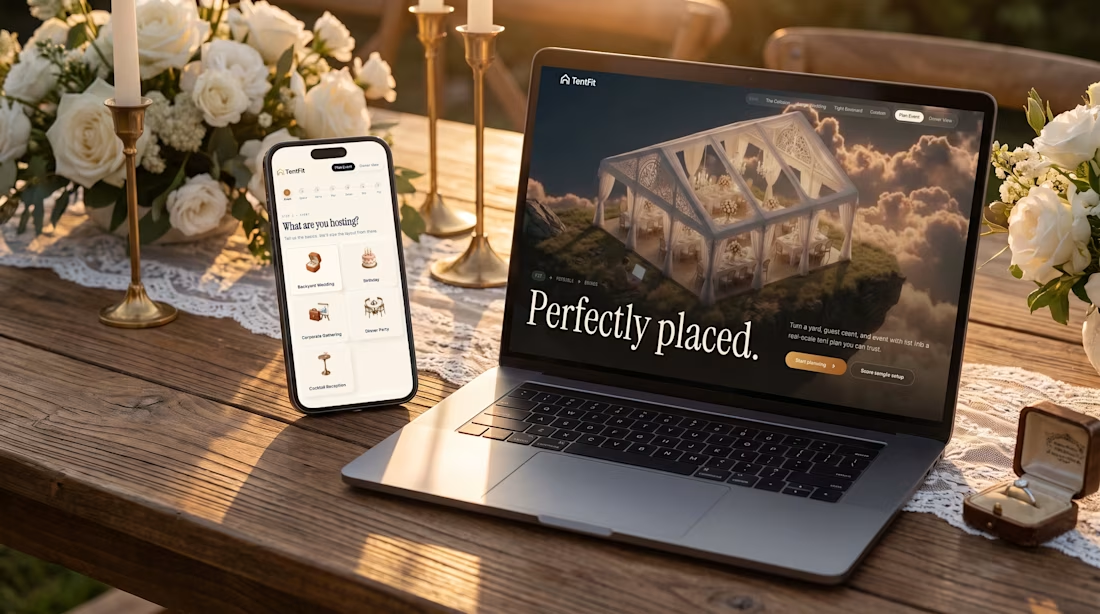


Nice stuff!

This is Mikuna. From WhatsApp chaos to a confirmed lesson.
Small language studios shouldn't have to manage every student through WhatsApp.
Mikuna started from a simple problem: a student wants to book a lesson, but the process quickly becomes a chain of messages about language, goals, tutors, availability, payment, changes and confirmations.
So I designed a system where the student handles the coordination themselves, while the tutor gets a ready-to-teach agenda.
The student can:
→ Choose a language and learning goal
→ Find the right tutor
→ Pick an available time
→ Purchase credits
→ Book the lesson
→ See their upcoming lessons and remaining credits
The tutor gets:
→ An organized agenda
→ Upcoming and past lessons
→ Relevant student context
→ One-click access to the lesson
Behind the interface, the system also handles tutor availability, booking conflicts, credits, payments and cancellation rules.
The idea was simple:
From managing conversations to managing lessons.
Mikuna was built for the Contra × Lovable Challenge, starting from an existing brand identity created at SUR Studio and reimagining it as a complete appointment-based product.

Love this! Such a clean solution to a very real problem for language studios. The shift from WhatsApp chaos to a seamless booking experience is brilliant.