The network for creativity
Join 1.25M professional creatives like you
Connect with clients, get discovered, and run your business 100% commission-free
Creatives on Contra have earned over $150M and we are just getting started
Back to feedPost

Speaker Rescue — Bringing Device Audio Back to Life with Google Stitch
Built with Google Stitch
Most people have experienced it.
You accidentally drop your phone in water, spill a drink near your earbuds, or notice your speaker slowly becoming quieter and more muffled over time.
Finding a solution usually means downloading random apps, watching YouTube tutorials, or paying for expensive repairs without knowing whether the problem is actually serious.
That's why I built Speaker Rescue.
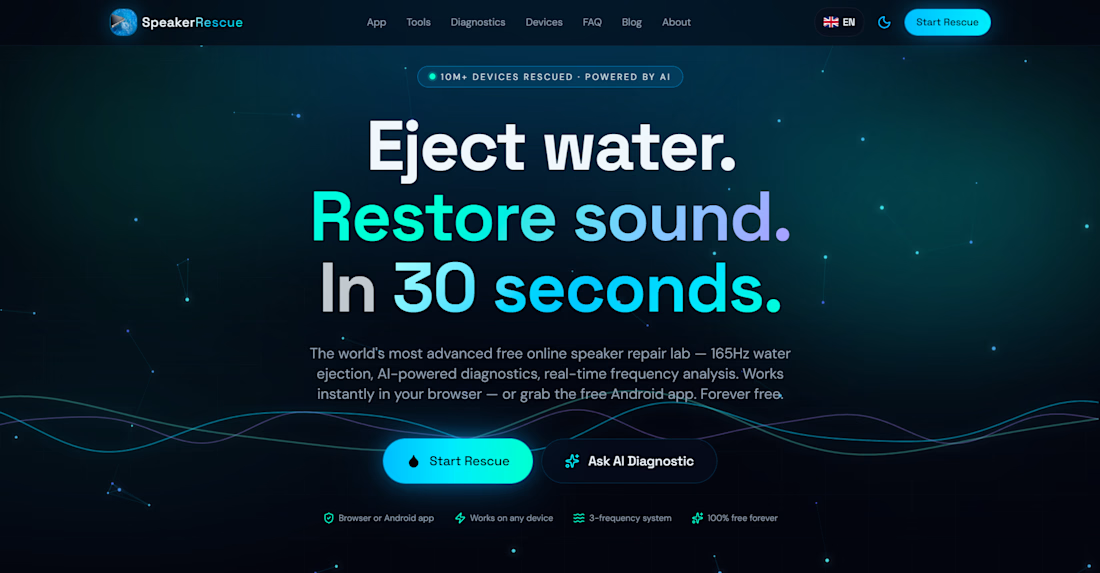
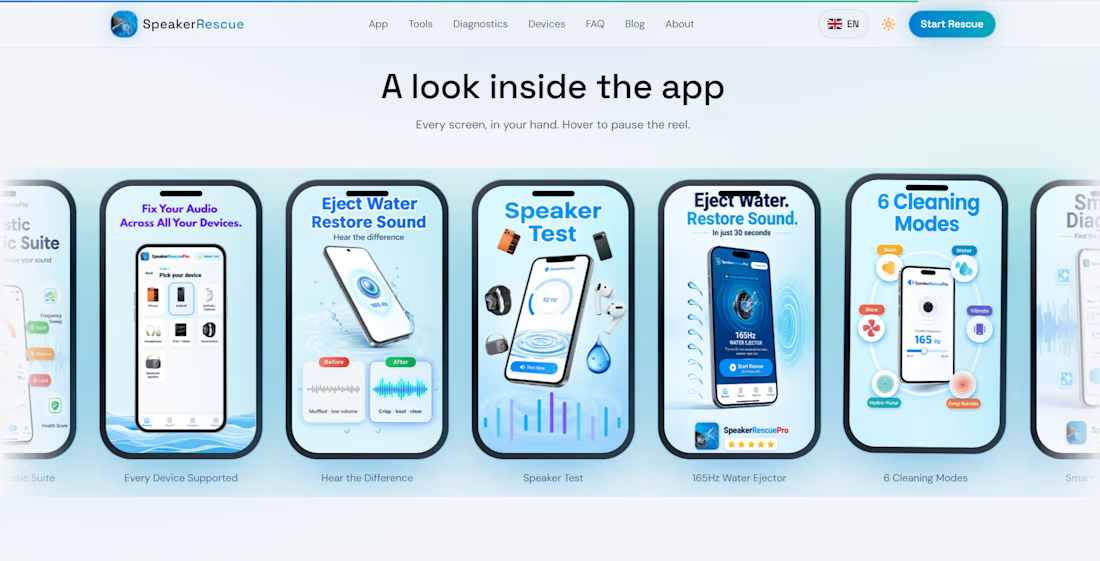
Speaker Rescue is a browser-based speaker recovery and diagnostic platform designed to help users restore audio quality, remove trapped water, clear dust and debris, and better understand the health of their device speakers — all without installing an app.
The goal was to create a professional, easy-to-use experience that feels more like an audio diagnostics lab than a typical utility website.
What I Built
Speaker Rescue combines multiple recovery and diagnostic tools into a single platform.
Features include:
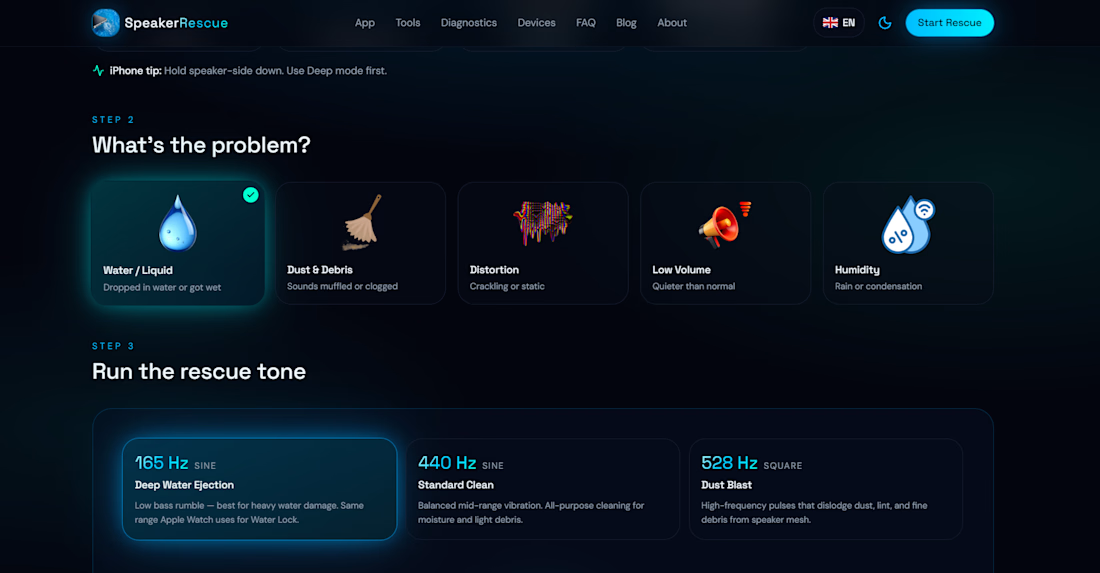
• Water Ejection Modes using specialized recovery frequencies
• Speaker Health Score analysis
• Corrosion Risk Calculator for liquid damage assessment
• Speaker Repair Cost Estimator
• Frequency Response Mapping
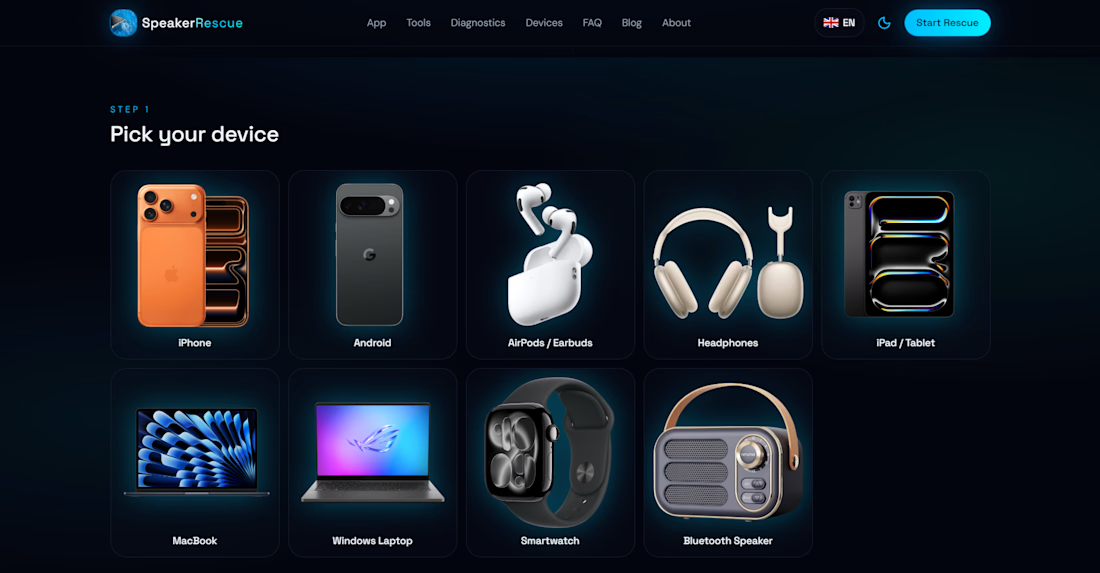
• Device-specific recovery tools for iPhone, Android, AirPods, Smartwatches, Bluetooth Speakers, and more
The platform uses a 3-frequency recovery system:
🔊 165Hz Deep Water Ejection
💧 440Hz Universal Cleaning Mode
⚡ 528Hz Dust & Debris Blast
Together, these tools help users diagnose speaker issues, remove trapped moisture, and restore lost audio performance.
How I Used Google Stitch
Google Stitch became the core design and prototyping tool throughout the project.
I started by defining a technical visual language inspired by professional audio laboratories:
• Deep charcoal backgrounds
• Electric cyan highlights
• Diagnostic dashboards
• Glass-style interface elements
• Interactive visual feedback
Using Stitch's streaming generations allowed me to rapidly explore different layouts and workflows while keeping the experience visually consistent.
The ability to make in-place AI edits was especially useful when refining diagnostic tools, dashboard components, and interactive recovery experiences.
Instead of rebuilding sections from scratch, I could iterate directly on the canvas and improve the experience much faster.
Once the design and prototyping phase was complete, I used Loveable AI to transform the Stitch-generated interface into a fully functional live website. This allowed me to move seamlessly from design exploration to implementation while preserving the visual language, interactions, and user experience established during the design process.
Building an Interface That Feels Alive
For this challenge, I wanted the platform to feel active and responsive rather than static.
To achieve this, I incorporated:
• Animated frequency visualizations
• Interactive diagnostic dashboards
• Dynamic audio monitoring interfaces
• Motion-rich tool interactions
• Real-time feedback components
• Visual speaker health indicators
These elements help users understand what is happening during the recovery process while making the platform feel more engaging and trustworthy.
Feedback on Google Stitch
The most valuable aspect of Stitch was how quickly it transformed ideas into usable interfaces.
The combination of:
🌊 Streaming generations
⏩ In-place AI editing
🎥 Motion-rich UI creation
🚀 Rapid prototyping workflows
allowed me to move from concept to working product significantly faster than traditional design workflows.
Stitch felt less like a design tool and more like a creative partner that accelerated exploration and iteration.
Final Thoughts
Speaker Rescue started as a simple idea:
Can a browser-based platform help people recover speaker performance without downloading software or paying for unnecessary repairs?
With Google Stitch, I was able to rapidly design, refine, and prototype that vision into a polished interactive experience. After finalizing the interface and workflows in Stitch, I used Loveable AI to convert the design into a fully functional live web application, allowing the project to move from concept to production-ready experience in a remarkably short timeframe.
The result is Speaker Rescue — a modern audio recovery platform built to help users diagnose, understand, and restore their device speakers.
Live Project: https://speakerrescue.online/
#GoogleStitch #BuildWithStitch #UIUX #ProductDesign #WebDesign #AI #Tech
The network for creativity
Join 1.25M professional creatives like you
Connect with clients, get discovered, and run your business 100% commission-free
Creatives on Contra have earned over $150M and we are just getting started









Related posts


GoodLoop — What I Built and Why
1. Project Overview
GoodLoop is a food-rescue platform designed to connect restaurants, cafes, bakeries, grocery stores, and other food businesses with NGOs and community kitchens that can distribute surplus food to people in need.
The platform aims to reduce food waste by helping businesses find suitable rescue partners before their surplus food reaches its collection deadline.
Live Application: https://good-loop-now.base44.app
2. The Problem I Wanted to Solve
Food waste and food insecurity exist simultaneously. Businesses often have surplus food that is still suitable for consumption, but coordinating its collection can be challenging. At the same time, NGOs and community kitchens need timely information about available food, quantities, pickup locations, storage requirements, and deadlines.
Traditional coordination can be slow and fragmented, making it difficult to find eligible recipients, track collections, identify missed pickups, and measure the amount of food successfully rescued.
I wanted to build a platform that makes this process more organized, efficient, and transparent.
3. What I Built
A. Food Donation and Listing System
Food businesses can create surplus food listings with information such as food category, quantity, pickup location, storage requirements, and collection deadline.
B. Intelligent Partner Matching
GoodLoop evaluates potential rescue partners using eligibility checks and a weighted scoring system. It considers proximity, food-category compatibility, available capacity, deadline feasibility, and partner trust.
The system ranks suitable partners and provides reasons behind its recommendations, making the matching process more transparent.
C. Rescue Assignment and Pickup Tracking
The platform supports a rescue workflow that tracks food from availability through assignment, pickup, and completion. It also supports status updates and scenarios involving failed or overdue pickups.
The acceptance process revalidates eligibility and uses concurrency-safe handling to prevent multiple partners from claiming the same listing.
D. Deadline Monitoring and Notifications
GoodLoop includes deadline-monitoring functionality to generate in-app reminders, expire eligible uncollected listings, and flag overdue assignments.
The current implementation supports manual monitoring and a throttled check triggered by command-center visits. It does not yet use a fully scheduled background service, and notifications are currently in-app rather than email or SMS.
E. Impact Tracking
Completed rescue assignments generate impact records for rescued meals, food weight, and estimated carbon emissions avoided.
These metrics help demonstrate how successful food-rescue operations could be measured over time. The current figures are based on fictional demonstration data and are not claims of real-world impact.
F. Operations Command Center
The command center provides an overview of rescue activity, assignments, statuses, monitoring results, and operational events. It helps administrators understand what is happening across the food-rescue workflow.
G. Organization Verification and Management
The application includes organization registration and verification workflows to support a network of food donors and rescue partners.
H. Responsive User Interface
The application is built with a modern interface intended to work across desktop and mobile screen sizes. Final hands-on mobile testing remains part of the submission-readiness process.
4. How the Automation Works
The core workflow is designed as follows:
A food business publishes a surplus food listing.
The matching engine evaluates potential partners against eligibility requirements.
Suitable partners receive in-app notifications about relevant opportunities.
A partner accepts the rescue assignment.
The collection progresses through the pickup lifecycle.
The completed assignment generates an impact record.
Deadline monitoring helps identify uncollected food and overdue assignments.
The matching engine uses a weighted score out of 100, based on proximity, food-category compatibility, capacity, deadline feasibility, and trust. Eligibility checks help exclude unsuitable partners before ranking.
This makes GoodLoop more than a simple food-listing website. Its objective is to coordinate the process from identifying surplus food to recording a completed rescue.
5. Technology Stack
Frontend
React
Vite
Tailwind CSS
shadcn/ui
React Router
Backend and Application Services
Base44 backend and data entities
Backend functions for listing creation, matching, rescue acceptance, assignment updates, deadline monitoring, organization verification, and impact tracking
Real-time entity subscriptions for application updates
The current implementation includes data models for food listings, rescue matches, assignments, organizations, verification records, user profiles, notifications, pickup events, audit events, impact records, and food categories.
6. Why I Chose GoodLoop for the Base44 Challenge
I wanted to build a product that demonstrates how an application can combine thoughtful UI design, meaningful automation, and a real-world problem.
GoodLoop addresses four important dimensions:
Design quality: A dedicated interface for food donors, rescue partners, and operations.
Automation depth: Partner matching, eligibility validation, rescue assignment, deadline monitoring, and impact recording.
Storytelling: A clear journey from surplus food to a completed rescue.
Mobile responsiveness: An interface designed for use across different screen sizes, subject to final device testing.
I chose this idea because food waste is a practical, recognizable problem, and improving coordination can help make existing food-rescue efforts more effective.
7. Current Status and Limitations
GoodLoop is a working prototype with implemented application workflows, but it is not yet a fully production-ready food-rescue network.
The current demonstration uses fictional Pune organizations, listings, assignments, and impact records. The map is schematic rather than a live mapping integration. Full end-user authentication, row-level access control, external email/SMS notifications, and scheduled background monitoring are not yet implemented.
The end-to-end rescue workflow and mobile layouts also require final verification before submission.
These limitations are important because the current demo is intended to demonstrate the product concept and its implemented workflows, not to claim that real-world food rescues have already taken place.
8. Future Vision
The long-term vision is to expand GoodLoop into a reliable food-rescue network connecting food businesses, NGOs, community kitchens, and volunteers across multiple cities.
Future improvements could include secure role-based access, verified organization accounts, live maps, scheduled alerts, pickup verification, and more comprehensive impact analytics.
The aim is to make food rescue easier to coordinate, more transparent to manage, and easier to measure.
9. The Core Idea
GoodLoop turns surplus food into a coordinated rescue opportunity by connecting suitable partners, tracking collections, monitoring deadlines, and measuring the potential impact.
The vision is simple: Rescue what matters. Reduce waste. Deliver impact.


Proud to share our sound design for Intescia brand manifesto film, bringing their new visual identity to life alongside Studio Dot.
Collaborating with Laura Durand; Nils Brière was an inspiring process. Our goal was to anchor the dynamic motion design with a tactile, futuristic audio world—blending delicate UI clicks, organic digital friction, and a driving synth groove that mirrors the transformation from complex numbers into decisive action.
Huge thanks to the Studio Dot team and Intescia for trusting Penrose Audio with the sonic side of this story!
#sounddesign #motiondesign #branding #audiopost #ui #creativestudio #motiongraphics #soundengineer


Title: Nexa Electronics: Premium E-Commerce Website with Interactive 3D Exploded Views
Description:
Nexa Electronics is a demo e-commerce website I designed and built to show my skills in modern web design, front-end development and interactive 3D experiences. This video is a walkthrough of the site.
What’s in the video
The home page, with a cinematic hero section and a 3D device showcase
Browsing by category: Smartphones, Laptops, Audio, Gaming, Smartwatches, Smart Home and Accessories
Product pages with configuration and colour options, a zoom inspection view, pricing, stock status and customer reviews
The interactive 3D exploded view (“Explore Inside in 3D”), where you can take products apart layer by layer to see their internal components
Quick View, the device comparison matrix, the shopping bag and a full checkout flow (shipping details, payment, order review and confirmation)
Customer sign-in and an admin dashboard for managing the store
Website features
Interactive 3D exploded views of products, with labelled internal parts and an explode slider
A mega-menu navigation and fast category browsing
Product configuration (storage and colour variants) with live pricing
Wishlist, compare and shopping bag functionality
Device comparison matrix
A simulated checkout with order confirmation
Customer accounts (sign-in)
An admin dashboard with store stats and inventory and price management
A newsletter signup section
A toggle to turn the 3D experience on or off
A responsive, dark and light themed premium UI
Note: I made this video with the help of AI, and it is just a demo to show my skills. To see my work properly, I recommend visiting the live website here: https://nexaelctronics.netlify.app/
Thanks for watching. I’m open to freelance projects, so get in touch if you’d like something similar built for you.


The dark theme and 3D device views look sharp.