The network for creativity
Join 1.25M professional creatives like you
Connect with clients, get discovered, and run your business 100% commission-free
Creatives on Contra have earned over $150M and we are just getting started
Back to feedPost

My suya man, your suya man, all of the suya men we've patronized have never advertised a day in their life.
No Instagram. No flyers No “link in bio.” No buy-one-get-one-free nonsense.
Just a smoky grill, a rusted skewer, and a memory that would shame your CRM.
He knows how I like it.
He knows when I request for more than my ‘usual’, mood is high or I’ve got friends over.
And even when he still knows my ‘usual’, He still asks me every single time: “E get as you want am abi?”
That’s not just a small talk, that’s a business strategy that brands spend a four-figure ads budget on and still can’t touch.
There is a particular kind of shop owner that we have all probably encountered. They watch you walk in, scan and browse for like seven minutes, clearly confused, but they still see you in your confusion and watch you like Nollywood’s Patience Ozokwor. Then when you leave empty-handed, they act offended and personally betrayed. Everyone loses.
Then there’s the other kind. The yaba market type who clocks what you’re holding, asks one sharp question, and thirty seconds later is pulling out exactly what you actually came for from a pile you would never have found on your own.
Even if you didn’t plan to spend much, you’ll do and also refer your friends, family, cousins.
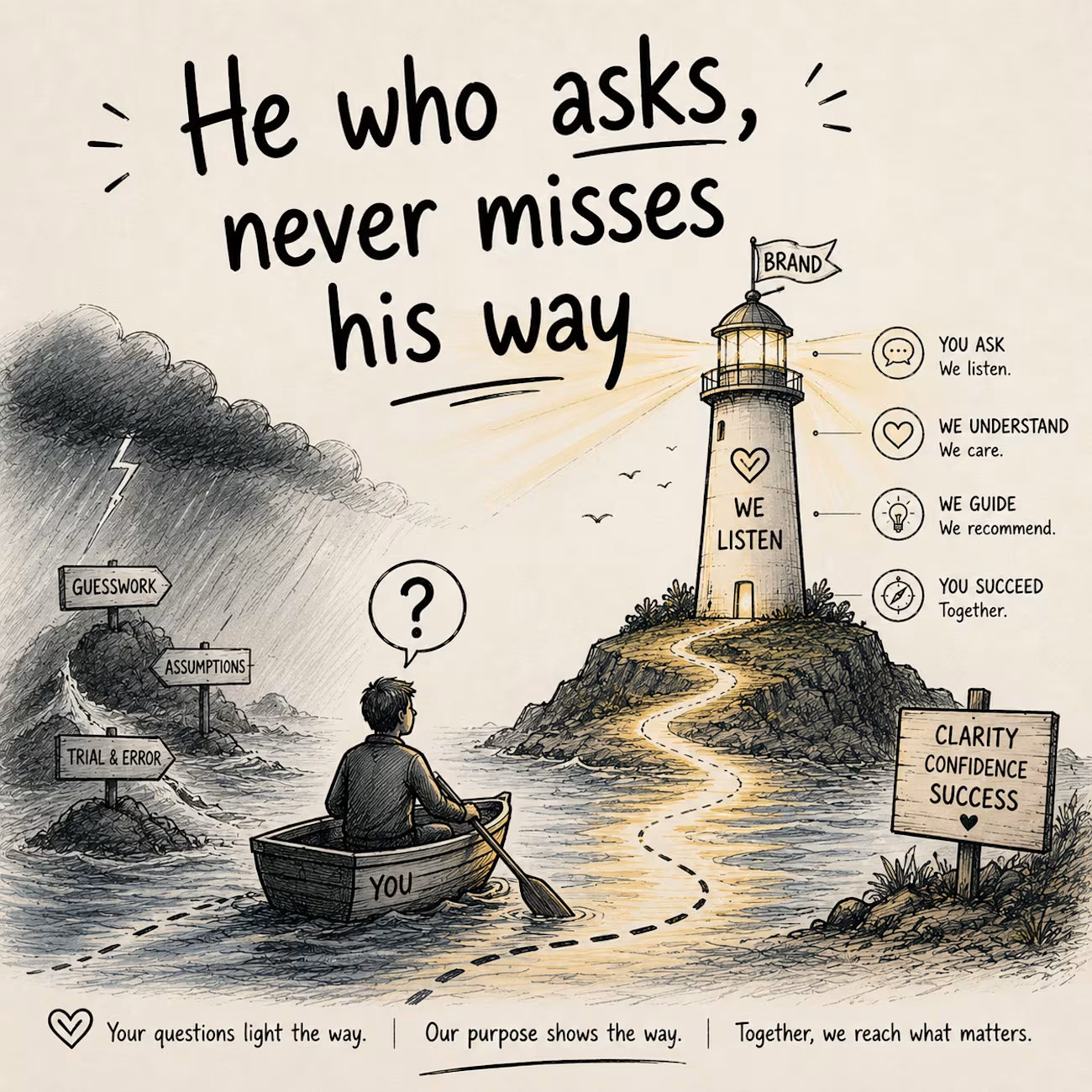
The difference between these two shop owners is not location, not product, not even price. It is that one of them understands that asking is not weakness. Brands have somehow convinced themselves that talking is the same thing as communicating. So they post, they announce, they run campaigns with big budgets and beautiful visuals, they broadcast into the void and then hold their breath waiting for sales to tell them if they were right. Then on Monday morning, they hold an intense meeting asking why retention numbers are down.
It is not just customer service. It is information warfare and in any market, the person with the most accurate information wins. Not the loudest, not the well packaged, not the prettiest, the most informed. Every time a customer tells you what they actually need, they are handing you a competitive advantage wrapped in a complaint or a compliment. But most brands unwrap neither; the complaint goes to a spreadsheet while the compliment becomes a testimonial screenshot. Neither one changes anything about how the business operates.
Real asking (the kind the suya man does), is asking with the intention to adjust, to remember, to do something differently because of what you just learned. That feedback loop, boring as it sounds, is the actual engine behind every brand that people stay loyal to through price increases, new competitors, and bad economy.
He who asks for directions does not get lost.
Not he who knows everything, not he who acts like he knows everything, He who asks. Your brand might not need more reach right now, it might need to ask better questions like:
“What almost stopped you from buying today?”
“What were you hoping to find that you didn’t?”
“Why did you come back?”
Not the generic “Thanks for your patronage”, “Hope to hear from you again”, then actually DO SOMETHING about the answers. Not make a post, not write a caption, an actual change. In your packaging, your response time, your product, your process. Something that would make the person who gave you that information feel like they were heard rather than surveyed.
That feeling of “this brand actually listens” is not a marketing strategy, it is rarer and more powerful than one. It is the thing that turns a customer into the person telling everyone in their office where they should be shopping.
So here is my final question to you and I actually want you to answer it, not just scroll past:
What does your brand really know about why its customers stay?
I’m not talking about what you assume or what your dashboard says. What do you actually know because someone told you directly, and you listened hard enough to change something?
If you don’t have an answer for that, then Go and ask.

The network for creativity
Join 1.25M professional creatives like you
Connect with clients, get discovered, and run your business 100% commission-free
Creatives on Contra have earned over $150M and we are just getting started
Trending
retrofuturism
Share your favorite designs from the past exploring the distant future. Or your own take on the aesthetic 🚀
halftone
Dots. Texture. Grain. Let's see your designs using the halftone technique.

Midjourney
Creatives are showing off what they're making with Midjourney.
colorgrade
Video editors sound off: How do you enhance the mood of your video in color grading?



Related posts

"Only One Flame Survives the Storm" — a single continuous one-take anime battle, entirely AI-generated in CapCut Video Studio with Seedance 2.5.
Two original warriors, one arena, no cuts: a lightning-wielding swordsman vs. a fire-fisted fighter, clashing across a storm-lit rooftop until only one is left standing.
🎬 Built with: CapCut Video Studio (Seedance 2.5)
⚙️ Workflow: Wrote a detailed single-shot prompt covering subject, action, and camera movement, then used 1-second timestamp control to direct each beat of the fight — the clash, the escalation, the simultaneous final attack, and the win. Negative prompting kept it clean (no jump cuts, no extra characters, no artifacts) to preserve the illusion of one unbroken take.
Prompt used: "A single unbroken continuous cinematic shot in high-quality anime style, dynamic camera circling and tracking through an epic battle between two original anime warriors on a destroyed rooftop city arena at dusk..." [continued in comments/caption card if platform truncates]
30 seconds. One shot. No cuts.
#contraseedancechallenge #CapCutCPP
contraseedancechallengeAI Video ProductionCopywritingFramer Website DesignWeb DesignFigmaFramerWebflowAI Content CreationSocial Media ManagementCapCut


good looking.

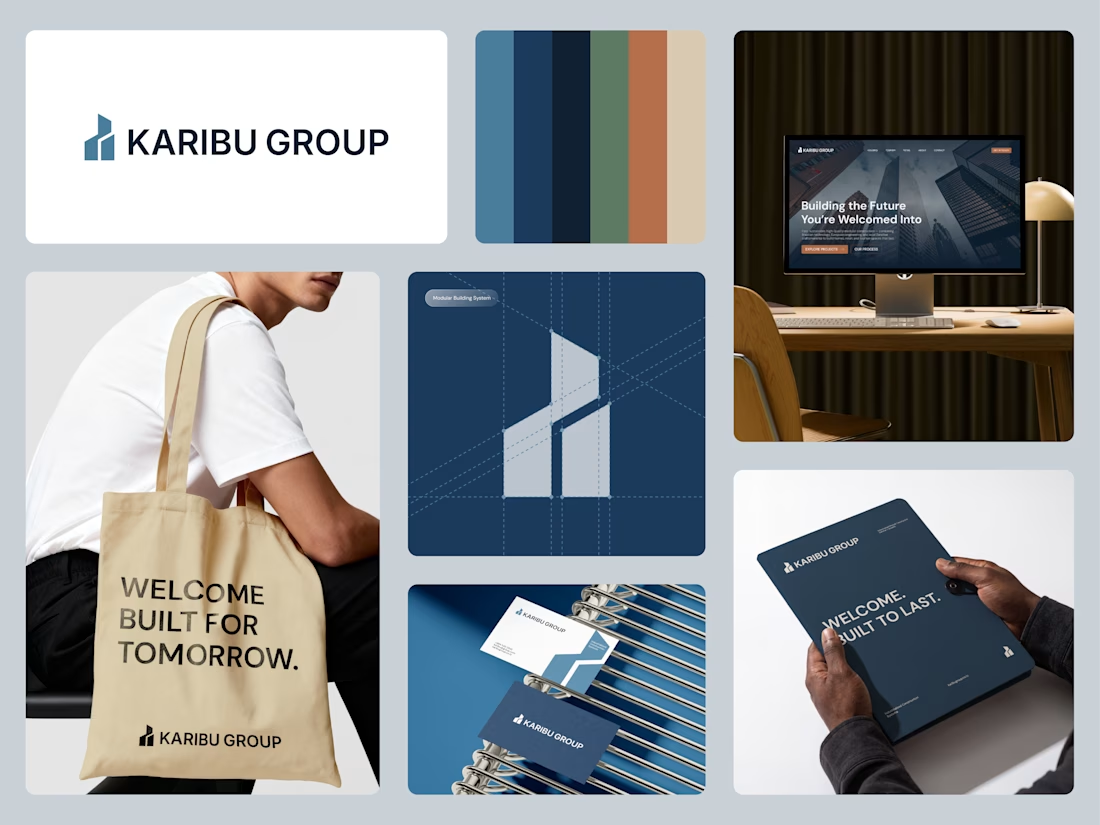
Karibu means “Welcome” in Swahili.
So the brand had to feel like one.
Karibu Group is a platform company delivering fast, sustainable, modular construction across housing, retail, and tourism in Zanzibar.
Brazilian technology. European expertise.
Local Zanzibar craftsmanship.
Three forces. One vision. One mark.
Here’s what we built:
◆ The mark: Two structural forms merging
Partnership. Precision. Modular assembly.
The joint venture built into a single symbol.
◆ The palette: Inspired by Zanzibar itself
Soft Amber · Clay · Hazel Green
Slate Blue · Nile Blue · Midnight
Warm sands. Ocean depth. Terracotta earth.
◆ DM Sans typeface
Clean, modern, international.
Built for everything from business cards to building signage.
◆ Applied at every scale
Stationery suite. Business cards.
Website. Signage. Tote. Folder. Phone.
One identity. Zero inconsistency.
“Welcome. Built to Last.”
That’s not just a tagline.
That’s a promise built into every pixel.
Building a construction, real estate or development brand? GET IN TOUCH. 👇
Brand DesignLogo DesignAdobe IllustratorAdobe Photoshopbrandidentitydesignlogodesignplatformbranding



So nice bro! Love the logomark and the colours!!

Built Socialo to help social Media agencies showcase their work.
Goat this post to receive a Remix Link 💯


Every detail here is just perfect!