The network for creativity
Join 1.25M professional creatives like you
Connect with clients, get discovered, and run your business 100% commission-free
Creatives on Contra have earned over $150M and we are just getting started
Back to feedPost

Strong architects are already pulling ahead with generative AI.
AI lets an architect direct work across several disciplines at once. The value of a good design grows when you can carry it through work you couldn't personally execute.
When our AI infrastructure needed independent processes to exchange work and retain records, I brought ROS 2 into the design. My robotics experience gave us an established foundation to investigate.
Developing that skill means learning to turn those connections into designs the agents can execute, then judging whether the result does what you intended.
As agents improve, people who have learned to direct them can take on more ambitious work. That's why I expect the skill gap to keep growing.
wildpines.ai
AI Is Widening the Skill Gap
As agents take on more specialist execution, architectural judgment determines how much someone can accomplish with them.

Agree that judging the output is the real skill. On the product side I see the same gap: people who write a clear acceptance check before prompting get far more out of agents than people who only review after.
The network for creativity
Join 1.25M professional creatives like you
Connect with clients, get discovered, and run your business 100% commission-free
Creatives on Contra have earned over $150M and we are just getting started
Related posts

Thinking about making a course on how I actually work with AI agents.
Not prompts.
The rules, skills and checks that make the agent build things the way my repo wants.
Would that be useful to anyone?

Yes please. The rules and checks part is what nobody teaches. Prompt tips are everywhere, repo setup isn't.


Feels like a lot of companies are trying their luck with AI instead of hiring designers right now.
I think it's going to backfire on them in a few months.
Trying to stay optimistic about it.

I can't wait for them to start hiring designers again. No matter how good AIs are, Human Intelligence will always supercede it.

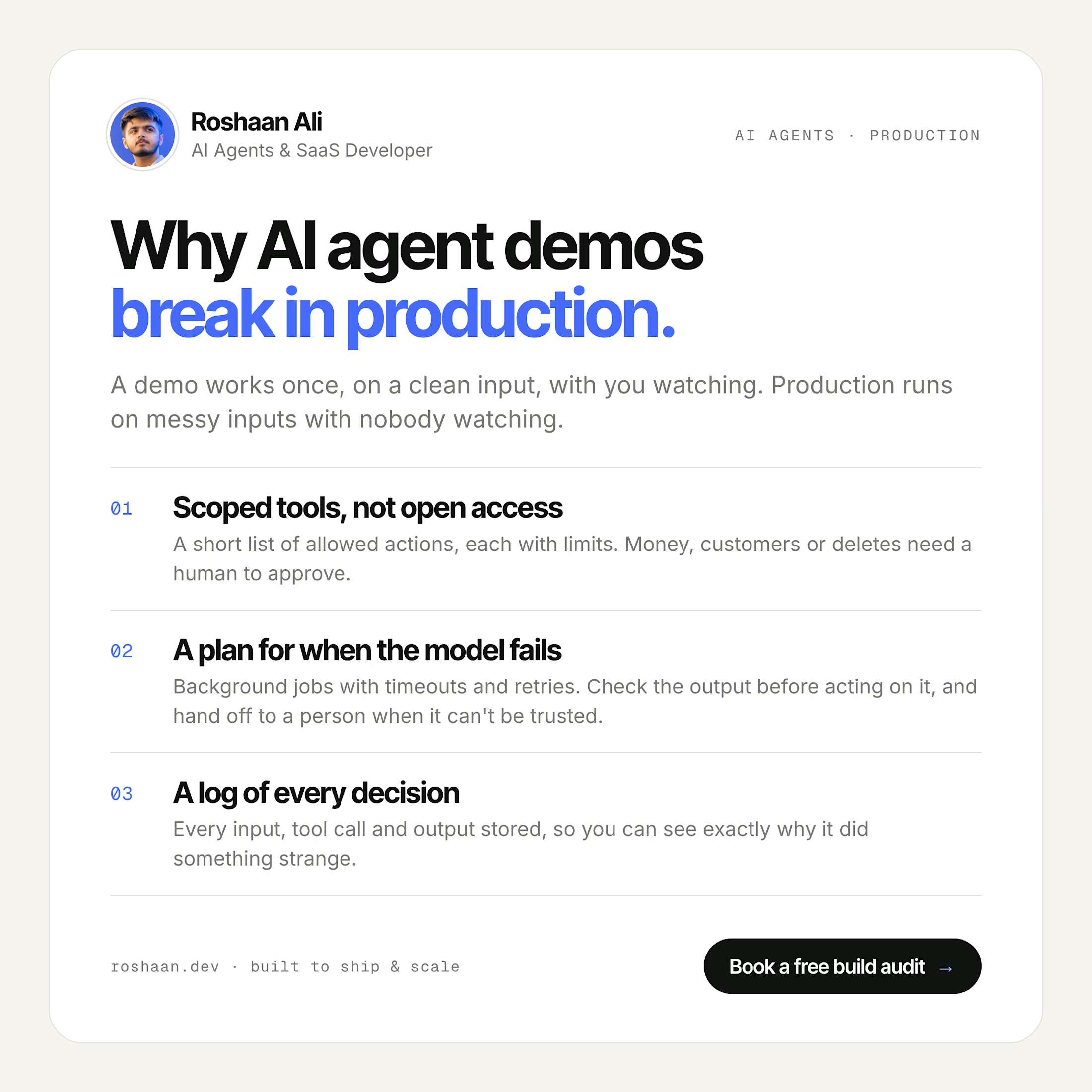
Why AI Agent Demos Break in Production
An AI agent demo only has to work once, on a clean input, with you watching. In production it runs again and again on messy real inputs, and nobody's watching.
I've built AI into real products, from a repricing engine that runs 24/7 for a US Amazon seller to a voice automation platform for a company in Germany. These are the three things I put in place before any agent goes live:
1. Scoped tools, not open access
Give the agent a short list of actions it's allowed to take, each with its own limits, instead of raw access to your database or APIs. Anything that touches money, customers or deleting data needs a human to approve it.
2. A plan for when the model fails
Model calls are slow, they time out, and sometimes they return something that makes no sense. Run agent work in background jobs with timeouts and retries, check the output before acting on it, and hand the task to a person when it still can't be trusted.
3. A log of every decision
Store every input, tool call and output. When the agent does something strange (and at some point it will), you can see exactly why and fix it instead of guessing.
None of this shows up in a demo. All of it decides whether the agent is still running a month later.
Planning an AI agent for your product? I offer a free build audit: calendly.com/roshaanali-business
"Works once with you watching" is the best way I've heard it put. Timeouts and a human fallback are the parts most demos skip.