The network for creativity
Join 1.25M professional creatives like you
Connect with clients, get discovered, and run your business 100% commission-free
Creatives on Contra have earned over $150M and we are just getting started
Back to feedPost

Ladle
Rescue your neighborhood's surplus food and pay a meal forward - a hyperlocal map where leftovers find a hungry neighbor in minutes, not a landfill.
Ladle is a hyperlocal food-rescue marketplace that turns the surplus food sitting in your kitchen - the half-tray of lasagna, the bagels you over-bought, the garden tomatoes you'll never finish - into a meal for a neighbor, before it spoils.
Instead of scrolling endless listings, you point your phone at the food and Ladle's on-device camera recognizes what it is and drafts the listing for you. It drops onto a live neighborhood map with a freshness countdown, and anyone nearby can claim it for free or for a few dollars. With one tap you can also "pay it forward" - funding a suspended plate that someone facing food insecurity can claim anonymously, with dignity.
The result is a faster, warmer way to move food from people who have too much to people who have too little - block by block, in real time.
The Problem
The United States throws away 30–40% of its food while tens of millions of people go hungry. The two problems sit side by side, unconnected.
Existing apps mostly rescue business surplus (cafés, bakeries, grocers). The everyday surplus in millions of home kitchens - and the neighbor two doors down who could use a meal - is almost entirely unserved, because listing food is tedious and there's no dignified way to give directly to a person in need.
Ladle explores a different question:
What if surplus food could move peer-to-peer, in real time, as easily as taking a photo - and what if giving a meal felt as good as getting one?
By combining on-device food recognition, a live hyperlocal map, and a pay-it-forward "suspended plate" mechanic, Ladle removes the friction that kills food-sharing and channels the urgency of "use it before it spoils" into a pro-social act.
Links
Live Project: https://ladle-84447.bubbleapps.io
Category
Marketplace - a peer-to-peer platform for giving, claiming, and paying forward surplus food.
Process
Ladle combines AI-assisted no-code development, on-device computer vision, and real-time geolocation, built on Bubble.io and Claude.
Development Workflow
The entire foundation was generated from a single Bubble AI prompt - pages, database schema, workflows, authentication, and seed data - then refined by hand. I used Bubble AI to scaffold the marketplace, then took the wheel: embedding the camera food-detection model, and designing the suspended-plate flow and the community impact dashboard.
Food Detection (on-device camera)
When a giver adds a photo of their surplus food, Ladle runs an image classifier entirely in the browser — no server, no API key, no quota — and auto-fills the listing with the detected food.
It uses TensorFlow.js with the MobileNet model (1,000 ImageNet classes, many of them foods — bagel, French loaf, pretzel, pizza, banana, lemon, and more), loaded in Bubble's native HTML element and bridged back into the app with the Toolbox plugin (Run JavaScript + JavaScript-to-Bubble). The detected label pre-fills the food name, and the giver can edit it before posting — turning a tedious listing into a single tap. (COCO-SSD is also supported for object-style detection of common foods like pizza, banana, and donut.)
APIs & Integrations
TensorFlow.js — MobileNet / COCO-SSD — on-device food image recognition, no API key — github.com/tensorflow/tfjs-models
Plugin — Toolbox (Mishav) bridges the in-browser CV model to Bubble.
Research & Problem Validation
Ladle's problem is real, measured, and unsolved in the peer-reviewed literature:
Conrad, Z. (2020). Daily cost of consumer food wasted, inedible, and consumed in the United States, 2001–2016. Nutrition Journal, 19(1):35. — Across 39,758 adults (NHANES), about 27% of daily per-capita food spending goes to food that is ultimately wasted (~$1,300/year per household), pointing to the consumer level as the highest-leverage place to intervene. https://doi.org/10.1186/s12937-020-00552-w nih
von Massow, M., et al. (2019). Valuing the Multiple Impacts of Household Food Waste. Frontiers in Nutrition, 6:143. — A detailed household audit quantifying the economic, nutritional, and environmental cost of avoidable household food waste. https://doi.org/10.3389/fnut.2019.00143
Principato, L., Mattia, G., Di Leo, A., & Pratesi, C. A. (2021). The household wasteful behaviour framework: A systematic review of consumer food waste. Industrial Marketing Management, 93, 641–649. — A systematic review confirming that roughly one-third of the food produced globally is lost or wasted along the supply chain, with household waste driven mainly by everyday food-related behavior. https://www.sciencedirect.com/science/article/abs/pii/S0019850119308600 ScienceDirect
Dunn, E. W., Aknin, L. B., & Norton, M. I. (2008). Spending Money on Others Promotes Happiness. Science, 319(5870), 1687–1688. — The behavioral engine behind the suspended-plate feature: spending money on others promotes greater happiness than spending it on oneself. https://doi.org/10.1126/science.1150952 Science
Context: USDA estimates U.S. food loss and waste in the hundreds of billions of dollars annually, while ~47 million people lived in food-insecure households in 2023 (USDA ERS) — the exact gap Ladle is built to close.
Sources & Imagery
Demo food photography is sourced from Unsplash (a unique image per listing). Nutrition data is provided by Open Food Facts.
Tech Stack
Bubble.io · Bubble AI · Claude · TensorFlow.js · MobileNet / COCO-SSD · Toolbox plugin · Mapbox · OpenStreetMap Nominatim · Open Food Facts · Unsplash

The network for creativity
Join 1.25M professional creatives like you
Connect with clients, get discovered, and run your business 100% commission-free
Creatives on Contra have earned over $150M and we are just getting started
Related posts

Music streaming platform concept 🎧
Music has always been emotional. The interface around it should be too.
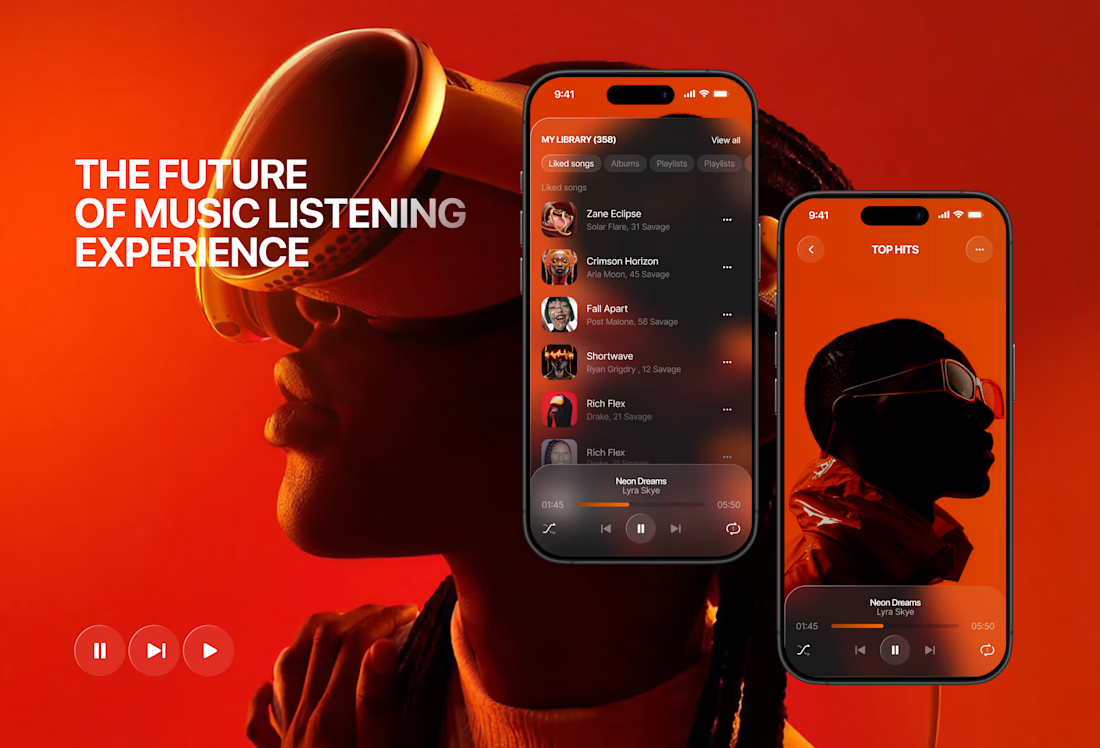
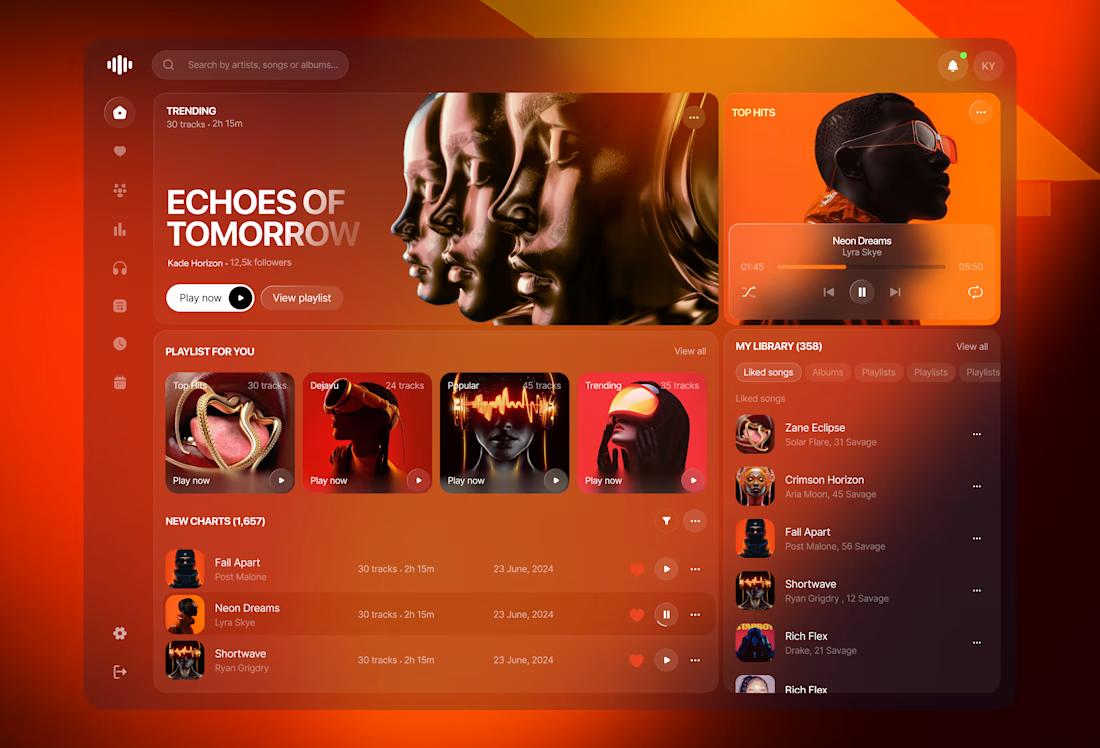
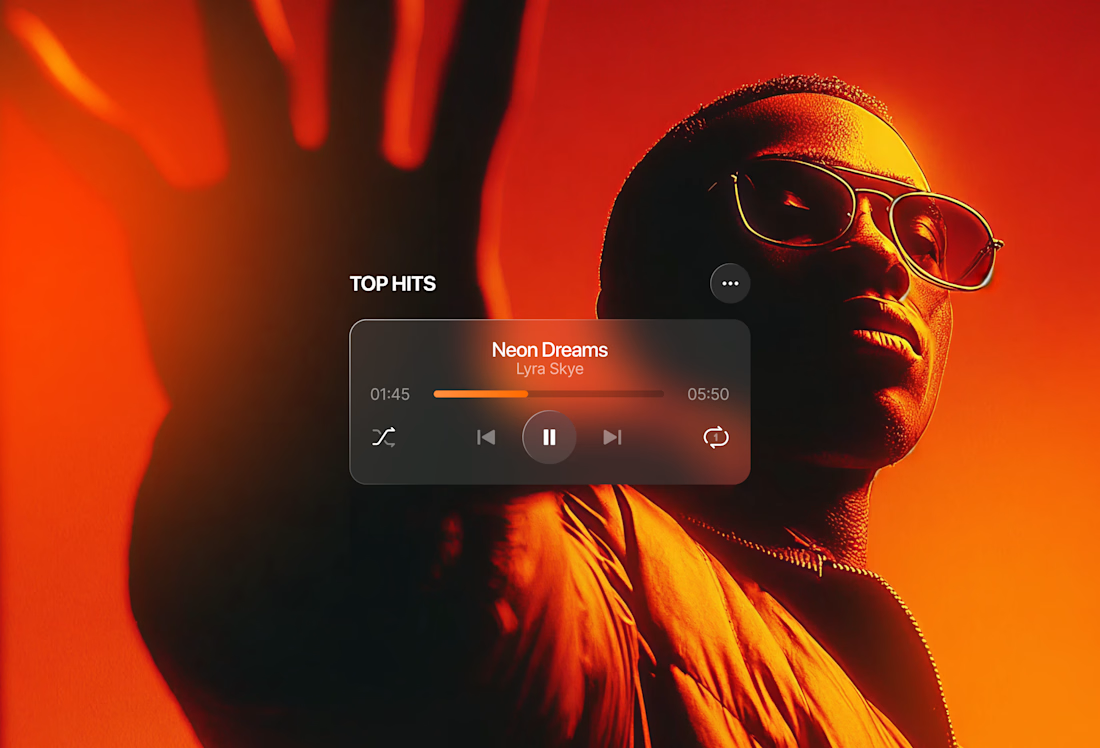
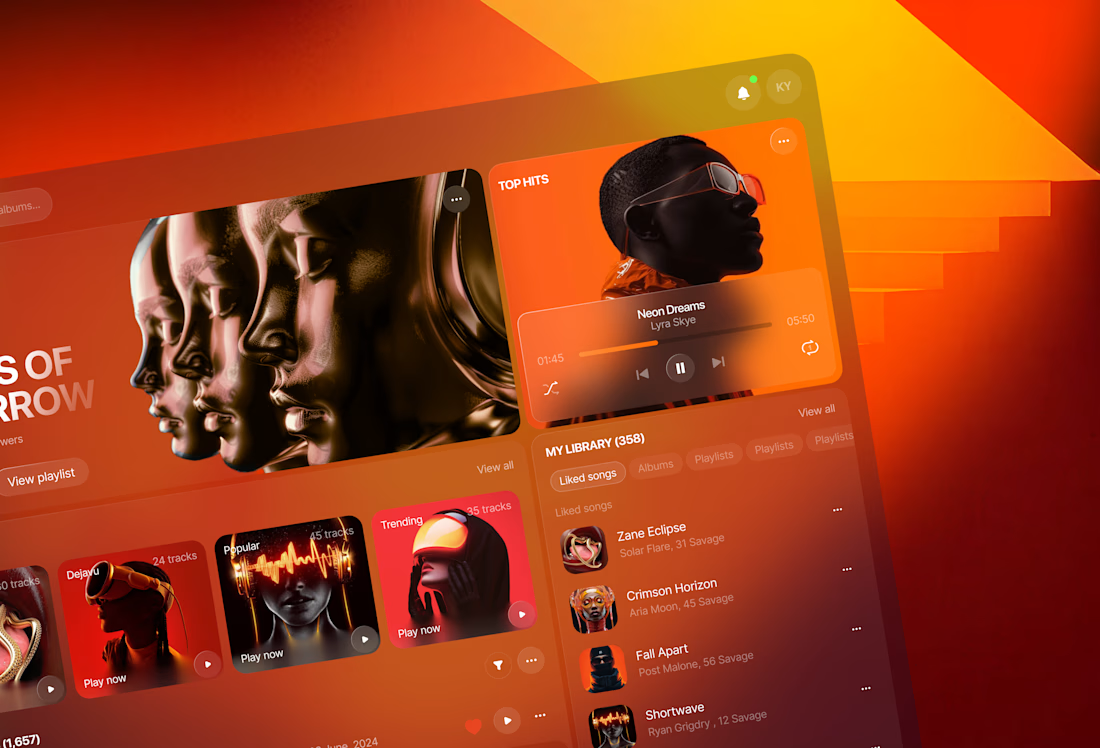
This is a concept for a music streaming platform built around one idea — immersion. Not just in the music, but in the visual experience of discovering and listening to it.
The warm palette of deep reds, burnt oranges, and dark backgrounds wasn't accidental. It creates a mood. It makes you want to stay, scroll, and listen.
What I focused on:
→ A dashboard that surfaces the right content without overwhelming
→ A "now playing" experience that feels cinematic
→ Mobile screens that carry the same visual weight as desktop
→ Typography and hierarchy that guide without interrupting the vibe
This is a concept — but built on real UX logic. Because even imaginary products deserve thoughtful design. 🎧🖤
#MusicApp #UIDesign #ProductDesign #DarkUI #AppDesign #UXDesign #MobileDesign


This palette is an absolute dream! The burnt orange and deep red tones mixed with that sleek dark UI create an incredibly warm, midnight-session vibe. It perfectly captures how music feels. Brilliant work! 🎧🔥

Live App: https://rgguttedarabhi-13110.bubbleapps.io/version-test
SkillSwap — The No-Money Freelance Economy
What if you could get a website built, a logo designed, or learn to code — without spending a single rupee? That's SkillSwap.
SkillSwap is a skill-for-skill marketplace where people trade talent instead of money. A designer offers brand identity work in exchange for React development. A writer offers SEO copywriting in exchange for a logo. Zero payments. Zero middlemen. Pure human exchange.
Category: Marketplace
How I built it:
I started with a single prompt to Bubble AI — and let it generate the foundation. Pages, data types, core UI — all AI generated in minutes. I then took full creative control: designed a premium editorial system using Playfair Display typography, warm paper tones (#efe7d2), and coral accents (#ed6f5c). Every page heading has custom CSS animations built inside Bubble HTML elements. The Skill Board, Post a Swap form, Request Swap popup, and success flow all work end to end.
What works:
Browse 11+ real skill swap listings across 6 categories
Filter by Design, Development, Writing, Marketing, Video, Photography
Request a swap with a message — confirmation popup included
Post your own swap listing in under 60 seconds
AI suggested matches shown after every submission
The idea behind it:
Millions of people have skills but no money to hire. SkillSwap removes the financial barrier entirely. Talent becomes the currency. This is the future of collaborative freelancing.
See it. Experience it. Make your first swap.

What a concept and design I really love it

Built a freelance marketplace where talent is judged on proven work — not bios. It's called Proven.
The whole premise is an inversion of how hiring usually works: freelancers never write their own bio.
Instead, they upload projects they've actually delivered — a short description and a screenshot. An AI engine reads that evidence and builds a verified capability profile from it: a generated headline, a factual capability summary, extracted skills, and a proof score derived entirely from delivered work. Nothing self-reported, nothing salesy.
And companies don't scroll through endless profiles. They describe what they need in plain language, and the platform interprets the brief, then surfaces the freelancers who have already proven they can build it — each match ranked with a feasibility score and a reasoned justification that cites the freelancer's real projects.
The features so far:
My Projects — upload delivered work; each project gets auto-analyzed (summary, capabilities, tech, complexity, domain).
Generated profile — one click synthesizes everything into a verified, evidence-first profile.
Post a Brief — write what you need; the AI structures it into required capabilities, domain, and constraints.
Match Results — ranked, justified matches with fit scores.
Browse Talent — a directory of profiles, every card built from delivered projects, no self-written bios.
The part I love most: every claim on the platform traces back to real evidence. The verified-green accent only ever shows up around things that have actually been proven.
The aesthetic is editorial and credible on purpose — Fraunces serif headlines, a warm off-white canvas — the look of evidence, not advertising.
Try it yourself 👇


this is such a great idea!















Trending

Claude
Claude has entered the design space. How are you using Claude Design?

Contra University
Learn from expert creatives how to earn more using next-gen AI tools.

MagicPath
The canvas is infinite, and exploration is becoming the workflow. How are you using MagicPath?
creativeaiflow
Creative AI workflows are evolving. What tools do you use, and what are their strengths and weaknesses?
freelancerlife
Freelancer life is wins, pivots, and everything in between. What’s yours right now?