The network for creativity
Join 1.25M professional creatives like you
Connect with clients, get discovered, and run your business 100% commission-free
Creatives on Contra have earned over $150M and we are just getting started
Back to feedPost

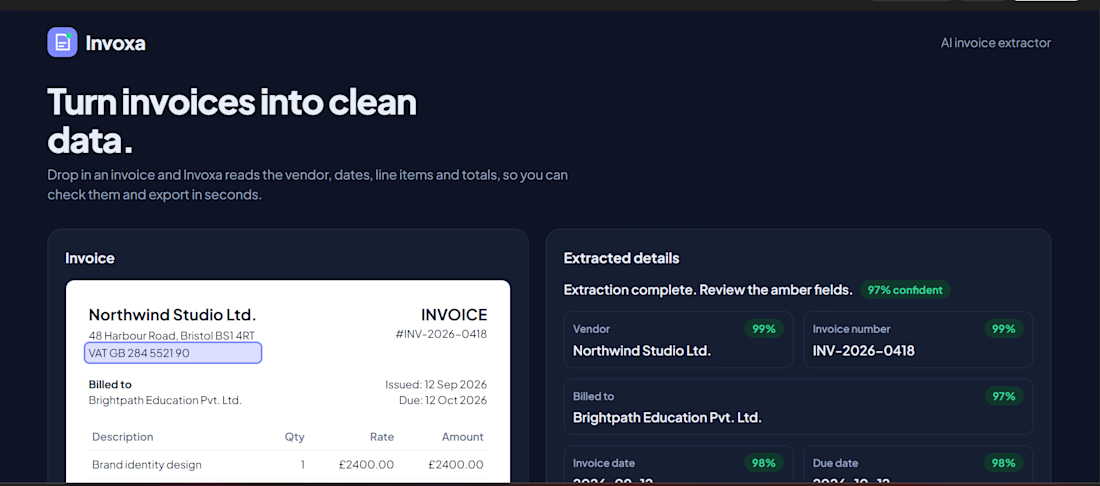
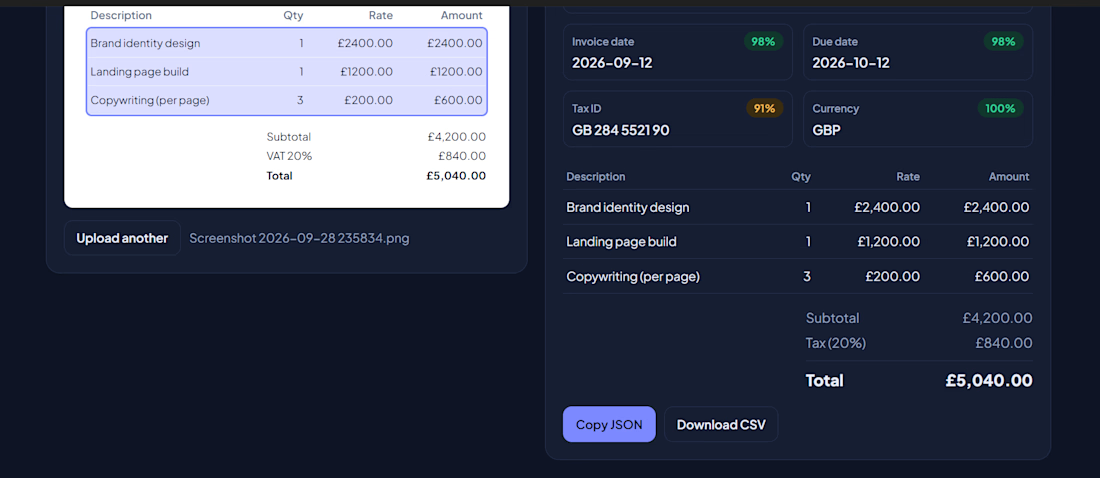
AI Invoice Details Extractor
An AI-powered invoice processing system designed to automatically extract structured information from invoices, reducing the need for manual data entry and making document processing faster and more scalable.
What I Built
I developed an end-to-end AI invoice information extraction pipeline that processes invoice documents and identifies important fields such as:
Invoice number
Invoice date
Vendor/supplier details
Customer details
Billing and shipping information
Tax information
Subtotal and total amount
Line-item details
Product/service descriptions
The project uses deep learning and document understanding techniques to understand both the textual content and spatial layout of invoice documents.
Dataset & Preprocessing
I collected invoice/document data from Hugging Face and built a preprocessing pipeline to prepare the documents for model training.
The preprocessing workflow included:
Dataset cleaning and filtering
Document/image processing
Text extraction and normalization
Annotation preparation
Layout information processing
Tokenization
Training/validation dataset preparation
Special attention was given to preserving the relationship between text and its position within the document, which is important for understanding complex invoice layouts.
Model Development
For the extraction model, I worked with LayoutLMv3 using PyTorch, leveraging its ability to combine:
Text + Visual Information + Document Layout
This allows the model to understand not only what information appears on an invoice, but also where it appears and how different elements are related.
End-to-End Pipeline
Invoice → Preprocessing → Layout/Text Understanding → AI Model → Field Extraction → Structured Data
The extracted information can then be converted into structured formats such as JSON or tabular data, making it suitable for integration into accounting, ERP, finance, or document-processing workflows.
Key Technologies
Python • PyTorch • LayoutLMv3 • Hugging Face • Transformers • OCR • NLP • Computer Vision • Document AI
Project Goal
The goal of the project is to move invoice processing from manual data entry toward automated intelligent document processing, while creating a system that can be further improved to handle different invoice formats and layouts.
This project represents my work across NLP, Computer Vision, Deep Learning, and Document AI, with a focus on building practical AI systems that can solve real-world business problems.
The network for creativity
Join 1.25M professional creatives like you
Connect with clients, get discovered, and run your business 100% commission-free
Creatives on Contra have earned over $150M and we are just getting started



Related posts





Great work!

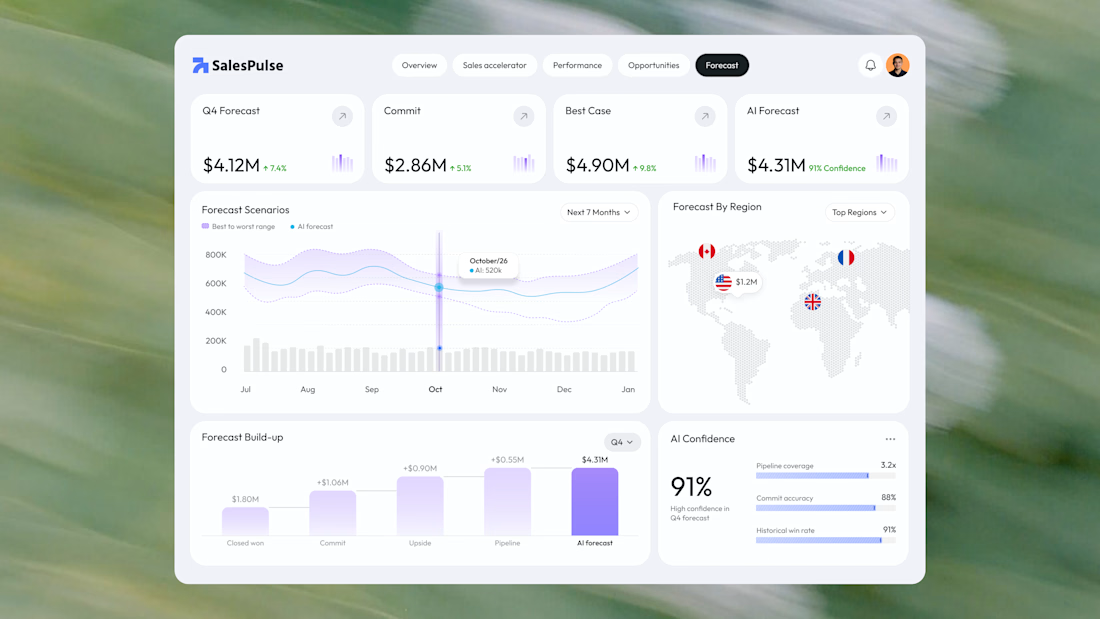
SalesPulse brings AI-powered revenue forecasting, pipeline insights, regional performance, and confidence metrics into one organized dashboard, helping sales te


I built an invoicing app that does not send your invoices for you. That was on purpose.
When I started building Invoping, the obvious feature was automatic sending. The app creates the invoice and fires it off to your client on WhatsApp.
But WhatsApp is where people talk to their clients. It's where they say hello, negotiate, and follow up. A message that arrives without you touching it feels like a bot, not like you.
So Invoping opens a WhatsApp message that's already filled in with the invoice link. You read it, change a word if you want, and press send yourself.
It's one extra tap, and the message still comes from you.
A few other small decisions followed the same idea. Your client can open the invoice without making an account. You can record partial payments, because real clients often pay in parts. And you can see the balance that's still owed at a glance.
The lesson for me: sometimes the best feature is the one you leave out.
If you're building a tool for people who work through conversations, what would you keep manual on purpose?
You can try Invoping here: https://invoping.vercel.app/

invoping.vercel.app
InvoPing
The simplest invoicing and payment-tracking SaaS for freelancers, contractors, agencies, and small businesses that use WhatsApp.