The network for creativity
Join 1.25M professional creatives like you
Connect with clients, get discovered, and run your business 100% commission-free
Creatives on Contra have earned over $150M and we are just getting started
Back to feedPost

AI is easy to demo. Building something that actually works is another story.
I'm a Lead AI Engineer & Full-Stack Developer, turning complex ideas into real, production-ready products.
From AI agents and LLMs to complete SaaS platforms, I work across the entire technical journey: architecture, development, deployment, and scaling.
My philosophy? "Faire, défaire, refaire."
Build, break, rebuild. Experiment, learn, improve. Because innovation isn't about getting everything right the first time.
My expertise: AI & LLMs, Machine Learning, Python, FastAPI, React, Next.js, React Native, Cloud Architecture & Technical Leadership.
I don't just integrate AI. I build the products around it.
Open to freelance opportunities and collaborations.
#AIEngineer #GenerativeAI #LLM #FullStackDeveloper #TechLead #Python #SaaS #Freelance #Innovation
The network for creativity
Join 1.25M professional creatives like you
Connect with clients, get discovered, and run your business 100% commission-free
Creatives on Contra have earned over $150M and we are just getting started





Related posts

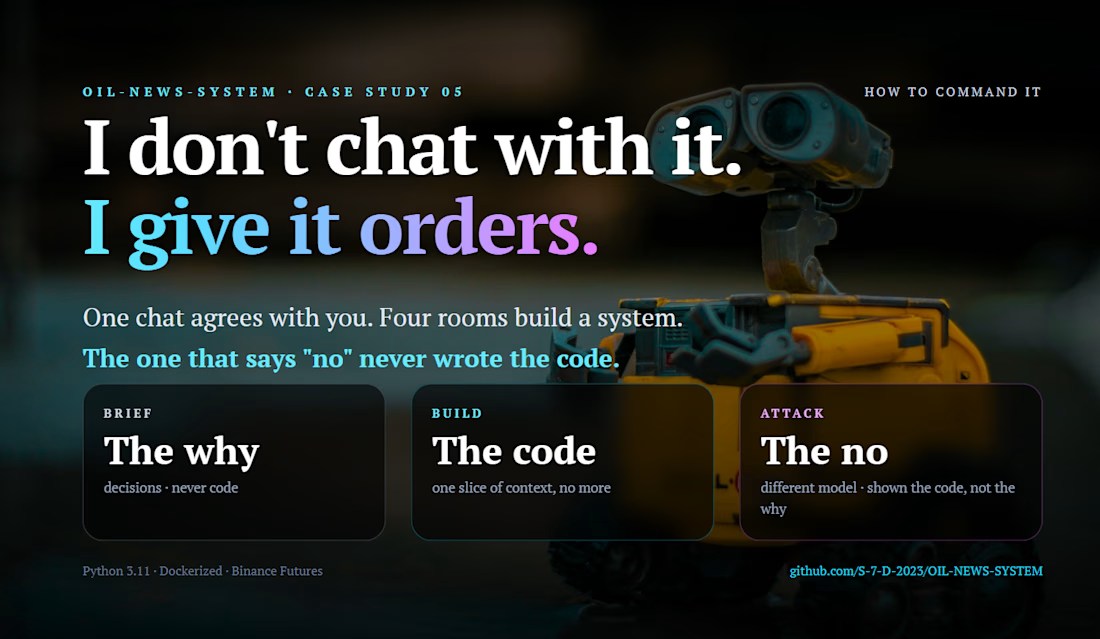
The Machine Wants to Please You. Break It.
Every coding model is trained on a reward signal that prefers agreement. Human raters like answers that confirm what they already believe — so the model learns to confirm. That is not a bug in the product. It is the product.
The consequences are measurable. Ask a coding agent to build a feature and it will tell you it is done, while the unfinished part sits silently out of view. Ask it to review its own work and it approves itself — the same instance that wrote the code grades the code. You are not getting a second opinion. You are getting an echo.
This is why most people cannot build anything serious with AI. They open one chat, ask nicely, and accept the first confident answer. They get a demo. They never get a system.
I do not run one chat. I run four rooms, and none of them talk to each other.
Room one — the brief. Domain knowledge, constraints, architecture decisions, the why. Never code. This room exists so the reasoning behind the project stays unpolluted by implementation noise.
Room two — the build. Pure code generation. It receives only the slice of context it needs for the current task — because the most common failure in agentic coding is not a weak model, it is bad context design: give too little and it guesses, give too much and the window rots. The goal is exactly enough, no more, no less.
Room three — the attack. A different model. I show it the code, not my reasoning, because a critic that sees your reasoning goes soft. It is told to argue against the output, not to review it kindly. An agent that checks its own work shares its own blind spots — a second agent on a different model does not.
This is the room that says no. It never wrote the code, so it has no ego to defend. It will tell me the premise is wrong before I build on top of it — which is the only moment that correction is still cheap.
Room four — the small problems. Errors, one-line questions, snippet checks. Quarantined here so they never contaminate the build context.
The discipline is the same in all four: no pleasantries, no "great question", no accepting a confident answer because it was confident. Push back once with reasoning — and if I overrule it, do it my way and log the disagreement. Surprise is not evidence.
You can see what this produces: hundreds of commits, one pipeline, no single conversation that could have held it — github.com/S-7-D-2023/OIL-NEWS-SYSTEM/commits/main.
Closed AI gives you an assistant. Open weights and this discipline give you a workforce you own.
#AI # OIL #contra #build #System #coding



I haven't posted a proper update here for a little while. I've been busy building a couple of AI applications and a healthcare workflow prototype, and writing about the work kept slipping down the list.
So, a small catch-up. :)
One project is an AI presentation builder for business teams. It starts with information about the business, its audience and the conversation they're preparing for, together with approved source material. From there, it helps create a presentation outline, a talk track, speaking notes and preparation notes.
The person using it can review the material, change it, save it and come back later to export it. That sounds fairly ordinary when written down, but those details are what make it something a team can actually work with. The connected pilot has been accepted, and I'm continuing to refine the content and develop the application.
Another project is a knowledge and planning workspace. Imagine having useful advice buried in hours of coaching transcripts. The application turns that material into a library of teachings that people can review, with links back to the sources.
It also supports a planning workflow: start with a client brief, confirm the details, then build a 90-day roadmap with check-ins and weekly updates. The knowledge foundation has been accepted; the planning workflow is on staging while the remaining integration work continues.
Alongside those, I've been working on a healthcare product prototype. This one is about showing how a complicated business process behaves: someone approves a decision, a member makes a choice, a referral moves forward, a booking happens, and someone needs help when the normal path doesn't fit.
It uses synthetic data and scripted scenarios, so the team can walk through the product without involving real patient records. Both demonstration releases were accepted, followed by a separate piece of work planning the next pilot.
I've kept the client names and interfaces private, but wanted to explain the work a little better than just saying "AI integrations" or listing frameworks.
These are the kinds of projects I'd like to do more of: useful AI features, B2B applications, and consumer products where the interface and the underlying workflow both get proper attention. I enjoy being involved in the whole thing, from figuring out what someone needs to do through to building the application that lets them do it.
I'm also updating my portfolio to make that work easier to find. You can see my public projects at https://nikocodes.com, including ReachLog and ThaiGlow.
If you're building something in this area, feel free to message me here. Happy to talk through what a sensible first version could look like.

Using synthetic data and scripted scenarios for the healthcare prototype is a smart call. Letting stakeholders walk the exception path, not just the happy path, is usually where a pilot earns its trust.


AI vs Creative Brains
AI can generate. But we think, analyze, and design with real expertise, data, and strategy to turn experiences into measurable business growth.
Hire us

Love it 🤩